Sunday, May 22, 2011

Big Top Images: The Circus comes to Canada

Ladies and Gentlemen, Boys and Girls, Children of all Ages, step right up and prepare yourselves for the most Exhilarating Exhibition on Earth! Animals from the far-flung jungles of Africa!  Exotic specimens from around the globe!  We've got the Wild West, Far East, Southern Belles and Natives of the North, all displayed for your amusement and curiosity under the Big Top!

The Circus in popular conception seems to wedded to America, yet one only need to think of the Roman Circus Maximus, where chariot races, animal displays and mock battles were staged, to consider the long human fascination with spectacle.  The modern circus is attributed to a Brit by the name of Philip Astley, whose riding school in the late 18th Century grew to include clowns, domesticated animals, music and acrobatics. Only in 1792 would the circus cross the Atlantic to the new world.  A number of circus posters at Library and Archives Canada show that the circus was a popular event in the twentieth-century dominion.  It was often the lure of the foreign unknown which drew Canadians in droves to the Big Top.

Poster From 1935. Library and Archives Canada, Acc. No. 1980-84-68


Part of the allure of the circus was the exotic animals and people on display.  Elephants, camels, tigers and lions were used to amaze patrons.  A fascination with foreign animals has long appealed to circus-goers, yet with the rise of animal rights activism, the humane treatment of these performers are increasingly scrutinized. Cole Bros. Circus, still active today, was recently fined for violating the endangered species act.


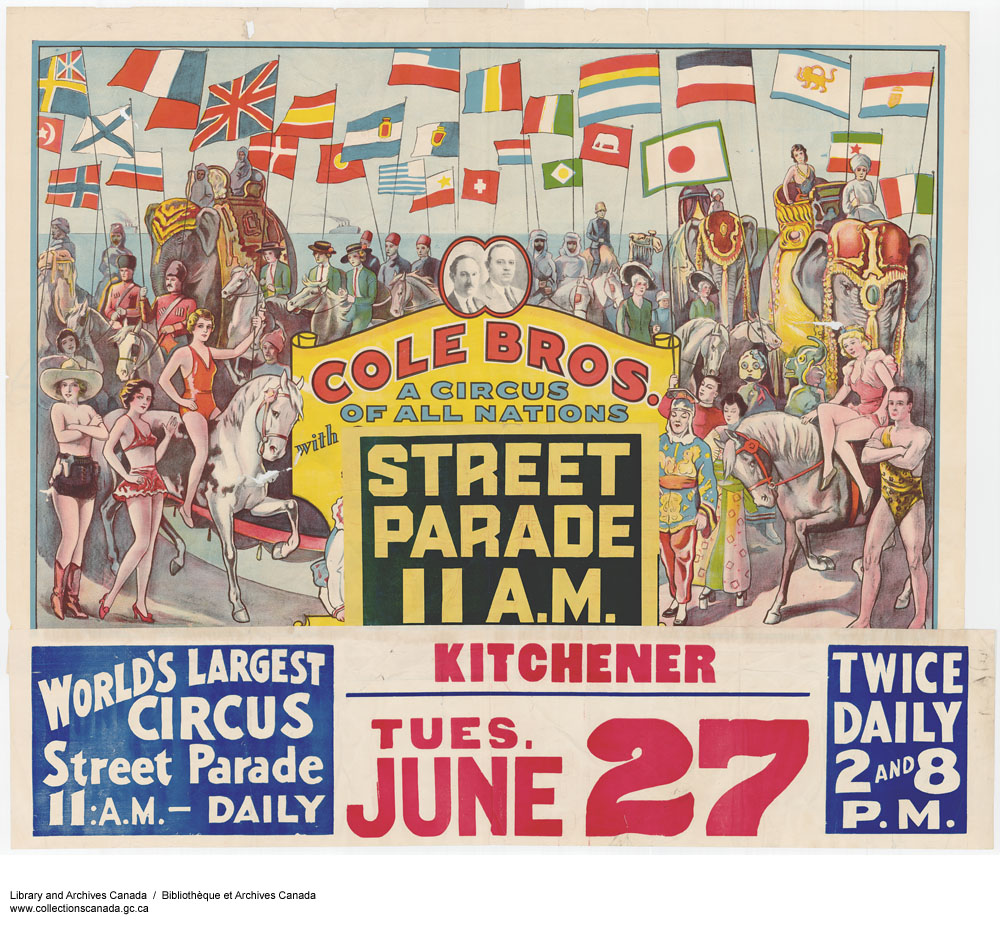
Human performers were another part of the exotic draw.  The Cole Bros. Circus advertised itself as a "circus of all nations", where locals could observe cultures and costume from around the world.
Poster from 1939.  Library and Archives Canada, Acc. No. 1980-84-159

Military display has always been a popular form of entertainment.  Buffalo Bill's Wild West Show, a form of Western circus and rodeo, featured theatrical battles, pitting cowboys versus Indians.  Gabriel Dumont was featured in the show after his role in the North-west Rebellion.  In the Great War, artillery pieces were brought back to Canada, and often featured in drives to recruit soldiers.  In a 1917 circus in Regina, a war exhibition featuring war posters and a captured German howitzer was free to all.
Glenbow Museum Archives.  NA-1574-6


Poster 1930. Library and Archives Canada, Acc. No. 1980-84-69


In international circuses, the Royal Canadian Mounted Policeman was featured as a dashing international figure of adventure.  The mountie has long been the symbol of Canada abroad, especially in the entertainment industry.  In the form of the Wild West show, the black and white division of the colonial world were played out in pantomime, with  brave Mounties standing their ground against the circling savage Indians.
Many of the Circuses travelling in Canada appear to have been American shows, but there were also home-grown Canadian exhibitions as well.  The Garden Bros.  Circus was one Canadian circus, perhaps based in Saskatchewan where its posters were printed.  Canada's most infamous circus, Cirque de Soleil, was not founded until 1984, but Canadians have long been entertained by the foreign spectacle of the circus, alongside more domestic interests in fairs, rodeos, and agricultural exhibitions.  In a world before television and internet, Canadians sought to experience in person the foreign sights, smells, and sounds of the Big Top.
1943 Library and Archives Canada, Acc. No. 1980-84-149

Thursday, April 21, 2011

Conscripting Youth: Children and the Posters of the Great War

Advertisers know that children can sell just about anything.  A grinning cherub armed with an endearing catch-phrase is often used to melt our hearts and open our pocketbooks.  It is no surprise, then, that during the Great War, images of children were conscripted to promote the war effort in many Allied countries.  It was not just the cute appeal of the innocent child, however, that was used to drum up money for war bonds or recruit men to the regiments. In many cases, the strong social bonds of family expectations were used to put pressure on citizens as family members.

As this British poster of the melancholy man shows, fathers were targeted by posters which hoped to recruit men to to the ranks.  Here it is the social pressure of participating in the major event of the generation that is used to coerce fathers into enlistment.  The girl on his knee points to a history book and inquires what her father's role was in this epic adventure.  One can only imagine the shame that the son may have endured in learning his father had stayed at home, missing out on the derring-do of the living-room floor campaigns of his heroic toy soldiers.

Compassion for children as family members was often used to attempt to convince citizens to contribute to war bonds.  A poster sponsored by Curtiss Airplanes has a child praying for a brother overseas.  The consoling mother in this domestic scene helps the youth send hopeful prayers for their soldier's safe return.  The strong coloured vertical lines from the American flag's bars are contrasted with the soft oval portrait.  In a case of patriotic product placement, in lieu of the flag's stars, the Curtis company has inserted its own biplanes.  If only the reader contributes to war savings stamps, the idyllic family will be reunited.
Children were also used symbolically as the youth of a nation. The national siblings of Australia and England are here portrayed as innocent friends with hands clasped.  The clean-handed childhood chums, clad in angelic white over the vibrant yellow seem to suggest that by contributing to the war effort, one would be on the side of purity and right.  Again it is the family member away at war that is used to implore contributions from the public.  Here the message is more explicitly aggressive.  Instead of focussing on bringing the family together again, in this case War loan bonds will help "daddy" win the war.


Children as targets themselves were used by the Red Cross to encourage contributions to their humanitarian efforts.  Here a stoic yet compassionate nurse looms over the destitute French orphans.  The drab outfits of the French citizens and the deep orange of the fire-wracked city are offset by the vulnerability of the infant's pink attire. Again the concept of family is used in the emphasis of motherless and fatherless suffering.


Library and Archives Canada has a vast online archive of war posters, from which all the above images came.

Cowboys, Indians, and Mountain-men: German Perceptions of the Canadian Soldier

Beaverbrook (left) during the Great War.  LAC.
During the Great War, Canadian soldier's fought well due to their rugged backwoods perseverance, and stalwart frontier pluck.  Or at least so Sir Max Aitken, (Lord Beaverbrook to you), would have the readers of his publications in the Canadian War Records Office believe.  Tim Cook notes in Clio's Warriors that "Beaverbrook [and his CWRO officers] constructed an image of the Canadian soldier reflecting his own ideals. Canadians were depicted as a northern race of rugged civilian-soldiers who were separate from their British cousins." (Cook, 38)

Such perceptions of the frontier soldier had survived the interwar years.  It appears that the image of the Canadian soldier as a vigorous worker of the hinterlands had at times a very western flavour. An 9 June 1944, intelligence summary of the I Canadian Corps in Italy noted,

"Enemy PW recently interrogated in Italy gave the following comparisons of the fighting ability of their adversaries:
Canadians:Very good 'cowboy' manner. Tough, good hand-to-hand fighter, very fair in combat.
English: do not like hand-to-hand fighting.
Americans: Avoid hand-to-hand combat."


Bill McAndrew noted that the German assessment of Canadian soldiers was one of excellent field-craft:
He writes that the Germans claimed, “in fieldcraft (Indianerkrieg) superior to our own troops. Very mobile at night, surprise break-ins, clever infiltrations at night with small groups between our strong points.” (McAndrew, 56)

Vokes speaks to PPCLI, Riccione, Italy, 13 November 1944. LAC.
National pride was used to drum up combat motivation  by Major-General Chris Vokes who urged the troops to
"remember that the German is a worthy opponent, but the German isn't born who can stand up to Canadian Infantry imbued with the will to close
and destroy him." 

That the Canadians had been used in Italy as the break-in formation for the stalled offensive on the Adriatic, as well as through the Hitler Line, meant that German command began to form its own opinions of the Canadian's role in the Campaign.  The presence of Canadians in the line became a portent that a major assault was under way.  Kesselring is reported to have noted upon reports of the Canadians moving towards the Adriatic before the battle of the Gothic Line:  "if they really are Canadians....then it will be a true major operation." (McAndrew, 118)

It would be hard to say to what extent the image of the Canadian soldier crafted by Beaverbrook in the Great War influenced foreign conceptions in the Second World War.  Certainly some of this reputation came from the actions of Canadian formations in both conflicts.  The way that they were characterized as cowboys, Indians or mountain-men, however, suggests that beyond military effectiveness there were cultural factors at play in constructing the ideal of the Canadian soldier.

"NOTES ON ACTIVITIES, 1 CDN CORPS." Week ending 19 Oct 44. (Historical Section)
"CMHQ [Canadian Military headquarters] reports - Ops and admn [Operations and administration] -1 Cdn [1st Canadian] Corps." Canadian Military Headquarters London, 1939-1947. Library and Archives Canada. RG24, C-2, Volume 12306. Reel T17907.
Cook, Tim. Clio’s warriors Canadian historians and the writing of the world wars. Vancouver :: UBC Press, 2006.
McAndrew, Bill. Canadians and the Italian Campaign: 1943-1945. Montréal: Art Global, 1996