When the horrors of war have got you down, and you just don't feel like brandishing that assault rifle, lift your spirits by popping a few pills. Nothing perks a soldier up like some amphetamines!
Richard Holmes, in Acts of War: The Behaviour of Men in Battle (1985), examines the factors effecting behaviour in combat: how soldiers steel themselves against fear, the discipline that coerces them to brandish a weapon and advance to certain death, and the various levels of group bonding which help them cope. One method for motivating soldiers, Holmes addresses is drugging them.
 |
| Vendel Era Bronze Plate |
Blood-crazed Viking beserkers apparently ate dried fly agaric (the hallucinogenic mushroom Amanita muscaria) to inspire their savage attacks. It seems reasonable that drugging a medieval warrior and inciting him to behave like a bear would improve his will to fight, but one has to wonder about the effects on hand-eye coordination.
Holmes writes that in the Second World War, benzedrine was commonly administered to soldiers of various nations, noting ten percent of American soldiers used amphetamines in WWII. The Yankees were following the German's lead in the prescription of pills which heightened awareness and warded off fatigue.
 As Adam Tooze notes in his excellent Wages of Destruction, the intense operational tempo during the fall of France led to the need for stimulating expedients. With the call for German armoured forces to push constantly for three days and nights, armoured crews needed a little pick-me-up to continue operating. As Tooze writes, "to ensure that the drivers could go without sleep, the quartermasters of the advanced units stocked up with tens of thousands of doses of Pervitin, the original formulation of the amphetamine now know as 'speed', but more familiar in the 1940s as 'tank chocolate' (Panzerschokolade)."
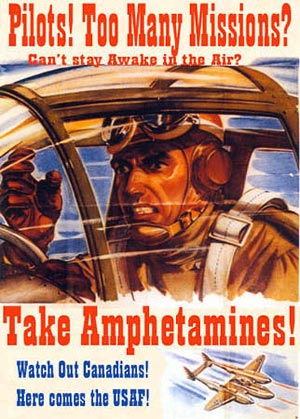 |
| Remixed Propaganda by Micah Wright |
It appears that drugs have a long and stimulating relationship with the military. Anti-depressants, and painkillers are also widely prescribed and one need not look too far to find accusations regarding the negative effects of this narco-love-affair.