Thursday, August 25, 2011

Germany's Synthetic Oil Industry in the Second World War

When Nazi Germany needed the rubber to hit the road, as imports of valuable raw materials were restricted, they turned to their old stalwart, the IG Farben chemical syndicate.

IG Farben Office.  Anti-fascist Encyclopedia.
As Adam Tooze notes in Wages of Destruction, it was the commitment of the IG Farben firm to synthetic chemistry that earned it the place of "the closest and most important industrial collaborator of Hitler's regime."  In 1926, IG set up the first coal hydrogenation plant which could turn coal into gasoline.  The firm also promised to create synthetic rubber, which would provide another vital component of motorized warfare.

When the German Army invaded Russia, industrial priorities shifted to the air war.  Operation BARBAROSSA was intimately linked with hopes for an expanded output of aviation fuel from 1 million to 3 million tons.  The high costs of the hyrdogenation process, however, meant that it was unrealistic to hope for this massive increase through processing German coal alone.  As Tooze writes, "here was the perverse logic of Barbarossa in a nutshell.  The conquest of the oilfields of the Caucasus, 2,000 kilometres deep in the Soviet Union, was not treated as the awesome military-industrial undertaking that it was.  It was inserted as a precondition into another gargantuan industrial plan designed to allow the Luftwaffe to fight an air war, not against the Soviet Union, but against the looming air fleet of Britain and the United States." (Tooze, 452)

Donald Caldwell and Richard Muller, in their work The Luftwaffe Over Germany : Defense of the Reich (2007) attribute a lack of aviation fuel as a major source of inefficiency of the Luftwaffe's defence of the Reich.  This dearth of fuel was heightened in 1944 with the bombing of synthetic oil refineries. While the German aviation industry kept pace in terms of production numbers, lack of fuel (along with declining pilot quality and attrition, and planes destroyed in accidents and by strategic bombers) meant that the Jagdgruppen could not reap the benefits of factory output.  A lack of aviation fuel for training purposes was particularly stifling in the long run.  On 12 May 1944, the bombing of five synthetic oil refineries is portrayed by Caldwell and Muller as a major turning point in the capabilities of German air defence.

"The Man from I.G. Farben" Spitfire List
Figures for 1945, gleaned from the New York Times by Alex Constantine, state that IG Farben's outputs were, "100 percent of German synthetic rubber, 95 percent of German poison gas (including all the Zyklon B gas used in the concentration camps), 90 percent of German plastics, 88 percent of German magnesium, 84 percent of German explosives, 70 percent of German gunpowder, 46 percent of German high octane (aviation) gasoline, and 33 percent of German synthetic gasoline."

Interestingly, the Fischer-Tropsch process of coal liquefaction has recently been applied to turning natural gas to diesel fuel, but is being resisted due to its potential environmental degradation.  Considerations of its base ethical roots as a key factor in the Nazi war industry will undoubtedly be trumped by the utilitarian ethics of energy demand.

Extra Reading on IB Farben and the Nazis from Anti-Fascist Encyclopedia
Excerpt on Synthetic Oil and Bombing Effects on Industry from United States Strategic Bombing Survey

Thursday, July 28, 2011

Drugging Soldiers: Bennies and Battle

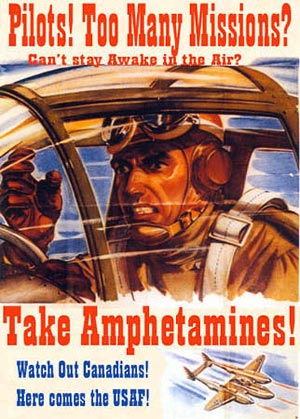
When the horrors of war have got you down, and you just don't feel like brandishing that assault rifle, lift your spirits by popping a few pills.  Nothing perks a soldier up like some amphetamines!

Richard Holmes, in Acts of War: The Behaviour of Men in Battle (1985), examines the factors effecting behaviour in combat: how soldiers steel themselves against fear, the discipline that coerces them to brandish a weapon and advance to certain death, and the various levels of group bonding which help them cope.  One method for motivating soldiers, Holmes addresses is drugging them.

Vendel Era Bronze Plate
Blood-crazed Viking beserkers apparently ate dried fly agaric (the hallucinogenic mushroom Amanita muscaria) to inspire their savage attacks.  It seems reasonable that drugging a medieval warrior and inciting him to behave like a bear would improve his will to fight, but one has to wonder about the effects on hand-eye coordination.

Holmes writes that in the Second World War, benzedrine was commonly administered to soldiers of various nations, noting ten percent of American soldiers used amphetamines in WWII.  The Yankees were following the German's lead in the prescription of pills which heightened awareness and warded off fatigue.

As Adam Tooze notes in his excellent Wages of Destruction, the intense operational tempo during the fall of France led to the need for stimulating expedients.  With the call for German armoured forces to push constantly for three days and nights, armoured crews needed a little pick-me-up to continue operating.  As Tooze writes, "to ensure that the drivers could go without sleep, the quartermasters of the advanced units stocked up with tens of thousands of doses of Pervitin, the original formulation of the amphetamine now know as 'speed', but more familiar in the 1940s as 'tank chocolate' (Panzerschokolade)."

Remixed Propaganda by Micah Wright
The practice of popping amphetamines like candy was continued in Vietnam, where soldiers were administered Dexedrine before action.  More recently, lawyers for two American pilots who bombed Canadian soldiers in Afghanistan, argued that the errant airmen's judgment may have been impaired by amphetamines.

It appears that drugs have a long and stimulating relationship with the military.  Anti-depressants, and painkillers are also widely prescribed and one need not look too far to find accusations regarding the negative effects of this narco-love-affair.  

Sunday, July 17, 2011

Harold Innis drops a footnote

 When Harold A. Innis wants to cite some evidence on the power relationships between late nineteenth capitalists, he does so with authority.  His 1923 work, A History of the Canadian Pacific Railway, is a dense economic history which argues that the company brought civilization to the Canadian West at the cost of Westerners.  Note that not only does the single footnote on American railway interests run for three pages, the sentence which it provides evidence for, has a further two footnotes!


Four pages Professor Innis?! Your passion for the politico-economic background to the Pacific Scandal has no bounds!