Showing posts with label economy. Show all posts

Friday, April 19, 2013

Burned in Effigy: The Vagaries of Symbolic Arson

Nothing voices disapproval like building a mannequin, parading it about town under abuse, and torching the thing in public.  When it comes to over-the-top antagonistic symbolism, it is hard to beat the power of incineration.  And who doesn't like a roaring bonfire?

Over the years Canadians have taken to the streets in protest for scores of reasons.  Most often, politicians are the source of public ire, and so scarecrows in their likeness have faced the flames.  At other times, the more creative members of unruly mobs have worked artful metaphor into the performance.  A handful of protests over a hundred years of Canadian history prove that economics was often a cause that brought the torch to the tinder.

Revolutionary Lego Men protest British Taxation
without Representation.
Cooperman Brick Foundry

While trade and tariffs may not seem like a topic that could kindle the ritualistic arson, the student of Canadian history will know the subject has raised ire since the colonial era.  One need not be an expert to know that taxes have provoked their fair share of revolt over the years.

An early account of symbolic arson arose in the colony of New Brunswick when the British mercantile system was teetering on the breach.  Timber became a profitable export after Napoleon's European blockade halted the supply of Baltic wood to Britain.  After the War of 1812, the lumber barons of New Brunswick were quick to press authorities for a preferential tariff against non-imperial timber so they could still turn a profit.
 
"View of the Town of St. Andrew's with its magnificent Harbour and Bay", ca. 1840.
 Coloured lithograph by William Day (Day and Son Lithographers) after a sketch by Frederick Wells. Credit: Library and Archives Canada/C-016386.Family Heritage


An 1831 description of pyrotechnics in St. Andrews, New Brunswick, shows the great enthusiasm for news of a British ruling which maintained the tariff.


A boat said to be Baltic built, was filled with a cargo of combustibles and ... towed into the harbour, where she was moored. The Effigy of a distinguished supporter of the Baltic interests was suspended from the mast with a paper in his hand bearing the superscription "Baltic Timber Bill" - several pounds of gunpowder were concealed under his waist coat, and there was a large quantity in the boat. The combustibles were set fire to, and in due seasons, poor ______ was blown to atoms." (Cited in Graeme Wynn, "On the Margins of Empire", Illustrated History of Canada, 2007, p.199)


The protectionism of Sir John A. Macdonald's National Policy proves tarriffs were still a pressing issue after confederation.  In the Conservatives last electoral victory with The Old Chieftain, reciprocity in trade (free trade on many goods) was on the receiving end of a symbolic scorching.  Historian D.J. Hall noted that when John A. Macdonald's Conservatives won the 1891 election, supporters in  Brandon, Manitoba, hit the streets in a victory parade.  The procession included the burning of a bin of "Liberal" rubbish labelled "Unrestricted Reciprocity."   Hall notes that "the Liberals were consoled when, despite the Tories' best efforts, it resolutely refused to ignite." (Hall, The Young Napoleon, p.50)


Glenbow Museum and Archives File number: NA-3561-1
Title: Social Credit rally poster, Fort Macleod, Alberta.
Date: July 2, 1935
During the deprivations of the Great Depression, there is no wonder that ordinary people again vented their frustrations at an economic system that had left them desititute.  When Alberta's Social Credit party under William "Bible Bill" Aberhart won an astounding majority in the provincial election of 1935, the village of Chancellor was witness to a conflagration.  As John Irving notes in his work The Social Credit Movement in Alberta (1959),


To celebrate the victory they piled up packing cases, boards, and poles in the main street and built a huge bonfire.   They made a straw man, to represent the former member and defeated U.F.A. candidate for Bow Valley, Jonathan M. Wheatley.  Around this effigy they wrapped the election posters of all the opposing parties, and heaved it into the flames with a pitchfork.  This act, they explained, was not to be understood as an attack on Mr. Wheatley.  They meant nothing  personal: they were burning the monetary system. (Irving, 332)

Mr. Wheatley's reaction to his stunt double's use in this fiscal allusion is not recorded.  The crowd's sentiments suggest the specious dogma of Social Credit financial ideology had taken a firm grasp of the Albertan psyche.  Wheatley's treatment shows there could be sinister undertones to such pageantry, with the threat of violence directed at the effigy's mold.

Protest of Maine Liquor Laws in Saint John N.B.
featured burning effigies of US authorities.

Economics and symbolic arson is just one theme in the fascinating history of Canadian public ritual.  When the mob takes to the streets one never knows what allegories the more creative participants may procure.  Fire is a powerful symbol in all cultures, and has the added bonus of offering a little light in the days before electrification.  While the burning of figures as economic symbols seems innocent enough, a more malevolent side to these rituals arises with the burning of models of politicians or local people No matter how jovial a crowd of revellers may seem, one MUST feel attacked when observing one's own likeness go up in flames!

Saturday, June 16, 2012

Louis Rasminksy and Canadian Antisemitism

Rasminsky.Karsh, Bank of Canada Archives (BCP 153-5)  Currency Museum
Louis Rasminsky was one of a key group of bureaucrats who transformed the Canadian state in the Second World War.  Jack Granatstein's The Ottawa Men (1982) notes that Rasminsky was, "one of the architects of the new monetary system" set up at the July 1944 Bretton Woods Conference.  (p. 134) Despite his talent, Rasminsky would face resistance at home due to antisemitism in the civil service.


In 1930, at the tender age of twenty-two, Rasminksy won the job competition for a position at the League of Nations.  Before he headed to Geneva, however, some domestic business needed to be attended to.  Legend has it that Rasminksy sent the following proposal to Lyla Rotenburg: "Have accepted job League of Nations at 13,700 Swiss francs.  Will you marry me?" (p.136)  Her reply was purportedly, "What is exchange rate on Swiss francs?"  She also agreed to become his wife.


As Rasminksy was Jewish, and Canada was far from the tolerant state that some would imagine, the bureaucrat would come across several barriers during his tenure in the civil service.  In 1932, O.D. Skelton, Under-Secretary for the Department of External Affairs wrote of,
...the difficulties which our unavowed but quite effective Canadian anti-semitism places in the way of such men.  When last in Geneva I was much impressed by a young Canadian of Jewish extraction named Rasminiski [sic], a Toronto University graduate, now in the Economic Section of the League Secretariat.  He struck me as having about the most vigorous and clear-cut intellectual equipment I had met in a young man for years.  Clark, Deputy of Minister of Finance was also impressed...and made efforts to secure him for a minor post...As it happened Rasminiski was not prepared to take the post.... Even if he had been willing there would probably have been difficulties because of the prejudice in question. (Granatstein, p. 138)
Despite such resistance, Rasminsky would join the Bank of Canada in 1940.  At the Bretton Woods Conference in July 1944, which established the groundwork for the International Monetary Fund, Rasminsky helped expedite an international consensus which leaned towards the clout of the Americans.  Rasminksy played the role of broker at the conference, and moved away from John Maynard Keynes' suggestions of a supranational currency (the bancor), and towards the system which set up the basis for the IMF and pegged currency values to the American dollar.  The eventually agreement was a compromise between American hopes for freer trade, and British wishes for full employment and stability.

Photo/Scan: Skaha_boY
Rasminsky would later rise to the position of the governor of the Bank of Canada.  Unfortunately in the early 1960s, he was still experiencing trenchant antisemitism from Canadian high society.  The Rideau Club of Ottawa, a long established cloister of the political and business elite, still maintained a policy that Jews could not become members.  In 1964 a group of members would not stand for this continued racism. Rasminsky's name rose as one of four members who must be granted admittance.  As Robert Fulford noted, "the motion passed, and in 1964 one of the institutionalized absurdities of Canadian bigotry vanished."

Thursday, June 14, 2012

Implements and Tariffs: John McDougall vs. the National Policy, 1887

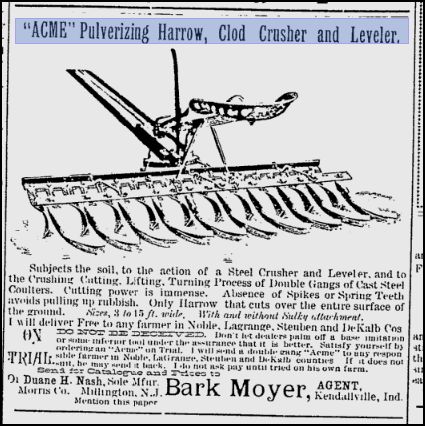
A curious letter of 17 May 1887, from one Duane H. Nash of Millington, New Jersey, to the Reverend John McDougall shows an interesting instance of one American manufacturer's response to the Canadian tariff.  The National Policy tariff had been in place for the better part of decade, hoping to foster Canadian industry, by charging prohibitive levies on American machinery crossing the border.


The American Agriculturalist 1883
Mr. Nash, of the Acme Pulverizing Harrow company, wrote in response to the Reverend McDougall of Morleyville, NWT, that the prices that McDougall had seen quoted were wrong for the North-west Territories.  Nash notes that in response to the Dominion's tariffs, he slashed his prices by $4, bringing the two horse harrow down to $14, and the three-horse harrow down to $17.  As Nash wrote of this tactic, "This is exceedingly low - too low - and there is little or no money in it for me, but owing to the excessive duty levied by your Government I am willing to sell this year at about cost for the purpose of getting them well started there." (McDougall Family Fonds, Glenbow Museum)

It seems that at least one manufacturer was willing to reduce his profits to establish a market in Canada for agricultural implements.  Perhaps Nash was waiting for a new administration to lower tariffs and reap the rewards of his established product.  Unfortunately for Nash, the 1891 Liberal flirtation with unrestricted reciprocity, (essentially free trade between the US and Canada), would come to naught, and both parties would continue on their protectionist course for some time.