Sunday, November 6, 2011

The Effects of the Great War on General E.L.M. Burns

Canadian General E.L.M. "Tommy" Burns' memoir General Mud (1970), notes that his primary lesson learned from his experience in the Great War was the diminishing returns of infantry offensives in poor weather.  "General Mud", was often more effective in stifling the offensive than the German generals across no-mans land.  Burns notes that most of what he learned about generalship came from the observation of Brigadier Victor Odlum, and not from the study of military history.
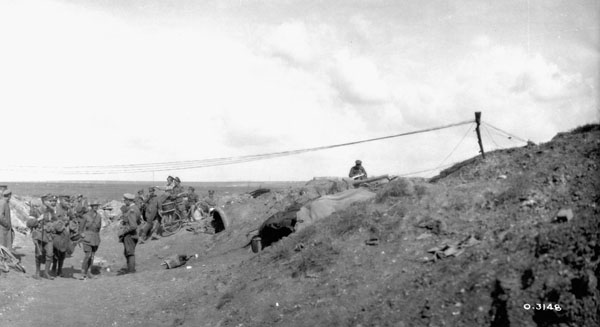
German rifle being used as telephone wire pole. Advance East of Arras. August, 1918.  Credit: Canada. Dept. of National Defence / Library and Archives Canada / PA-040216

The war's psychological effects on Burns are interesting to contemplate.  Burns' role as officer commanding of the 11 Brigade signals section meant that he did not accompany the first infantry waves over the top.  This did not prevent him from observing first-hand the horrors of war.  Burns wrote in his memoirs:

"...I was passing along the same route with some men, when shelling began we decided to make our way along what passed for a communication trench near the Courcelette cemetery.  In many places the trench was over knee-deep in liquid mud.  At one point I stepped on something which yielded, and there rose up before me the rear end of a dead German.  His clothes had been torn off, and his flesh, visible in places through the mud, was green.  By that time we had been living for many days in the stink and visible presence of dead men, and so this very horrid sight excited no more than a moment's shock and disgust.  But the memory has remained." (Burns, p.27)
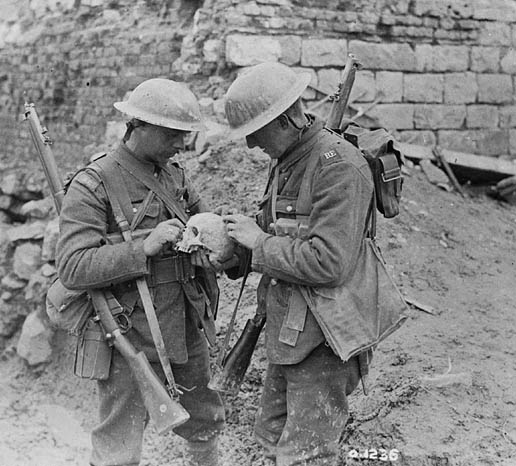
Examining a Skull found near Vimy Ridge.  W.I. Castle Library and Archives Canada / PA-001211
Later at Vimy Ridge, Burns noticed a soldier who was sharing a crater for cover, making a whistling sound.  The man was shot through the jugular.  Burns attempted to stop the bleeding by placing his fingers in the hole.  As he recalled, the man's face, "became scarlet, and then purple.  Finally he ceased breathing.  Possibly the bullet had gone on through the spine.  He made no articulate sound in dying.  I laid him down at the side of the trench, and wiped my fingers on his jacket."
Burns later commanded I Cdn Corps in WWII Italy
DND photo – CFPU ZK704 Canadian Military Journal
General H.D.G. Crerar (left) and Lt-Gen. E.L.M. Burns in Italy, 1944.

Burns' considerable intellectual efforts to modernize the Canadian Army in the interwar years may have had something to do with these grisly experiences in the mud of France and Flanders.  Mobile, mechanized warfare offered an answer to the bloody attritional stalemate of the Great War.  Burns' major command in the Second World War, that of the I Canadian Corps, would also see its share of mud and blood.  One can only speculate on the effects of Burns' Great War experiences on his later command.  He certainly would have had a memory stocked with the brutal effects of combat to add to the strain of the responsibilities of leadership.

Thursday, October 27, 2011

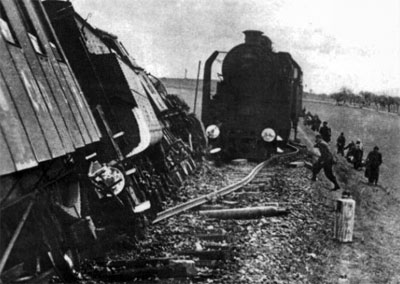
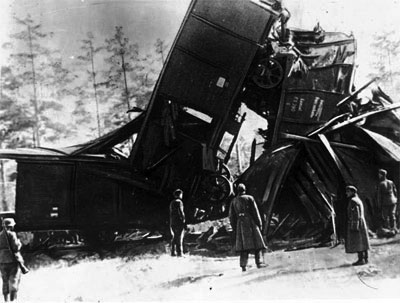
Of "Puff-Pastries" and Partisans: Soviet partisans vs. GRM rail traffic 1943

Flames of War
Leonid Grenkevich's The Soviet Partisan Movement, 1941-1944 argues that the Soviet partisans behind the German lines were effective in their efforts to destroy communications.  One major success was the dismantling of railways, which were critical to German logistics.  When lacking explosives for basic demolitions, partisans were said to dismantle rails and hide them in marshes, rivers or lakes.  Grenkevich notes, "in this fashion, in August 1943 the fighters of three large partisan units in the Rovno District of the Ukraine managed both to blow up and dismantle about 34 kilometres of permanent railroad way." (249)  Actions such as this led to the greatest success of the partisans during the war, greatly hampering the later stages of the Battle of Kursk.

Flames of War
Partisans reportedly innovated in their methods of disrupting German rail traffic.  Removing both rails and sleeping cars, they would pile these up on top of each other resembling a layered "culinary delicacy".  When these so called "puff-pastries" were set on fire, the result was rails which were so mangled, they would never be used again.  Partisans near Minsk reportedly bent rails in such a way that they could never be used again, reminiscent of the famed Sherman's neckties in his destructive march to the sea.

Bedwetting as a Ticket Home: Canadian Psychiatrists in Britain, 1940

Psychiatry was a relatively new field when Canada went to war in 1939.  The establishment in 1940 of the No. 1 Neurological Hospital (or No. 1 Nuts as the group was known), in Basingstroke, England, to deal with neuropsychiatric cases was thus a milestone in Canadian Military History.  Here the staff assessed a number of men who had become stress casualties, during the Blitz.  Terry Copp and Bill McAndrew noted in their work Battle Exhaustion, that a number of men riding motorcycles on the wrong side of the road during the blackouts caused not only accidents but post-traumatic anxieties as well.   Some of these unfortunate men were treated to an "electric wire brush treatment", but most were diagnosed, treated to some psychotherapy and sent on their way.
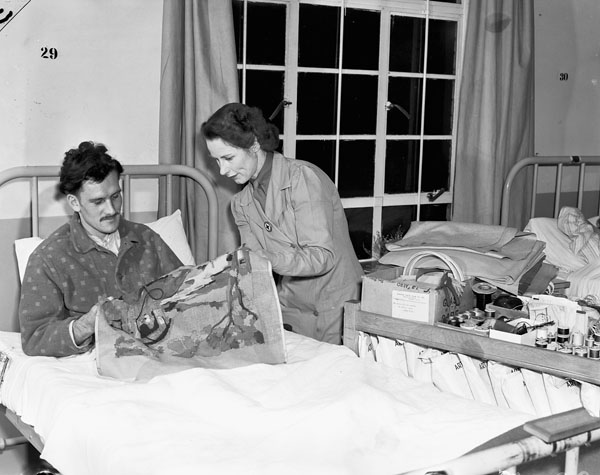
Mrs. M.A. Simpson of the Canadian Red Cross assisting Lance-Corporal L.D. Turner with needlepoint work, No.11 Canadian General Hospital, Royal Canadian Army Medical Corps (R.C.A.M.C.), Taplow, England, 14 December 1944.  Credit: Capt. Jack H. Smith. / Canada. Dept. of National Defence / Library and Archives Canada / PA-128180

With little in the way of psychological screening for the original members of the 1st Canadian Division, a number of soldiers with previous records of neurosis had been enlisted and were visiting the hospital.  H.H. Hyland, who had worked in the Toronto General Hospital in the interwar years, was not convinced anything could be done for these men.  Alcoholics and the occasional psychopath that graced Basinstroke's halls were also deemed incurable.  Hyland was determined that these men should be returned to Canada, but that policy was soon found to be troublesome.  When administrators told one "chronic bedwetter" that he would be returned to Canada, the other patients soon caught wind of the news.  As Copp and McAndrew note, "by next morning word had spread and the ward stank of urine."

A wartime article by Hyland on neuroses cases at No. 1 Neurological Hospital:
http://www.ncbi.nlm.nih.gov/pmc/articles/PMC1827527/pdf/canmedaj01696-0113.pdf