Showing posts with label railroad. Show all posts

Friday, June 15, 2012

Sir William Cornelius Van Horne: Prankster, Builder, and Irreverant Pleasure Seeker

William Van Horne was a central figure in the development of the Canadian West.  An American that refused a knighthood three times, before finally accepting the title in 1894, Van Horne worked his way up from modest means. As his father passed away while the boy was young, Van Horne accepted a menial job with a telegraph company.  (Canadian Stories, Kevin Patterson)


One anecdote of these early years related by Kevin Patterson shows that Van Horne could be a bit of a prankster:
Once he ran a ground wire from his employer's office to a steel plate in the [] railway yards - which could be seen from the office he was working in. The wire being charged with electricity, would shock anyone who stepped on it. This was an amusing spectacle for William until his boss stepped on the plate and unlike William's other victims knew about electricity. William was given a serious reprimand for his actions and shown the door.  (Canadian Stories)
Van Horne seen to the left of hammerer Donald Smith.  Van Horne gazes casually down at the completion of the road.
The energetic Van Horne did not let his dismissal stop him from climbing the ranks in the railway business, and he was soon an acknowledged expert in organization and construction.  His role as General Manager of the Canadian Pacific Railway served to solidify his historical reputation, and he posed for the  the most recognized photograph in Canadian history as Donald Smith pounded in the last spike of the road.  As of June 2012, Van Horne's descendants have returned the ceremonial last spike to the public, and it will be held at the Canadian Museum of Civilization.


Glenbow Museum Image No: NA-4432-1
Title: Portrait of W.C. Van Horne.
Date: June 1910
Pierre Berton notes in his popular work The Last Spike that the secret to Van Horne's incredible stamina was explained simply by the man who rose to the CPR's presidency:


"I eat all I can; I drink all I can; I smoke all I can; and I don't give a damn for anything."

Perhaps not an encouraging motto for youngsters.


Glenbow MuseumFile number: NA-2864-1771b-6a
Title: Van Horne students work on school mural, Calgary, Alberta.
Date: May 1967


As a final trivial tidbit, the song Van Horne, by Calgary rock band Chixdiggit!, has absolutely nothing to do with Van Horne himself, and probably refers to a teenage romance surrounding Van Horne high school in north-west Calgary.

Monday, December 5, 2011

A Bath of Bubbly in Brandon: Captain Vivian bathes in his Profits

Few writers can top the late Pierre Berton in the use of colourful anecdotes to add life and interest to the history books.  His work on the construction of the C.P.R.'s main line, The Last Spike, is one of the most readable books in Canadian history.  His account of a certain Captain Vivian, in the heady days of 1881, when the C.P.R. thrust its main line due west from Winnipeg, and real estate speculation was in its heyday, is worth re-telling.  Vivian was English gentry in bearing, sported a gleaming monocle, and spent a thousand pounds on a quarter section near Brandon.  As Berton recounted:
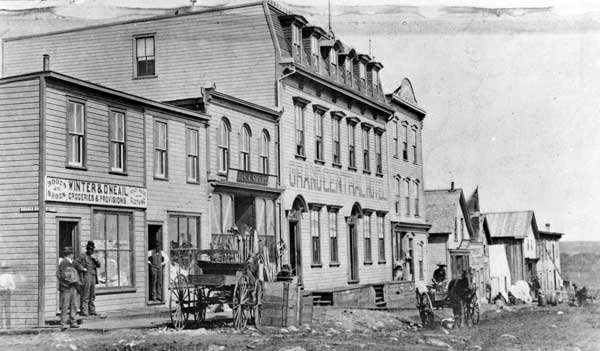
Rosser St. and 6th Ave. Brandon, 1882.   MHS Source: S. J. McKee Archives, Brandon University, Lawrence Stuckey Collection C1

"Vivian sank the entire sum into a quarter section homestead in the Brandon district, which he proceeded to sell at inflated prices.  By February he was said to be worth four hundred thousand dollars.  Unable to drink up all the champagne he had purchased, he filled a bathtub with it and invited his friends to watch him splash about.  The affair cost him seven hundred and fifty dollars."


Berton reports that the Brandon real estate boom was so sudden that no cemetery was planned and the dead had to be shipped back to Winnipeg.

Saturday, November 19, 2011

James Jerome Hill: A Bit of a Pirate

JJ Hill, by Getty.  Inc.com
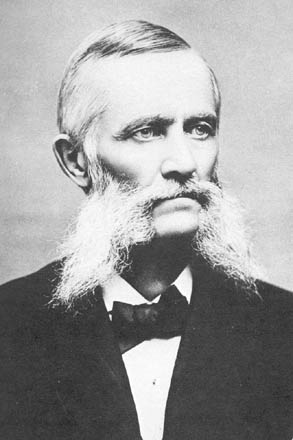
One of the founding members of the Canadian Pacific Railway is given a colourful introduction in Pierre Berton's classic popular history The Last Spike (1971).  Berton notes that Hill was, "a tougher and rougher specimen than his colleagues.  With his single, burning eye, his short, lion's beard and long mane, he looked like a bit of a pirate, which, in truth, he was."  As a child of nine Hill had lost his eye in an accident.  In his youth he had to work as a clerk in an Upper Canadian grocery store to help his impoverished family.  In 1856 Hill would begin to build his railway empire from scratch.  He moved to the booming city of St. Paul, and soon began his own shipping company.  This meagre start was the base for numerous railway interests.  In 1874, he teamed together with Donald Smith, Norman Kittson, and George Stephen to complete the St. Paul and Pacific railway to the Canadian border.  This partnership would lead to his eventual position on the board of the Canadian Pacific Railway.

Berton attributes the decision-making of Hill, who had been convinced by naturalist John Macoun that the southern prairies were inhabitable, as instrumental in selecting the southern route through Calgary and the yet to be explored Kicking Horse Pass, instead of along the old settlements on the North Saskatchewan River.  The original route, surveyed by Sandford Fleming, bore northwest from Selkirk, Manitoba (near Winnipeg), and continued through Battleford and the Yellowhead pass.  Due to the selection of the southerly route, the nascent communities of Brandon, Regina, Moose Jaw and Calgary were all to flourish into metropolitan centres on the northern Great Plains.

The southern route was also more ideally located to curb competition from the closest American railway, the Northern Pacific, and any other Canadian railways that may have emerged when the CPR monopoly clause, which prohibited railways building within 15 miles of the international border, ran out.
MHS

A central tenant of Hill's railway philosophy was that the first railway through the frontier would generate its own business.  As Hill claimed, "if we build this road across the prairie, we will carry every pound of supplies that the settlers want and we will carry every pound of produce that the settlers wish to sell, so that we will have freight both ways."

Hill would leave the CPR in 1883, due to the mismanagement of the Manitoba line, which Hill felt was neglected due to the larger projects of the CPR.  In 1889 the Manitoba line would become the Great Northern railway, and grow to dominate the northern American plains to the Pacific.  Hill is regarded as one of the greatest empire builders of nineteenth century North American business.

Canadian Encyclopedia Article on Hill

Thursday, October 27, 2011

Of "Puff-Pastries" and Partisans: Soviet partisans vs. GRM rail traffic 1943

Flames of War
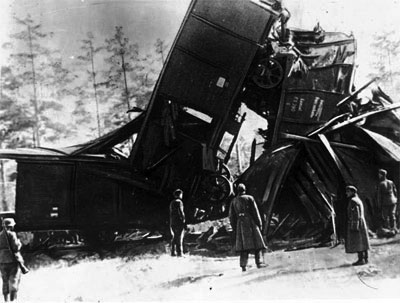
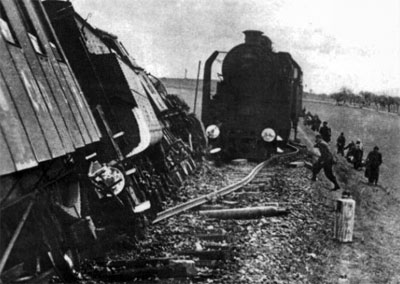
Leonid Grenkevich's The Soviet Partisan Movement, 1941-1944 argues that the Soviet partisans behind the German lines were effective in their efforts to destroy communications.  One major success was the dismantling of railways, which were critical to German logistics.  When lacking explosives for basic demolitions, partisans were said to dismantle rails and hide them in marshes, rivers or lakes.  Grenkevich notes, "in this fashion, in August 1943 the fighters of three large partisan units in the Rovno District of the Ukraine managed both to blow up and dismantle about 34 kilometres of permanent railroad way." (249)  Actions such as this led to the greatest success of the partisans during the war, greatly hampering the later stages of the Battle of Kursk.

Flames of War
Partisans reportedly innovated in their methods of disrupting German rail traffic.  Removing both rails and sleeping cars, they would pile these up on top of each other resembling a layered "culinary delicacy".  When these so called "puff-pastries" were set on fire, the result was rails which were so mangled, they would never be used again.  Partisans near Minsk reportedly bent rails in such a way that they could never be used again, reminiscent of the famed Sherman's neckties in his destructive march to the sea.

Friday, October 7, 2011

Major Rogers Cusses a Blue Streak

Rogers.  Explorer and Cusser.  Train Web
Major Albert Bowman Rogers is deeply entrenched in Canadian history for the discovery of a railway route through the mountain pass that bears his name.  Pierre Berton's Last Spike characterizes Rogers as a hard travelling man who could survive on some hard tack and a plug of tobacco for long periods in the bush.  Rogers was no shrinking violet, and his demeanour could best be described as gruff.


An incident in 1881 serves to illuminate the colourful language spat when Rogers rode into a survey crew's Bow River camp. The top engineer, Hyndman, was the unfortunate recipient of Rogers' ire.  Rocky Mountain outfitter and guide Tom Wilson noted that he had the honour of leading Rogers, described as the "tattered creature on the scarecrow horse", to the man's tent.


"'What's your altitude?' [Rogers] shot at Hyndman.  The engineer stammered that he did not know. 'Blue Jesus!  Been here several days and don't know the altitude yet.  You _____!' There followed what Wilson described as 'wonderful exhibition of scientific cussing [which] busted wide all of Hyndman's 'Holy Commandments' and inspired delighted snickers and chuckles of admiration from the men who had quickly gathered around.'"


Buy your Own Blue Jesus at room322shop
Pierre Berton had to guess at what expletive came after the word "Blue", as Wilson had edited it out of his memoirs.  Berton explains that, "it is doubtful that he would have censored so mild a word as 'blazes' (and equally doubtful that the Major himself would have lapsed into such a euphemism), I have filled in the blank with the most obvious expletive." "Blue Jesus", seems to be a fitting 1880s epithet. One is left to wonder what term Rogers used to call Hyndman at the end of the statement.  There is so many options that Berton didn't even wager a guess and left the expletive blank.


"You _____!"


Saturday, February 26, 2011

Retlaw, Alberta, The C.P.R., and the Naming of Prairie Towns

A: Location of Retlaw Alberta

Due to the Canadian Pacific Railroad's massive influence on Canada's prairie West, there is no surprise that the company's station names can still be found on maps long after branch-lines have fallen into disuse and communities withered.

Retlaw, Alberta, is a prime example.  Until 1913, the area was referred to as "Barney", and that name graced the local post-office.  It was in that year that the iron road came to the area.  Apparently, "Barney" was just not dignified enough for railway executives.  The renaming of this town can be linked to a certain Walter R. Baker.  Walter was an official of the CPR, and had served as the private secretary to Canada's governor general.  Apparently Walter was an important enough personage to have his name granted to one of the CPR's railway station.  To further obscure the origins of this name, however, the powers that be flipped things on their head and named the station "Retlaw", which to the meanest intellect at the slightest reflection, is indeed Walter, spelled backwards.


To further prove the arbitrary nature of the names of a number of prairie towns, we only need to observe those headed north-west from Retlaw: Enchant, Travers, Lomond and Armada.  The first letters in these small grain hubs all lead us back(wards) to WALTER.  The last station, never built, was to be named Waldeck.
Retlaw NWMP 1916. Glenbow Archives
Retlaw had a fairly brief existence.  After the Great War, population numbers peaked at 250, which included the surrounding farmers.  In 1925 crops were especially poor, and the exodus from the area began.  Visitors to the town now will observe only a couple permanent residents.  What was once a bustling town with a bank, several cafes, grain elevators, hotel and North-West Mounted Police detachment, has now been all but eroded by the elements.

Retlaw Hotel 1914. Glenbow Archives.

A Local Historian has preserved  Retlaw's History
Retlaw is included in my online Ghost Towns of Alberta guidebook from Geotourism Canada.


“ALTAPOP: Alberta’s Annual Official Population List Publication (1960 to present).” Alberta Population. http://www.altapop.ca/opl.htm.
Aubrey, Merrily K. Concise Place Names of Alberta. Calgary: University of Calgary Press, 2006.  
Fryer, Harold. Ghost Towns of Alberta. Langley: Stagecoach Publishing Co. Ltd., 1976.
“Walter spelled backwards | Forgotten Alberta.” http://forgottenalberta.com/2010/08/09/walter-spelled-backwards/.