Showing posts with label Brandon. Show all posts

Friday, June 29, 2012

Brandon's First Restaurant...and Domestic Badger

Ken Storie. Winnipeg Times,Nov. 15, 1881
The tale of the founding of what Pierre Berton referred to as the first of the C.P.R. towns is that of a rustic backwater, soon flooded by profit-seeking speculators.  Like many other railway towns, the CPR's great powers of site location would decide who would get rich from the Brandon boom. In 1881, Brandon, Manitoba was little more than a tent city, but real estate fuelled expansion  would soon see the foundations laid for a major prairie grain hub.

Early Brandon is portrayed by Berton as the romantic epitome of the Old West.  The initial post office was reportedly quite austere.  This bastion of civilization and primary contact with the outside world was limited to a soap box with a hole in it, which sat outside the postman's tent.


Berton's characterization of fine dining in Brandon is worth quoting in full:
The first restaurant was a plank laid across two barrels on the trail that was to become Pacific Avenue.  The proprietor was an eccentric, white-bearded cockney named Tom Spence whose entire stock consisted of a keg of cider, a bottle of lime juice, a couple of pails of water, and two drinking glasses.  To attract trade, Spence had chained a live badger to a nearby post, 'just far enough from the counter to be unable to bite the customers.' (Berton, The Last Spike, p.30)
Title: Collection of small animal heads mounted on wall plaques.
Date: [ca. 1893]Photographer: Smyth, S.A., Calgary, Alberta
Early Brandon makes good fodder for the nostalgic lover of the bygone West.  Berton is in his element describing clap-board sidewalks, and rough frontier living.  While the bison and coyote usually take the spotlight in the western genre, it is good to see some other furry friends get their due.  In Berton's anecdote, and on a curious 1890s taxidermy display in Calgary, the noble badger is preeminent among the pantheon of prairie critters.


Monday, December 5, 2011

A Bath of Bubbly in Brandon: Captain Vivian bathes in his Profits

Few writers can top the late Pierre Berton in the use of colourful anecdotes to add life and interest to the history books.  His work on the construction of the C.P.R.'s main line, The Last Spike, is one of the most readable books in Canadian history.  His account of a certain Captain Vivian, in the heady days of 1881, when the C.P.R. thrust its main line due west from Winnipeg, and real estate speculation was in its heyday, is worth re-telling.  Vivian was English gentry in bearing, sported a gleaming monocle, and spent a thousand pounds on a quarter section near Brandon.  As Berton recounted:
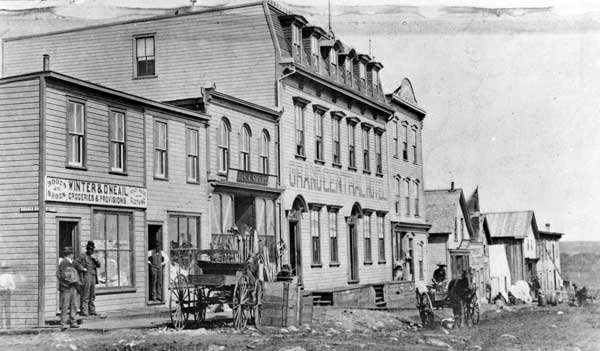
Rosser St. and 6th Ave. Brandon, 1882.   MHS Source: S. J. McKee Archives, Brandon University, Lawrence Stuckey Collection C1

"Vivian sank the entire sum into a quarter section homestead in the Brandon district, which he proceeded to sell at inflated prices.  By February he was said to be worth four hundred thousand dollars.  Unable to drink up all the champagne he had purchased, he filled a bathtub with it and invited his friends to watch him splash about.  The affair cost him seven hundred and fifty dollars."


Berton reports that the Brandon real estate boom was so sudden that no cemetery was planned and the dead had to be shipped back to Winnipeg.

Sunday, November 13, 2011

Forming of Brandon: C.P.R Real Estate Control

Pierre Berton's The Last Spike contains numerous examples to prove that real estate speculation was a major facet in the development of Canada's prairie west.  The forming of the town of Brandon shows how the Canadian Pacific Railway shaped the region, and thwarted speculators and homesteaders alike in order to maximize its own profits on land sales.  In 1881, the decision to build the CPR's southern route towards the yet to be discovered Kicking Horse Pass had been made.  Those who were savvy to the needs of the railroad knew that a divisional point would be needed about one hundred and thirty miles west of Winnipeg, where a settlement on the Assiniboine river by the name of Grand Valley was already situated.


Settlement Stories from Manitoba.  Ken Storie.
Thomas Rosser. MHS.
The McVicar brothers were first settlers in the area, coming in 1879.  Farming the area for two years, the McVicar's were visited two years later by US Civil war veteran, General  Thomas L. Rosser, the engineer who was surveying the route.  Rosser offered the brothers a healthy sum of money (Pierre Berton notes in The Last Spike that the amount varies from $25,000 to $50,000), but John McVicar, despite being flabbergasted by the huge sum, was convinced by some neighbours to hold out for more money and perhaps even interests in future sales.  General Rosser reportedly replied to this counteroffer, "I'll be damned if a town of any kind is ever built here."

True to his word, no divisional point was set up at Grand Valley, and the town of Brandon emerged two miles further west.  Berton reports that it was later proven that Rosser and other CPR officials were in fact speculating in real estate themselves, making personal profit off inside knowledge of future station locations.

 Ken Storie's Settlement Stories from Manitoba. has great detail and further pictures, maps and newsclippings of Grand Valley and Brandon during the railway era.