Thanks for visiting.
This blog's content will slowly move over to www.dustbinepitaph.blogspot.ca
Check out the most recent post about the explorer George Back:
http://dustbinepitaph.blogspot.ca/2016/11/george-backs-ravens-20-april-1844.html
Sunday, November 20, 2016

Saturday, December 13, 2014
URL Change
Just a note to those that are following this blog. New content for DUSTBIN EPITAPH has moved to
http://dustbinepitaph.blogspot.ca/
Thanks for following the blog!
http://dustbinepitaph.blogspot.ca/
Thanks for following the blog!
Sunday, March 16, 2014
Community, Piety, and Nationalism: St. Patrick's Day in Toronto during the nineteenth century
The Irish have long been considered a key component of Canadian society. Their population base was firmly entrenched as the largest immigrant group in the first half of the nineteenth-century. Today, the majority of Canadians celebrating St. Patrick's Day find an excuse to have a drink, wear some green, and proudly state one's Irish heritage, no matter how distant or diluted. In earlier times, however, much more was at stake during St. Pat's celebrations. Historians have shown that the meanings associated with St. Patrick's feast day varied a great deal during the nineteenth century, ranging from a sense of community, to Catholic piety, to Irish nationalism. With its large population of Irish Catholics, Toronto offers an interesting perspective on the changing nature of the day's celebration in Canada.
From 1825 to 1845 nearly half a million Irish immigrants came to British North America, many of whom were escaping the plight of mono-crop failures as tenant potato farmers. In 1845, a new strain of potato blight spread through Ireland, and in three years nearly 800,000 people were dead.
An officer wrote to London Times reporting the grisly details of the brutal conditions found in Ireland,
Nativism against Irish Catholics, saw their religion as corrupt and conspiratorial, and their race as barbaric, ignorant and intemperate. (Scott W. See, "An unprecedented influx": Nativism and Irish Famine Immigration to Canada", American Review of Canadian Studies (December 2000), p. 437) At times the idea that the Irish would spread communicable disease was extended to the moral realm, with one newspaper noting that the Irish should be sent to the countryside as soon as possible to avoid "moral contamination" in the cities. (See, p.442) In 1830, the Orange Order came to Canada. Started by Ogle R. Gowan, the fraternity was dedicated to Protestant dominance over Roman Catholics, and giving patronage to its own members. In the later nineteenth-century violent clashes came to typify relations between Orange and so-called Green groups on important religious days.
By 1851, Irish Catholics comprised one quarter of the Toronto's population. (Scott W. See, "An unprecedented influx": Nativism and Irish Famine Immigration to Canada", American Review of Canadian Studies (December 2000), p. 434) Irish Protestants could at times out-number Irish Catholics in the city that was known to some as the "Belfast of North America". Racist responses grew with the great influx of poor Catholics in the 1840s. In 1847, over 1,000 Irish Catholics died in the shanties built in the feverish poor district of Toronto called Cabbagetown.
In his 1992 Social History article "St. Patrick's Day Parades in Nineteenth-Century Toronto: A Study of Immigrant Adjustment and Elite Control", Michael Cottrell notes that parades and processions for the commemoration of the Battle of the Boyne and the feast day of St. Patrick were linked to ethnic political and economic struggles. Cottrell suggests that from the forming of the St. Patrick's Society in Toronto in 1832, the celebrations grew from "low-key affairs - concerts balls and soirees - which brought together the Irish elite to honour their patron saint and indulge their penchant for sentimental and self-congratulatory speeches", to more sectarian public rituals of the 1860s. (Cottrell, p. 60) St. Patrick's day increasingly became associated with Irish Catholicism, as Protestants expressed nativist sentiments after the 1840s, and in the 1850s the Catholic Church itself focused the celebrations around the church mass.
Church services did not remain completely apolitical. In 1855, Father Synnott pleaded to his Toronto congregation,
With the influence of the Young Men's St. Patrick's Association, a fraternal organization which sought to provide a social life and connections for Irish immigrants, in the 1860s a more secular bent was added to the processions. "Religious hymns were replaced by popular tunes and secular emblems such as shamrocks, harps and wolfhounds were now more prominent than Catholic icons." (Cottrell, 63) The wishes of temperance from the clergy also gave way to the alcohol soaked festivities that the day is still associated with.
It may be that the growing scale of parades as well as their tendency towards drunkeness provoked the Orange Order to clash with the parade in 1858, which resulted in violence and the death of a Catholic man from a wound by a pitchfork. This incident prompted the creation of the Hibernian Benevolent Society of Canada, whose mission was "assisting...their distressed members, attending them in their sickness, and, in case of death, defraying their funeral expenses." (WS Niedhardt, DCB) By 1863, they had also organized for paramilitary self-defence.
Cottrell writes that the largest of St. Patrick's Day parades during this period in Toronto was that of 1863. The celebrations began the previous night with the Hibernian Benevolent Society's band playing Irish music on the march. The next morning, around two thousand persons marched to St. Michael's Cathedral and attended a sermon which reached its crescendo with the telling of the exploits of Saint Patrick and the need of the Irish to spread Catholicism globally. Cottrell writes that hereafter, "Religious obligation having been fulfilled, the procession then reformed and paraded through the principal streets of the city." (Cottrell, p. 58)
Here another speech was delivered, by the president of the Hibernian Benevolent Society, denouncing the British government in Ireland. He told the crowd that, "three-fourths of the Catholic Irish of this country would offer themselves as an offering on the altar of freedom, to elevate their country and raise her again to her position in the list of nations. Nothing could resist the Irish pike when grasped by the sinewy arm of the Celt." (Irish Canadian, 18 March 1863, cited in Cottrell, p. 58) After all of this formal speechifying, the main procession broke up "into smaller parties and soirees which lasted late into the night." Cottrell emphasizes that St. Patrick's Day was the one day a year which Irish Catholics could "claim the city as their own and proudly publicize their distinctiveness on the main streets." (p. 59) In the process, Irish identity was reinforced, and associated with Home Rule or Catholicism depending upon the times and circumstances.
Despite these large processions in the early 1860s, the links between the Hibernian society and the Fenians, who sought Irish independence through attacks on British North America, resulted in several years without parades. The violence of the late 1850s had seen previous events cancelled, and with the Fenian raids of 1866, suspicion of the Irish community, and incarceration of suspected Fenians, many Irish-Canadians wished to maintain a low profile. (Cottrell, p. 69) The rounding up of Fenian sympathizers within the Hibernian Society further reduced their stature within Toronto's Irish-Canadian society.
Historians disagree as to the nature of the decline in St. Patrick's day parades in Toronto. Rosalyn Trigger has taken issue with Cottrell's suggestion that 1877 was the last public celebration of the day for more than a century. Noting that several large parades in the 1890s occurred, Trigger questions the argument that the decline of parades from the 1870s represent Irish assimilation. Drawing on American research, Trigger notes that while anti-Catholicism was a factor, the desire to send money to those suffering in Ireland prompted some Irish to abandon the parade out of frugality. (Rosalyn Trigger, "Irish Politics on Parade: The Clergy, Naitonal Societies, and St. Patrick's Day Processions in Nineteenth-century Montreal and Toronto", Social History, 37:74, 2004, p. 196) Trigger agrees, however, with Canadian researchers who argue that in the 1880s and 1890s, Irish nationalism was diminishing in Toronto as Irish-Catholics hoped to participate in society, but retain their faith. Hopes were turned from Home Rule for Ireland to greater rights for Catholics in Canada.
The meaning behind St. Patrick's day in Canada certainly fluctuated with the circumstances of Irish-Canadians, and was adapted to the needs of the community, and altered by international events. The day was central to Irish-Canadian identity, with themes of Irish Home Rule, or rights for Catholics in Canada entering into the discourse when these issues were imminent. On the 17th of March 2014, Canadian pubs will be abuzz with glossy-eyed Canadians in emerald attire, perhaps swaying to a Irish reel or two. Few will consider the historical context of the Irish in Canada: the flight from famine; violent nativist resistance; and interesting ways that Saint Patrick's Day has changed over the years.
From 1825 to 1845 nearly half a million Irish immigrants came to British North America, many of whom were escaping the plight of mono-crop failures as tenant potato farmers. In 1845, a new strain of potato blight spread through Ireland, and in three years nearly 800,000 people were dead.
An officer wrote to London Times reporting the grisly details of the brutal conditions found in Ireland,
From 1845 to 1850 another 300,000 Irish refugees arrived in British North America. When the first few "coffin ships" arrived, great pity was expressed by British North Americans towards the suffering of the Irish, yet these sentiments were quickly replaced by fears of the effects of great numbers of Irish Catholic immigrants on colonial society.Fever, [dystentry], and starvation stare you in the face every-where - children of ten and nine years old I have mistaken for decrepit old women, their faces wrinkled, their bodies bent and distorted in pain, the eyes looking like those of a corpse. Bodies are found lifeless, lying on their mothers' bosoms. I tell you one thing which struck me as particularly horrible: a dead woman was found lying on the road with a dead infant on her breast, the child having bitten the nipple of the mother right through in trying to derive nourishment from the wretched body. Dogs feed on the [half-buried] dead, and the rats are commonly known to tear people to pieces who, though still alive, are too weak to cry out....Instead of following us, beggars throw themselves on their knees before us, holding up their dead infants to our sight. (Cited in Donald Mackay, Flight from Famine, 1990, p. 245)
Great Famine 1847. Illustrated London News

Nativism against Irish Catholics, saw their religion as corrupt and conspiratorial, and their race as barbaric, ignorant and intemperate. (Scott W. See, "An unprecedented influx": Nativism and Irish Famine Immigration to Canada", American Review of Canadian Studies (December 2000), p. 437) At times the idea that the Irish would spread communicable disease was extended to the moral realm, with one newspaper noting that the Irish should be sent to the countryside as soon as possible to avoid "moral contamination" in the cities. (See, p.442) In 1830, the Orange Order came to Canada. Started by Ogle R. Gowan, the fraternity was dedicated to Protestant dominance over Roman Catholics, and giving patronage to its own members. In the later nineteenth-century violent clashes came to typify relations between Orange and so-called Green groups on important religious days.
By 1851, Irish Catholics comprised one quarter of the Toronto's population. (Scott W. See, "An unprecedented influx": Nativism and Irish Famine Immigration to Canada", American Review of Canadian Studies (December 2000), p. 434) Irish Protestants could at times out-number Irish Catholics in the city that was known to some as the "Belfast of North America". Racist responses grew with the great influx of poor Catholics in the 1840s. In 1847, over 1,000 Irish Catholics died in the shanties built in the feverish poor district of Toronto called Cabbagetown.
 |
| St. Patrick's Society, Toronto, Speech. Internet Archive |
In his 1992 Social History article "St. Patrick's Day Parades in Nineteenth-Century Toronto: A Study of Immigrant Adjustment and Elite Control", Michael Cottrell notes that parades and processions for the commemoration of the Battle of the Boyne and the feast day of St. Patrick were linked to ethnic political and economic struggles. Cottrell suggests that from the forming of the St. Patrick's Society in Toronto in 1832, the celebrations grew from "low-key affairs - concerts balls and soirees - which brought together the Irish elite to honour their patron saint and indulge their penchant for sentimental and self-congratulatory speeches", to more sectarian public rituals of the 1860s. (Cottrell, p. 60) St. Patrick's day increasingly became associated with Irish Catholicism, as Protestants expressed nativist sentiments after the 1840s, and in the 1850s the Catholic Church itself focused the celebrations around the church mass.
 |
| "St. Patrick's Day Arch", Quebec City. Andrew Merrilees, LAC |
Church services did not remain completely apolitical. In 1855, Father Synnott pleaded to his Toronto congregation,
Go on then, faithful, noble and generous children of St. Patrick, in your glorious career...keep your eyes ever fixed on the faith of St. Patrick which shall ever be for you a fixed star by night and a pillar of light by day - forget not the examples and memorable deeds of your fathers - be faithful to the doctrines of your great apostle. A voice that speaks on the leaf of the shamrock - that speaks in the dismantled and ruined abbeys of lovely Erin - yea a voice that still speaks on the tombstones of your martyred fathers and in the homes of your exiled countrymen - be faithful to the glorious legacy he has bequeathed to you. (Mirror, 23 March 1855, cited in Cottrell, p. 62)
 |
| Coat of arms of Young Men's St. Patrick's Association John Henry Walker (1831-1899)Museum McCord http://creativecommons.org/licenses/by-nc-nd/2.5/ca/ |
It may be that the growing scale of parades as well as their tendency towards drunkeness provoked the Orange Order to clash with the parade in 1858, which resulted in violence and the death of a Catholic man from a wound by a pitchfork. This incident prompted the creation of the Hibernian Benevolent Society of Canada, whose mission was "assisting...their distressed members, attending them in their sickness, and, in case of death, defraying their funeral expenses." (WS Niedhardt, DCB) By 1863, they had also organized for paramilitary self-defence.
 |
| St. Michael's Cathedral, TO, 1887 Credit: Canada. Patent and Copyright Office / Library and Archives Canada / PA-028762a |
Here another speech was delivered, by the president of the Hibernian Benevolent Society, denouncing the British government in Ireland. He told the crowd that, "three-fourths of the Catholic Irish of this country would offer themselves as an offering on the altar of freedom, to elevate their country and raise her again to her position in the list of nations. Nothing could resist the Irish pike when grasped by the sinewy arm of the Celt." (Irish Canadian, 18 March 1863, cited in Cottrell, p. 58) After all of this formal speechifying, the main procession broke up "into smaller parties and soirees which lasted late into the night." Cottrell emphasizes that St. Patrick's Day was the one day a year which Irish Catholics could "claim the city as their own and proudly publicize their distinctiveness on the main streets." (p. 59) In the process, Irish identity was reinforced, and associated with Home Rule or Catholicism depending upon the times and circumstances.
Despite these large processions in the early 1860s, the links between the Hibernian society and the Fenians, who sought Irish independence through attacks on British North America, resulted in several years without parades. The violence of the late 1850s had seen previous events cancelled, and with the Fenian raids of 1866, suspicion of the Irish community, and incarceration of suspected Fenians, many Irish-Canadians wished to maintain a low profile. (Cottrell, p. 69) The rounding up of Fenian sympathizers within the Hibernian Society further reduced their stature within Toronto's Irish-Canadian society.
Historians disagree as to the nature of the decline in St. Patrick's day parades in Toronto. Rosalyn Trigger has taken issue with Cottrell's suggestion that 1877 was the last public celebration of the day for more than a century. Noting that several large parades in the 1890s occurred, Trigger questions the argument that the decline of parades from the 1870s represent Irish assimilation. Drawing on American research, Trigger notes that while anti-Catholicism was a factor, the desire to send money to those suffering in Ireland prompted some Irish to abandon the parade out of frugality. (Rosalyn Trigger, "Irish Politics on Parade: The Clergy, Naitonal Societies, and St. Patrick's Day Processions in Nineteenth-century Montreal and Toronto", Social History, 37:74, 2004, p. 196) Trigger agrees, however, with Canadian researchers who argue that in the 1880s and 1890s, Irish nationalism was diminishing in Toronto as Irish-Catholics hoped to participate in society, but retain their faith. Hopes were turned from Home Rule for Ireland to greater rights for Catholics in Canada.
 |
| Credit: Library and Archives Canada, Acc. No. 1984-4-849 |
The meaning behind St. Patrick's day in Canada certainly fluctuated with the circumstances of Irish-Canadians, and was adapted to the needs of the community, and altered by international events. The day was central to Irish-Canadian identity, with themes of Irish Home Rule, or rights for Catholics in Canada entering into the discourse when these issues were imminent. On the 17th of March 2014, Canadian pubs will be abuzz with glossy-eyed Canadians in emerald attire, perhaps swaying to a Irish reel or two. Few will consider the historical context of the Irish in Canada: the flight from famine; violent nativist resistance; and interesting ways that Saint Patrick's Day has changed over the years.
Tuesday, March 11, 2014
The Innocent "Iyties": Soldiers' Perceptions of Children in the Italian Campaign
Canadian historical memory of liberated Europe during the Second World War is dominated by themes of celebration, gratitude, and co-operation. The generously free-flowing Calvados unearthed from Normandy cellars, or the joyous Dutch street celebrations are the stuff of safe reminiscences of victors and victims. In the Italian campaign, however, a more uncomfortable narrative challenges these tropes. Here, racist language towards Italians, and perceptions of Italy as dirty and barbaric are not difficult to find in soldiers' letters. An exception to the rule, however, is found in Canadian consideration of Italian children, who are seldom included in condemnation, but often held up as innocent exceptions to an otherwise blameworthy, wayward, and unhygienic people.
Of the campaign in Sicily, Jeff Keshen writes in Saints, Sinners, and Soldiers (UBC Press, 2004), his critique of the Canadian "Good War", that many interactions were "cordial, even warm, as the Canadians were often greeted as liberators." (Keshen, p. 245) Others, however, distrusted Sicilians, disdained the "squalid" conditions they lived in, and stole what they wanted from them, occasionally at gunpoint. Soldiers issued chits for payback which were signed by movie stars or cartoon characters. While many men reportedly rejected Sicilian women for their dark complexion, this did not prevent seven rapes by the end of July 1943 (Keshen, p. 246). The poverty of the civilian population is illustrated in the payment of several cigarettes or tinned rations to women for sex. Children of the age of eight or nine would wander the streets to drum up business for prostitutes. The booklet that prepared soldiers for Italy stated that in regards to women, "the less you have to do with them the better." (Quoted in Keshen, p. 248)
Racist themes continued to mix with more favourable encounters across the straits of Messina. Of interactions on the Italian mainland Keshen records, "As in Sicily, there were many reciprocal exchanges between soldiers and civilian. But some Canadians considered the Italians, or "Iyties" as they called them, in the same light as they saw the Sicilians: chameleon-like in allegiance, crooked, and thus deserving of little consideration." (Keshen, p. 248-49) Here too, looting occurred, at times escalating to armed robbery, and justified by the perception that Italians were price-gouging the soldiers.
Comments in Canadian censorship reports which pertain to Italians were seldom favorable. In December of 1943, the censors recorded that only 10% of references to Italians were positive. Especially in Southern Italy, the general attitude of soldiers was distrust, dislike, and disgust at the squalor that Italians were living in.
A comment from a member of the 3rd Field Regiment of Royal Canadian Artillery may serve to express the ethnocentrism of those familiar with sanitary conditions in Canada towards those in war-torn Italy: “These wops are a dirty filthy bunch, I wouldn't trust them as far as you can smell them and that's a fair distance.” (December 1943, Library and Archives Canada, RG24 Volume 12,323)
There was, however, an exception to these harsh sentiments, found in sympathies expressed towards children. In December 1943, a British war correspondent wrote an account of sharing shelter in a home in Ortona with a handful of Canadian soldiers. He reported, "The children clambered around the Canadian soldiers and clutched at them convulsively every time one of our anti-tank guns, located only half a dozen paces from the door of the house, fired down the street in the direction of one of the remaining German machine-gun posts. Soon each one of us had a squirming, terrified child in his arms." (Quoted in GWL Nichols, The Canadians in Italy (Queen's Printer, 1956), p. 331.
 |
| UBC Press |
Racist themes continued to mix with more favourable encounters across the straits of Messina. Of interactions on the Italian mainland Keshen records, "As in Sicily, there were many reciprocal exchanges between soldiers and civilian. But some Canadians considered the Italians, or "Iyties" as they called them, in the same light as they saw the Sicilians: chameleon-like in allegiance, crooked, and thus deserving of little consideration." (Keshen, p. 248-49) Here too, looting occurred, at times escalating to armed robbery, and justified by the perception that Italians were price-gouging the soldiers.
Comments in Canadian censorship reports which pertain to Italians were seldom favorable. In December of 1943, the censors recorded that only 10% of references to Italians were positive. Especially in Southern Italy, the general attitude of soldiers was distrust, dislike, and disgust at the squalor that Italians were living in.
A comment from a member of the 3rd Field Regiment of Royal Canadian Artillery may serve to express the ethnocentrism of those familiar with sanitary conditions in Canada towards those in war-torn Italy: “These wops are a dirty filthy bunch, I wouldn't trust them as far as you can smell them and that's a fair distance.” (December 1943, Library and Archives Canada, RG24 Volume 12,323)
There was, however, an exception to these harsh sentiments, found in sympathies expressed towards children. In December 1943, a British war correspondent wrote an account of sharing shelter in a home in Ortona with a handful of Canadian soldiers. He reported, "The children clambered around the Canadian soldiers and clutched at them convulsively every time one of our anti-tank guns, located only half a dozen paces from the door of the house, fired down the street in the direction of one of the remaining German machine-gun posts. Soon each one of us had a squirming, terrified child in his arms." (Quoted in GWL Nichols, The Canadians in Italy (Queen's Printer, 1956), p. 331.
 |
|
Pte. Alex Livingstone Handing Biscuits to Italian Children .Copyright belongs to the Crown ; Credit: Canada. Department of National
Defence / Library and Archives Canada / ecopyLibrary and Archives Canada Item no. (creator) ZK-552
Archival reference no. R112-1459-1-E
|
 |
| (Credit: Members of the Seaforth Highlanders sit down for their Christmas dinner. Photo: Terry F. Rowe / Canada.DND / Library and Archives Canada / PA-152839) Toronto Public Library |
For most soldiers of the 1st Canadian Infantry Division, letters included more references to children than Christmas parties in and of themselves. A member of the 2nd Canadian Armoured Regiment wrote of the feasting,
Most of us had an Italian child with us – they were very happy Darling believe me but they were so glad to get a dinner. They would have framed the plate if they could of. It makes one feel like crying to see them eat. (Dec. 1943, RG24, Vol 12,323)

Canadian
letters generally blamed Italians for the state of their war-ravaged
country, but were willing to make exceptions for youth. The postal
censors wrote in February 1944:
The plight of small under-nourished children is often mentioned and children are regarded with sympathy and understanding as the unfortunate victims of conditions for which their parents are wholly responsible. Although certain individual kindnesses are appreciated, the general attitude to the adult population never seems to be free of a feeling of suspicion and distrust.Men are very often appalled with the insanitary and dirty conditions existing in the Italian villages and it forms a never-ending theme in letters home. (Feb. 1944, RG24 Volume 12,323)
It seems that it was involvement with partisans in the battles breaking the Gothic Line and beyond that finally changed the opinions of soldiers towards Italians. The censor wrote in November 1944, “A number of forward units have
recently been in contact with Italian partisans, and, in their case,
a marked change in the usual unfavourable attitude towards local
inhabitants has been noted. They have nothing but praise for the
work done by these guerrillas.”
 |
| Troopers W. Balinnan and A. Gallant of a Canadian reconnaissance regiment speaking to partisans Louisa and Italo Cristofori after the capture of Bagnacavallo, Italy, 3 January 1945. Credit: Capt. Alex M. Stirton / Canada. Dept. of National Defence / Library and Archives Canada / PA-173569 |
In December 1944, the chief censor's report wrote that relations with Italians in the villages of the North were cordial, and the mail contained frequent reference to the hospitality and cooperation of partisans. An officer of the Seaforth Highlanders of Canada wrote of a kindness alongside racist references, writing, “Despite what these rough tough Canadians say about these 'gawdamn
Wops' they treat them royally and the kids never go without
chocolate.”
Attitudes towards Italians were mitigated by the passage of time since their co-belligerency against the Allied cause, and by partisan willingness to risk their lives fighting against the Germans. The ethnocentric judgement of living conditions found in early letters from the campaign tapered off as Canadians themselves were forced to live in the mud and ruined remnants of Italian homes.
Children encountered in the campaign were treated with a generosity often not extended to adults. Young people were interpreted as innocent of Italian transgressions earlier in the war, and reminded soldiers of young friends and family members left behind on the homefront. They served as ambassadors between two cultures, softening soldiers to a "foreign" people, and providing a way to break down tensions and hostilities between Canadians and Italians.
Attitudes towards Italians were mitigated by the passage of time since their co-belligerency against the Allied cause, and by partisan willingness to risk their lives fighting against the Germans. The ethnocentric judgement of living conditions found in early letters from the campaign tapered off as Canadians themselves were forced to live in the mud and ruined remnants of Italian homes.
Children encountered in the campaign were treated with a generosity often not extended to adults. Young people were interpreted as innocent of Italian transgressions earlier in the war, and reminded soldiers of young friends and family members left behind on the homefront. They served as ambassadors between two cultures, softening soldiers to a "foreign" people, and providing a way to break down tensions and hostilities between Canadians and Italians.
Tuesday, February 25, 2014
Hyperbole, Sarcasm and Fatalism: Canadian Humour in the Italian Campaign 1943-45
Stephen Leacock wrote in Humour and Humanity that humour approaches indifference or cruelty, but is softened by its link to pathos in its compassion and pity. This union, he claimed, was what prevented humour from "breaking into guffaws" in callous mockery, or "subsiding into sobs", in commiseration. (Gerald Lynch, Stephen Leacock: Humour and Humanity McGill Queens: 1988.) Both the anger and the sadness of humour is found in the censored letters of Canadian soldiers in the Italian campaign. Men on campaign wrote home with exaggerated criticism of army policy, and told stories of their fellow soldiers' humour relieving the most pitiable circumstances. Both the cruelty and the sorrow of war lies sublimated below the rough surface of their sarcastic and often biting humour.
Tim Cook recently published an interesting article on humour in the Canadian Expeditionary Force during the First World War, arguing that humour was a way to release tension and survive the horrific conditions and experiences on the Western Front. The article, "'I will meet the world with a smile and a Joke': Canadian Soldiers Humour in the Great War" in Canadian Military History, (Spring 2013) argues that while the lasting memory of the First World War, constructed by poets such as Siegfried Sassoon and perpetuated in print and on film ever since, has been that of pointless carnage and suffering, that soldiers' writings provide an important adjunct to this somber tone. Cook writes that soldiers' humour was by no means uniform, but that themes can be drawn from the wide corpus of personal testimony including: justification of the killing process; masculine teasing; gallows humour which hoped to "trivialize the terrifying"; mockery of the heroic and patriotic rhetoric of the war; masculine teasing; and plain bawdy lewdness and silliness.
In Italy, attempts to relieve the stress of battle are clear in an account of the crossing of the Moro River. In December 1943, a member of the 3rd Field Company of Royal Canadian Engineers wrote at length of the sappers under his command who made light of his attempts to sooth their concerns at being under fire while bridging the river on the outskirts of Ortona:
Using humour to relieve stress and misery is particularly apt in front-line conditions. As one soldier from 3rd Field Regiment, Royal Canadian Artillery wrote in April 1944, “There may be lots of mud and rain and the unpleasant thoughts of what we are engaged in but there is always humour. Men are irrepressible – there is always the brighter side for the picture.” (RG24 Volume 12323)
As men found more problems with administrative policies later in the campaign, the humour in censorship excerpts was increasingly of the sarcastic variety. Men frequently complained about lack of leave back to Canada. The Zombies (the nickname for National Resources Mobilization Act conscripts who were for the time still allowed to serve in Canada) were continually criticized. One trooper's comment suggests that suspicions and jealousy lay close below the surface. He sarcastically wrote in August 1944,
Cook noted that First World War soldiers used humour to raise grievances, and the tradition continued for the next generation of Canadian soldiers. In Italy, the policy of putting towns out of bounds to Canadians after the Battle of the Hitler Line as an attempt to reduce venereal disease rates was a notable hit on troop morale. Again in August, as the I Canadian Corps prepared to breach the Gothic Line, signs bearing "Out of Bounds to Canadian Troops", came under sarcastic criticism. A private wrote home,
 |
| Tim Cook gave a lecture at Trent in 2009 on Soldiers' Humour. |
In Italy, attempts to relieve the stress of battle are clear in an account of the crossing of the Moro River. In December 1943, a member of the 3rd Field Company of Royal Canadian Engineers wrote at length of the sappers under his command who made light of his attempts to sooth their concerns at being under fire while bridging the river on the outskirts of Ortona:
We have been having a ding-dong, knock-em-out-drag-em out battle with Jerry the last little while and are still advancing so I guess we are better than he is at this war game. All the advantage is on his side. Hills and rivers forming natural obstacles for him to defend and we to overcome. We had quite a job about a week ago getting over a river but did get over it amid much praise from General Montgomery down. I was explaining to the boys that getting to the job was the worst part and on the job we would be as safe as in a church. A sapper pipes up and wants to know if I have any particular church in mind, quite humorous under the conditions. When we got to the job we came under machine gun fire and again the great fatalist tried to explain that if one had your number on it you got it, if not you would not. A sapper said he wasn't ascaird of the one with a number on it, it was the one addressed 'To whom it may concern' which worried him. Humor comes out in the strangest places. (Library and Archives Canada, RG24 Vol. 10,705)
 |
| Poppy on the Moro Approaches. 2009 Gregg Centre Battlefield Tour. Copyright Will Pratt. |
Using humour to relieve stress and misery is particularly apt in front-line conditions. As one soldier from 3rd Field Regiment, Royal Canadian Artillery wrote in April 1944, “There may be lots of mud and rain and the unpleasant thoughts of what we are engaged in but there is always humour. Men are irrepressible – there is always the brighter side for the picture.” (RG24 Volume 12323)
As men found more problems with administrative policies later in the campaign, the humour in censorship excerpts was increasingly of the sarcastic variety. Men frequently complained about lack of leave back to Canada. The Zombies (the nickname for National Resources Mobilization Act conscripts who were for the time still allowed to serve in Canada) were continually criticized. One trooper's comment suggests that suspicions and jealousy lay close below the surface. He sarcastically wrote in August 1944,
Jealous worry about women on the homefront is a major theme in soldiers letters, and has been identified as prevalent in the Eighth Army in earlier postal censorship by Jonathan Fennel in his work Combat and Morale in the North African Campaign (2010).How are those Zombies doing back in Canada? They must really have a tough battle over there. Trying to keep away from beer parlours or keeping form having too delightful a time. Or keeping a fighting man's wife company. (RG24 Volume 12,323)
 |
| Something funny was definitely going on here.
Troopers of the Governor General's Horse Guards
displaying distinctive haircuts before the advance on the Hitler Line,
Italy, 26 May 1944. Credit: Lieut. Strathy E.E. Smith / Canada. Dept. of National Defence / Library and Archives Canada / PA-189923
|
Every damn place is out of bounds to the Canadians. It is getting beyond a joke now. Most of the boys are wondering if Canada will be 'Out of bounds.' I guess the only place they can trust them is at the front. (RG24, Vol. 12,323)
The old saw that the army marches on its stomach seems to be as true for the General ELM Burns' troops as it was for Napoleon's. Those in the Chief Censor's office got in on the joke by labelling some grousing about the tinned rations of Meat and Vegetables the "Gourmet's Resolve". A private soldier wrote, “I'm
still on that balanced diet of M. & V. I'll get even with
Argentina someday.” (RG24 Vol 12,323)
The connection with the homefront and longing to return there was observed in many letters as a second winter in Italy began. By the end of 1944, the lack of home leave was criticized by many soldiers. A new points scheme had been put in place, but many correctly assumed they wouldn't see Canada until after the war. One gunner wrote home using a little hyperbole about his expected leave date:

The connection with the homefront and longing to return there was observed in many letters as a second winter in Italy began. By the end of 1944, the lack of home leave was criticized by many soldiers. A new points scheme had been put in place, but many correctly assumed they wouldn't see Canada until after the war. One gunner wrote home using a little hyperbole about his expected leave date:
Guess the papers have quite a write-up about the '39 boys coming home for Christmas leaves. At the rate they are going about it, I'll likely be home about 1960. We have sent two men out of about 500. (RG24 Vol. 12,323)
 |
| Maple Leaf, 24 January 1945. |
While criticism of officers and superiors was not a general feature of Canadian mail, in 1945 the visit of John Bracken, the Progressive Conservative leader of the opposition, came in for griping against politicians who visited the front and later spoke in the press on behalf of soldiers. As the censorship report for early February wrote, Bracken need not have taken these grouses personally as comments were “characterized
by a certain impatience with politicians as a class.” Lamenting the long campaign in Italy, a private wrote,“Bracken is here in Italy – the opposition chief. I wonder if he
comes to bring us our Italian naturalization papers.” (February 1945) Another private's note home bordered on mania.
The marriage between pathos and cruelty that Leacock identified as the essence of humour certainly existed in Canadian letters from the the Italian front. Men joked their fear away, and used sarcasm to complain of policies that restricted them. The strain of humour that Cook identified as mocking the patriotic or heroic discourse of the war is related to the complaints against leave policies that kept soldiers in Italy. Considering that longing to return home was a major theme of wartime letters, and that unlike trench newspapers, the audience for these writings was friends and family at home, the sublimation of homesickness with a wry joke at the Army's expense comes as no surprise.I won't be qualified to come home for another six months or so as the powers that be have decided that the Cdns are the toughest solider on earth and as a result they can stand five years overseas when Br. Forces only stay three and a half, N.Z.'s three years and American 18 mos. Yeah, we're tough and we love it. Yeah!!! (February, 1945)
Wednesday, February 12, 2014
Mediterranean Musings: 5th Canadian Armoured Division Medical Humour
Amidst the quarterly medical returns and operational message logs in the 5th Canadian Armoured Division's medical services war diary, a comic account of the Italian campaign awaits those studying medical aspects of the Canadian Army during the Second World War. Captain Brian Murphy's "Mediterranean Musings" is a witty reminiscence of his experiences with the No. 13 Canadian Field Dressing Station which acts as a tonic to the otherwise deathly serious account of daily medical operations.
The bulk of the war diary of 5th Canadian Armoured Division's Assistant Director Medical Services is what one would expect from a medical headquarters in the Italian Campaign. The documents deal mainly with the operations of the field ambulances under its command, and the evacuation and treatment of casualties. A number of interesting modifications to jeeps and carriers were made to accommodate stretchers to take the wounded from the battlefield, but in no quarter did battle casualties exceed sickness. Major drains on manpower included infective hepatitis (jaundice), influenza, and venereal disease. Captain Murphy's "Musings", however, were no treatise on epidemiology, nor a statistical rending of gonorrhea and syphilis rates in the Division. Instead, Murphy opted for a humorous review of his campaign with the medicals.

Writing from the North-West Europe campaign, in the summer of 1945, Murphy started with a complaint to his editor which devolved into a description of a local Dutch elixir, which had the ability to raise the spirits of those awaiting repatriation. The "Musings" begin,
After three weeks at sea, the troop transports arrived in Phillippville and the division then started the tedious train trip to Bizerta, which Murphy suggested was an excellent way to develop battle exhaustion symptoms. The train travelled at 15 miles per hour, and Murphy noted sarcastically that this was, "fast I admit, but this is the modern age." A fire broke out on one of the train cars which set off small arms ammunition and in the insuing chaos locals began looting the train. Murphy recalled, "a few natives had decided they were in dire need of blankets and boots, and more small arms ammo went off, only this time it was aimed in the general direction of the said culprits."
Once the 5th Division was in Italy, Murphy recalls several interesting tales about interactions between medical officers and Italian civilians. When it became known that Canadian doctors diagnosed civilians, the line ups resembled those at London fish and chip stands. Eggs were the usual payments for treatments, which usually involved assuring patients that they could not expect imminent death. Murphy wrote, "At this realization, Guiseppe's or Maria's face would light up and with shrugging shoulders and clasped hands they would exclaim 'Grazie, grazie Dottore Canadesi buona' (translation: Gracious thanks, as a physician you are not bad.)" Murphy noted if patients were "very impressed by roadside manner", they might welcome the medical officer into their home for a spaghetti meal. Returning to a familiar theme, he wrote,
Murphy's account continues to spin humorous yarns of housecalls to remove worms from Italian children, and intimacies in crowded rooms during air raids. He even coins a term for a new affliction called "airmenorrhea", in which young Italian women mysteriously stop menstruating for months after spending an hour or two in close confines sheltered from bombers.
After a long campaign in Italy, suffering through two wet winters in the mud and snow, it comes as no suprise that Murphy was pleased to leave the theatre. In closing his account, he wrote, "Christmas came late last year. In fact it didn't happen until we sailed away from the land of the mud, mountains, mosquitoes and mines...and that was in February."
The bulk of the war diary of 5th Canadian Armoured Division's Assistant Director Medical Services is what one would expect from a medical headquarters in the Italian Campaign. The documents deal mainly with the operations of the field ambulances under its command, and the evacuation and treatment of casualties. A number of interesting modifications to jeeps and carriers were made to accommodate stretchers to take the wounded from the battlefield, but in no quarter did battle casualties exceed sickness. Major drains on manpower included infective hepatitis (jaundice), influenza, and venereal disease. Captain Murphy's "Musings", however, were no treatise on epidemiology, nor a statistical rending of gonorrhea and syphilis rates in the Division. Instead, Murphy opted for a humorous review of his campaign with the medicals.
Writing from the North-West Europe campaign, in the summer of 1945, Murphy started with a complaint to his editor which devolved into a description of a local Dutch elixir, which had the ability to raise the spirits of those awaiting repatriation. The "Musings" begin,
Dear Ed;
You said I was becoming morose; you said let's have something gay for a change; and cut it down to a thousand words; you said gaiety is the spice of life and brevity is its container...Please don't ask me to be gay. But then gaiety can be acquired artificially, so gather round and allow me to pour you a drink of Moose Milk...an old Dutch remedy for rheumatics contracted whilst awaiting transport to Canada. Incidently the above-mentioned 'Lait de Moose' consists of gin, milk and eggs in proportions depending on whether you wish to stay in your billet and play 'Button, button, who'se got the button', or desire to sally forth and destroy single-handed a town, say of 20,000 inhabitants. A list of such towns can be obtained by writing to the Moose Milk Dairies. Only one town allotted per customer.After this strange aside on the benefits of the local egg nog, Murphy cuts to the chase, but continues charting his alcoholic course, recalling the that the trip to the Italian theatre, code-named Operation TIMBERWOLF, was far from dry.
In September '43, we boarded the Cap Paradan a ship that was decidedly wet, outside and in. I have never travelled with so many lawyers, everybody seemed to be called to the bar. Cases weren't defended. They were opened. The juries were vicious, they kept yelling "Let's Kill It."
 |
| "Finito Signor???", Bing Coughlin, Herbie!, (Nelson: 1946). |
Once the 5th Division was in Italy, Murphy recalls several interesting tales about interactions between medical officers and Italian civilians. When it became known that Canadian doctors diagnosed civilians, the line ups resembled those at London fish and chip stands. Eggs were the usual payments for treatments, which usually involved assuring patients that they could not expect imminent death. Murphy wrote, "At this realization, Guiseppe's or Maria's face would light up and with shrugging shoulders and clasped hands they would exclaim 'Grazie, grazie Dottore Canadesi buona' (translation: Gracious thanks, as a physician you are not bad.)" Murphy noted if patients were "very impressed by roadside manner", they might welcome the medical officer into their home for a spaghetti meal. Returning to a familiar theme, he wrote,
the spaghetti is not good food to get stiff on. But with said filaments of flour and water, is served wine, of which the Canucks were very fond. Italy was no place for a chap with alcohic [sic] tendencies, water was just a place to wash clothes in.
 |
| "Think I'll Have M'Lunch. Who's got a cork-screw?" , Bing Coughlin, Herbie!, (Nelson: 1946). |
After a long campaign in Italy, suffering through two wet winters in the mud and snow, it comes as no suprise that Murphy was pleased to leave the theatre. In closing his account, he wrote, "Christmas came late last year. In fact it didn't happen until we sailed away from the land of the mud, mountains, mosquitoes and mines...and that was in February."
Captain Brian Murphy's account is found in the June 1945 War Diary of 5th Canadian Armoured Division's ADMS HQ, Library and Archives Canada, Record Group 24, Vol. 15,664.
Friday, November 8, 2013
Brutalized Landscapes: Wayne Larsen on AY Jackson and the Great War (2/2)
.jpg)
Continued from previous post.
Wayne Larsen's A.Y. Young (Toronto: Dundurn, 2009) is a biography of a Canadian war artist who experienced the Great War as a private in the ranks before being picked up by the Canadian War Memorials Fund. His work for Lord Beaverbrook's organization produced some of the most iconic depictions of battlescapes on record. After Second Ypres, Jackson accepted the war would not be over quickly, and enlisted in the 60th Battalion.
That A.Y. Jackson was on the cusp of renown when he joined the army, is reflected in the reportage of the Montreal Gazette of June 29th, 1915.
Wayne Larsen's A.Y. Young (Toronto: Dundurn, 2009) is a biography of a Canadian war artist who experienced the Great War as a private in the ranks before being picked up by the Canadian War Memorials Fund. His work for Lord Beaverbrook's organization produced some of the most iconic depictions of battlescapes on record. After Second Ypres, Jackson accepted the war would not be over quickly, and enlisted in the 60th Battalion.
That A.Y. Jackson was on the cusp of renown when he joined the army, is reflected in the reportage of the Montreal Gazette of June 29th, 1915.
O.C. 60th Battalion. May, 1917.
/Library and Archives Canada/When the first five hundred men of the 60th Battalion, under Lieut.Col. F.A. Gascoigne, entrain at the Windsor street station tomorrow night for Valcartier, the force will have on its strength Private A.Y. Jackson, artist, and associate of the Royal Canadian Academy...Mr. Jackson a few years ago traveled through Belgium, sketched its landscapes and its historic monuments, and in that time of peace and prosperity saw the cities that have since been devastated by the Germans - Bruges, Brussels, Antwerp, Liege and Namur. Now he is anxious to battle on that soil in the common cause." (Quoted in Larsen, p. 72)

Jackson arrived in
Le Havre, France in February 1916, and would see four months of
action before being wounded. Fifteen years
after the fact, he recalled a surreal day in the trenches:
I was just thinking back to another June 3rd crawling along a trench in Sanctuary Wood, and an aeroplane circling overhead like a big hawk, signalling to the artillery who were trying to blow us up. It was a day of glorious sunshine and only man was vile, in general, individually they were magnificent. I thought a cup of cocoa in a dressing station was an undreamed of luxury. (Quoted in Larsen, p. 73)
A little over a week later, Jackson was wounded in the Battle of Mount Sorrel. After his
recovery, when training at Shoreham, England, in the summer of 1917,
he received the news that Tom Thomson had drowned. The event was shrouded in mystery, and has since been the subject of much historical speculation.

It was in the
summer of 1917 that Jackson's fortunes as a common soldier changed.
While digging a latrine in Shoreham, he was approached by a member of
the Canadian War Memorials Fund, who told Jackson of the opportunity
to work for Lord Beaverbrook as an official painter. After he proved
that he had the skills for the job, he was promoted to Lieutenant,
which was a source of some embarrassment. As Larsen wrote, "Whereas
Private Jackson had avoided saluting officers by taking alternate
routes down quiet side streets, Lieutenant Jackson now had to keep to
the busy main roads to avoid being saluted." (Larsen, p. 80)
 |
| AY Jackson. Gas Attack, Lievin. 1918. Beaverbrook Collection of War Art, Canadian War Museum. 19710261-0179 |
Later that year,
when he made his way to Flanders, he again felt embarrassed traveling around in a staff car, while the poor bloody infantry
slogged on through the endless muck. Soldiers were generally cold to
him until they learned that he had been wounded in combat. Larsen
suggests that something in the changed nature of warfare, the
estrangement of artillery, chlorine gas, night attacks, and tunnels,
meant that old depictions of battle no longer sufficed. Jackson's memory supports this:
When the War Records of World War I were organized, the artists started off thinking in terms of the kind of war art popularized by the Graphic and the Illustrated London News. It gave one the feeling of something left over from previous wars, the old stock poses, the same old debris lying around like still life, and smoke drifting whenever the composition gave trouble.
The machine gun had destroyed the old death and glory picture which depended on a mass of cavalry or infantry hurtling forward with the shot-riddled flag clutched in the striken hero's hand. There pictures were mostly painted by artists who had no first-hand information and it was not long before we realized how ineffective they were. (Cited in Larsen, p. 81)
 |
| Portrait of t Robert Shankland, The Victoria Cross, 1917. Canadian War Museum. Beaverbrook Collection of War Art Photo Credit |
 |
| A Copse Evening. AY Jackson, 1918. |
The winter of
1917-18 was spent in his London studio, and it was on his return to
the battlefields in the spring of 1918 when he painted A Copse,
Evening, one of his best known works of the war. The German
spring offensive pushed the artists off the continent, and curiously,
Jackson did not return to capture Canadian advances during the
Hundred Days campaign. Jackson was instead ordered back to Canada to
prepare to join Canadian troops to Siberia.
It is here that Larsen leaves the reader wanting more. Why did Jackson go back to Canada at this time instead of heading back to the front as the British pressed forward in 1918? The Canadian Siberian Expeditionary force, was sent
to aid the White Russians against their revolutionary foe, in hopes
to allow Russia to fight the Germans in the east. The expedition
sailed in October of 1918, yet Larsen notes that on the 11th of
November, Jackson was on Sainte-Catherine Street, Montreal when he
heard the church bells ringing to announce the end of the war. So
when Larsen writes, "of course the trip to Siberia was
automatically cancelled", part of the story is
missing. (Larsen, p. 86)
Troops were still sent to Siberia in December 1918, in fact,
some of them mutinied in Victoria before sailing. Was the action no longer
considered part of the First World War and thus no longer justified
commemoration under the Canadian War Memorials Fund? Was no other
artist available to go with the expedition other than Jackson? London to Vladivostok is a long journey, was no one closer that could have done the job?
 |
Personnel of the Canadian Siberian Expeditionary Force
with truck Date(s)ca. Jan. - May 1919PlaceVladivostok, Russia.
|
Larsen can't answer every question about Jackson's motivations and attitudes towards the war, especially in a full length biography of which 1914-1918 is but one small component. He does relay an amusing anecdote about Jackson and the Siberian
Intervention. He notes that in preparation for the trip, Jackson
purchased twenty tubes of white paint so that he would have enough to
capture all the snow. With his trip cancelled, he had more white
paint than he would need for years. He joked that it was this stash
of white paint that prompted him to become a painter of snowy
landscapes in the following years, "as I had to find some use
for it." (Larsen, p. 86)
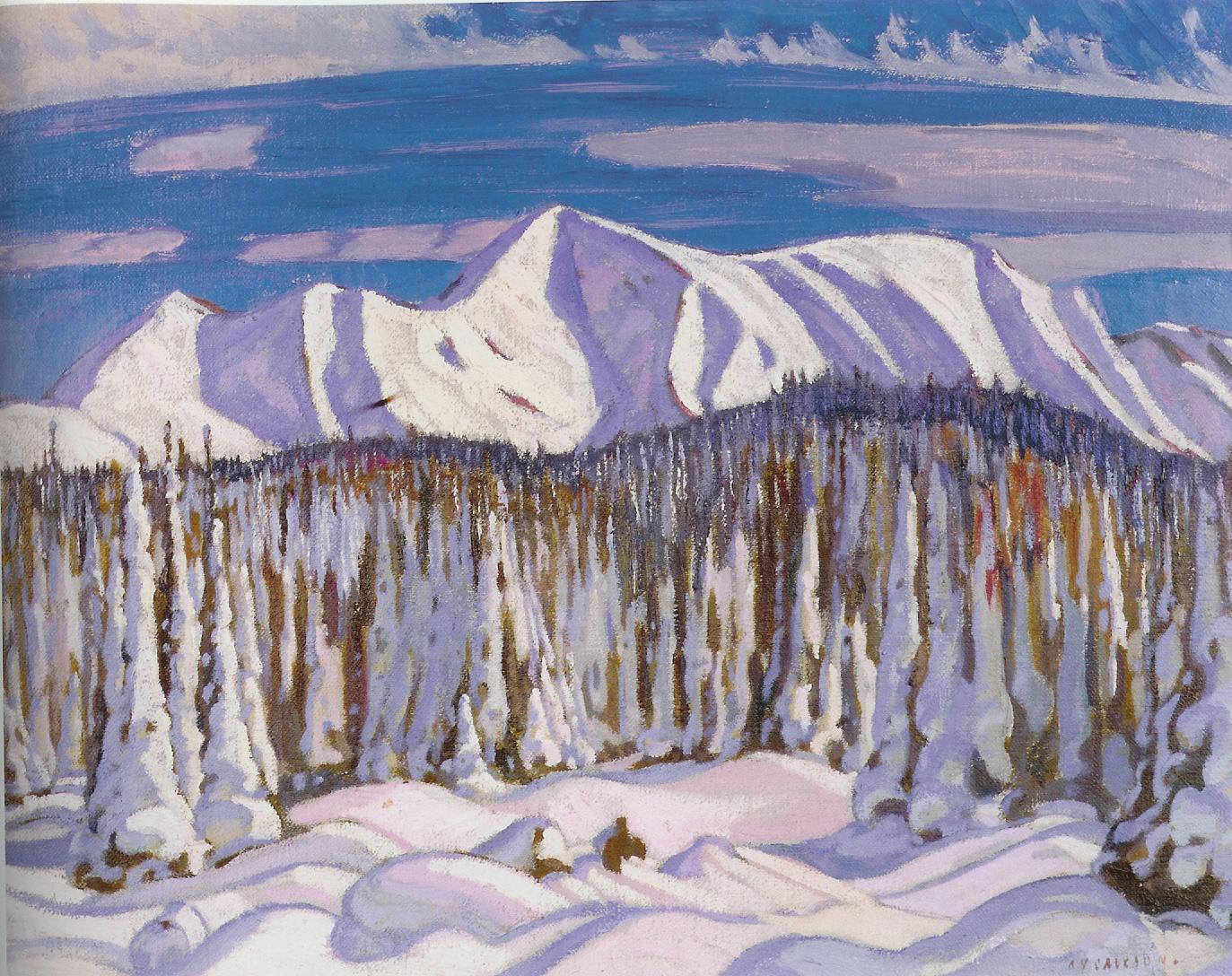 |
| A.Y. Jackson’s In Jasper Park, 1924. A Y Jackson's painting In Jasper Park. Thomson Collection at The Art Gallery of Ontario Photo Courtesy of the Estate of the late Dr. Naomi Jackson Groves Westbridge Fine Art |
In the years
following the First World War, Jackson painted troopships in Halifax
before being officially discharged. He would soon become affiliated
with the Group of Seven, working to promote a distinct Canadian way
of art. Some argue that the war altered his style to shift from early-modernist impressionist styles to more post-impressionist expressions of landscapes. Some of Jackson's work is available for viewing at the Glenbow Museum's Transformations exhibit, which examines the development of Jackson's nationalism and its relation to the Great War.
Thursday, November 7, 2013
Distant Trumpets: Wayne Larsen on AY Jackson and the approach of the Great War (1/2)
.jpg) Wayne
Larsen's A.Y. Jackson: The Life of a Landscape Painter
(Toronto: Dundurn, 2009), is a handsome book which offers a
biography of one of Canada's most renowned artists, illustrated richly by the painter's works. It provides an excellent primer to an ongoing
exhibition
at the Glenbow Museum (Calgary) featuring Jackson's work
alongside the landscapes of Otto Dix, and emphasizing the various
conceptions of nationalism affected by the Great War. Jackson is a quintessentially Canadian painter, but Larsen makes it clear that the future Group of Seven member, was indebted to European impressionists in his pre-war works.
Wayne
Larsen's A.Y. Jackson: The Life of a Landscape Painter
(Toronto: Dundurn, 2009), is a handsome book which offers a
biography of one of Canada's most renowned artists, illustrated richly by the painter's works. It provides an excellent primer to an ongoing
exhibition
at the Glenbow Museum (Calgary) featuring Jackson's work
alongside the landscapes of Otto Dix, and emphasizing the various
conceptions of nationalism affected by the Great War. Jackson is a quintessentially Canadian painter, but Larsen makes it clear that the future Group of Seven member, was indebted to European impressionists in his pre-war works.
Larsen
argues that Jackson's most important role was that of promoter of
Canadian art, and his post-war resolve to continue to support the Group of
Seven's desires to form a dynamic national style. Larsen notes that
it was the core Group of Seven members' discovery of Jackson's The
Edge of the Maple Wood in a 1911
exhibition in Toronto, which connected the artist to these
influential painters. This was the first time that Jackson applied
his Parisian training to Quebec subjects, depicting
a sunny day in the Eastern Townships. (Larsen, p. 5-7)
Jackson
had traveled to France and had studied at the Academie Julian in
September 1907, but
art dealers and collectors were little impressed by Jackson's works
upon his return. As he would later write, it was European art which
was in demand: "Dutch pictures became a symbol of social
position and wealth...The houses bulged with cows, old women peeling
potatoes, and windmills." (Cited in Larsen, p. 33). Another
work which applied impressionist style to Canadian subjects was
Sweetsburg, Quebec
(1910). The depiction of mud in front of a dilapidated barn suggests
that decaying, barren, and muddy landscapes were a part of Jackson's work before the Great War.
 |
| The Edge of the Maple Wood (1910) A.Y. Jackson
Canadian, 1882
- 1974
oil on canvas 54.6 x 65.4 cm Purchased 1937 National Gallery of Canada (no. 4298) Courtesy of the Estate of the late Dr. Naomi Jackson Groves |
 |
| Sweetsburg, Quebec (1910) Courtesy of the Estate of the late Dr. Naomi Jackson Groves 54 x 64.1 cmoil on canvasBequest of Dr. J.M. MacCallum, Toronto, 1944National Gallery of Canada (no. 4730) |
 |
Autumn in PicardyA.Y. Jackson1912
Courtesy of the Estate of the late Dr. Naomi Jackson Groves21.2 x 27 cm oil on wood Gift of members of the Arts & Letters Club, Toronto, 1914 National Gallery of Canada (no. 6529r) |
The pre-war years were a time that Jackson began to gain some notoriety for applying Impressionist techniques to Canadian landscapes, yet he still had his traditionalist academic detractors. It was at this time that Toronto Star critic HF Gadsby coined the term "The Hot Mush School", in reference to these new artists, noting "all their pictures look pretty much alike, the net result being more like a gargle or gob of porridge than a work of art." (Larsen, p. 57-61).
 |
| Tom Thomson Algonquin Lake, 1914. Credit: Franklin Carmichael / Library and Archives Canada / e007914169 |
Larsen suggests that Jackson did not sign up in the Canadian services believing, like many, that the war would end very quickly. (Larsen, p.69) It was the Spring of 1915, when the painter learned of the Canadians being gassed at the Second Battle of Ypres, that he realized the grave nature of the conflict. He wrote, "At the railway station one morning I heard the first news of the Battle of Saint-Julien. I knew then that all the wishful thinking about the war being of short duration was over." (Cited in Larsen, p. 71)
In addition to Larsen's book, the National Gallery of Canada has a large range of Jackson's paintings online, for those wishing to examine his earlier works. Many of his sketches from his time in Paris exist, and a sense of his early European influences are clear. Soon after the shock of Second Ypres, the landscape painter would cross the Atlantic himself, and was wounded on service before finding his role as Canadian war artist and promoter of a national school of art.
For more on Jackson and the Great War, see the following post.
Monday, November 4, 2013
Alexander Young Jackson, the Group of Seven, and the First World War
Many historians have claimed that the First World War was a
transformative period, ushering in a new modern era of bureaucracy and state control. For Canadian historians, the
dominant narrative surrounding the war, has been that of colony to
nation. In art history, this nationalist tone rings true as well, for it was during
the Great War that key nationalist artists who would later become
known as the Group of Seven developed their skills and were broadly
publicized through patriotic efforts linked to the conflict.
Four future Group of Seven artists were officially commissioned by the Canadian War Memorials Fund to depict the war. On the homefront, Arthur Lismer and Frank Johnston depicted Canadian efforts, and overseas, AY Jackson and Frederick Varley captured the battlefields of Europe. Unofficially, a fifth member, JEH MacDonald, lent his hand to the war effort by producing illustrations for honour rolls, posters, and other patriotic impressions.
The Canadian War Memorials Fund was the organization which did the most to support Canadian war art during the First World War. Headed by Lord Beaverbrook, the Fund commissioned artists to create a permanent artistic record of the conflict. It prioritized the documentary aspects of art, giving artists the opportunity to explore the battlefields and sketch what they observed. The Fund supported British artists as well, but historians have argued that its major contribution was the support of artists, and the organization of critics and gallery executives, "which enabled a national school of art to fluorish." (Maria Tippett, Art at the Service of War: Canada, Art, and the Great War (Toronto, 1984), p.6.) From November 1916, the CWMF gave artists full-time officer's rank and wages to memorialize the war.
AY Jackon created one of the
largest bodies of work of any battlefield war artist, and had served
in the 60th Battalion before being committed full time as an artist.
He would write that "Lawren Harris wanted me to apply for a
commission and offered to defray all expenses in connection with it,
but I knew nothing about soldiering and decided to start at the
bottom as a private in the infantry." (Art in the
Service of War, p. 4) During
his time in the line, Jackson put his artistic skills to military
use, by drawing diagrams and details from military maps. (Tippett,
p.12) Jackson was wounded at Maple Copse near Ypres, which
fortunately kept him out of the fighting in Passchendaele. The
artist was no stranger to France, having spent some time studying
there a decade previous to the war.
 |
| Group of Seven, 1920. From left to right: Frederick Varley, A. Y. Jackson, Lawren Harris, Fairley, Frank Johnston, Arthur Lismer, and J. E. H. MacDonald. It was taken at The Arts and Letters Club of Toronto. Photo: Arthur Goss. |
Four future Group of Seven artists were officially commissioned by the Canadian War Memorials Fund to depict the war. On the homefront, Arthur Lismer and Frank Johnston depicted Canadian efforts, and overseas, AY Jackson and Frederick Varley captured the battlefields of Europe. Unofficially, a fifth member, JEH MacDonald, lent his hand to the war effort by producing illustrations for honour rolls, posters, and other patriotic impressions.
The Group of Seven are the
quintessential Canadian visual artists, known for depicting a stark
Canadian wilderness which some argue bears the mark of military experience.
As Colleen Sharpe, (curator of a previous exhibition at Calgary's
Military Museums on the emergent Group of Seven and war), wrote in
2009, "The iconic features of the Group of Seven's art -
disturbed ground, prominent rocks, muddy colours and skeletal tree
trunks - have not been widely acknowledged as originating in the
landscape of the First World War, yet it seems no accident of
chronology that these men painted many of their seminal art works
directly following the war."(Colleen Sharpe, "Artists and
Soldiers", in Art in the Service of War: The Emergent Group
of Seven (2009), p. 3) Maria
Tippett also saw a direct military connection in the formation of the Group's style, writing that "The low-keyed
colours of no man's land and the trenches - muddy brown, yellow
ochre, and cool grey - came to permeate the post-war canvases of
Varley, Jackson, and others who had lived and painted at the front."
(Maria Tippett, Art at the Service of War: Canada, Art, and
the Great War (Toronto, 1984), p. 108)  She also notes that exposure to British modernists
during their time in England, was a wartime connection that
would bring change to Canadian art.
She also notes that exposure to British modernists
during their time in England, was a wartime connection that
would bring change to Canadian art.
She also notes that exposure to British modernists
during their time in England, was a wartime connection that
would bring change to Canadian art.The Canadian War Memorials Fund was the organization which did the most to support Canadian war art during the First World War. Headed by Lord Beaverbrook, the Fund commissioned artists to create a permanent artistic record of the conflict. It prioritized the documentary aspects of art, giving artists the opportunity to explore the battlefields and sketch what they observed. The Fund supported British artists as well, but historians have argued that its major contribution was the support of artists, and the organization of critics and gallery executives, "which enabled a national school of art to fluorish." (Maria Tippett, Art at the Service of War: Canada, Art, and the Great War (Toronto, 1984), p.6.) From November 1916, the CWMF gave artists full-time officer's rank and wages to memorialize the war.
The Great War occurred at a time when
artistic taste was changing. As Jackson himself wrote, the war would
let Canadian art "emerge from all its tribulations. Its worst
foe materialism is being walloped, and will never be quite so
formidable again. And all the academic bunch are dying off,
gradually very gradually ... the future will take care of us."
(Tippett, p. 7) For Jackson, more traditional means of portraying
battle no longer rang true. As he put it, depictions of clashes of
arms, with crisp lines, and vibrant colours had, "gone
underground. There was little to see. The old heroics, the death
and glory stuff, were obsolete." (Tippett, p. 13)
 |
| House of Ypres Painted by Alexander Young Jackson Beaverbrook Collection of War Art CWM 19710261-0189 |
 |
| Private A.Y. Jackson c.1915 60th Battalion, enlisted June 1915 McMichael Canadian Art Collection Archives |
Jackson spent time convalescing in
France before being sent back to England. He was taken on strength
of a reserve battalion and in Shoreham Camp when he heard about the
CWMF and decided to approach Lord Beaverbrook. The environment in
the battalion contributed to this decision. Jackson noted there was
"not enough food and too many military police" with
disgruntled soldiers being "drilled and disciplined by men who had
not been in France". (Tippett, p. 14) Shortly after he left the
battalion a mutiny broke out in the unit.
It was the battlefield itself that inspired; the alien mudscapes, and shattered woods. Maria Tippett wrote that, "Nothing
came to symbolize the war for the artist and the combatant as much as
the land upon which it was fought....Pock-marked with gaping
water-filled craters, strewn with bones, metal, and all the refuse of
modern warfare, the topography of the front line offered few familiar
associations....The machine had superseded God's handiwork; his
landscape was being reshaped by man's instruments." (Tippett, p.
58) Tippett notes that it was this violent new meaning and
manifestation of the landscape that made Romantic-Realist conventions
seemingly out of place. Jackson felt that his style needed to be
adjusted as well: "the impressionist technique I had adopted in
painting was now ineffective, visual impressions were not enough."
(Tippett, p.59)
 |
| A Copse, Evening Painted by Alexander Young Jackson Beaverbrook Collection of War Art |
These landscapes and the new techniques
used to portray them were directly influential in the development of
a national school of art for Canadians after the war. As Tippett
writes, "After the war Jackson and his fellow artists
deliberately sought to paint 'swampy, rocky, wolf-ridden, burnt and
scuttled country with rivers and lakes scattered all through it.' The
Group of Seven's concern to demonstrate...the 'spirit' of painting in
Canada, was thus associated with a sense that this could best be done
by employing methods and techniques they and their colleagues had
either seen used or themselves employed to paint the war-torn
landscape of the Old World." (Tippett, p. 109)
The Glenbow museum of Calgary is currently exhibiting the work of AY Jackson and Otto Dix, drawing comparisons around the idea of nation and the influence of the Great War on their art.
Subscribe to:
Posts (Atom)