Showing posts with label Italian Campaign. Show all posts

Tuesday, March 11, 2014

The Innocent "Iyties": Soldiers' Perceptions of Children in the Italian Campaign

Canadian historical memory of liberated Europe during the Second World War is dominated by themes of celebration, gratitude, and co-operation.  The generously free-flowing Calvados unearthed from Normandy cellars, or the joyous Dutch street celebrations are  the stuff of safe reminiscences of victors and victims.  In the Italian campaign, however, a more uncomfortable narrative challenges these tropes.  Here, racist language towards Italians, and perceptions of Italy as dirty and barbaric are not difficult to find in soldiers' letters.  An exception to the rule, however, is found in Canadian consideration of Italian children, who are seldom included in condemnation, but often held up as innocent exceptions to an otherwise blameworthy, wayward, and unhygienic people.

UBC Press
Of the campaign in Sicily, Jeff Keshen writes in Saints, Sinners, and Soldiers (UBC Press, 2004), his critique of the Canadian "Good War", that many interactions were "cordial, even warm, as the Canadians were often greeted as liberators." (Keshen, p. 245) Others, however, distrusted Sicilians, disdained the "squalid" conditions they lived in, and stole what they wanted from them, occasionally at gunpoint.  Soldiers issued chits for payback which were signed by movie stars or cartoon characters.  While many men reportedly rejected Sicilian women for their dark complexion, this did not prevent seven rapes by the end of July 1943 (Keshen, p. 246).  The poverty of the civilian population is illustrated in the payment of several cigarettes or tinned rations to women for sex.  Children of the age of eight or nine would wander the streets to drum up business for prostitutes.  The booklet that prepared soldiers for Italy stated that in regards to women, "the less you have to do with them the better." (Quoted in Keshen, p. 248)

Racist themes continued to mix with more favourable encounters across the straits of Messina.  Of interactions on the Italian mainland Keshen records, "As in Sicily, there were many reciprocal exchanges between soldiers and civilian.  But some Canadians considered the Italians, or "Iyties" as they called them, in the same light as they saw the Sicilians: chameleon-like in allegiance, crooked, and thus deserving of little consideration." (Keshen, p. 248-49)  Here too, looting occurred, at times escalating to armed robbery, and justified by the perception that Italians were price-gouging the soldiers.

Comments in Canadian censorship reports which pertain to Italians were seldom favorable.  In December of 1943, the censors recorded that only 10% of references to Italians were positive.  Especially in Southern Italy, the general attitude of soldiers was distrust, dislike, and disgust at the squalor that Italians were living in.

A comment from a member of the 3rd Field Regiment of Royal Canadian Artillery may serve to express the ethnocentrism of those familiar with sanitary conditions in Canada towards those in war-torn Italy: “These wops are a dirty filthy bunch, I wouldn't trust them as far as you can smell them and that's a fair distance.” (December 1943, Library and Archives Canada, RG24 Volume 12,323)

There was, however, an exception to these harsh sentiments, found in sympathies expressed towards children.  In December 1943, a British war correspondent wrote an account of sharing shelter in a home in Ortona with a handful of Canadian soldiers.  He reported, "The children clambered around the Canadian soldiers and clutched at them convulsively every time one of our anti-tank guns, located only half a dozen paces from the door of the house, fired down the street in the direction of one of the remaining German machine-gun posts.   Soon each one of us had a squirming, terrified child in his arms." (Quoted in GWL Nichols, The Canadians in Italy (Queen's Printer, 1956), p. 331.

Pte. Alex Livingstone Handing Biscuits to Italian Children .Copyright belongs to the Crown ; Credit: Canada. Department of National Defence / Library and Archives Canada / ecopyLibrary and Archives Canada Item no. (creator) ZK-552
Archival reference no. R112-1459-1-E

(Credit: Members of the Seaforth Highlanders
 sit down for their Christmas dinner.
Photo: Terry F. Rowe / Canada.DND
 / Library and Archives Canada / PA-152839)
Toronto Public Library
The Christmas in Italy of 1943 was one which has gone down in the lore of Canadian military history, largely due to the press reportage of the time.  The official historian G.W.L. Nicholson broke from his battle narrative to describe the occasion.  He accounted, "Long after the lessons of Ortona recede into the pages of military textbooks men who were there will remember how, despite their joyless surroundings, the two Canadian battalions [the Seaforth Highlanders of Canada and the Loyal Edmonton Regiment] observed Christmas day.  Nothing could be less Christmas-like than the acrid smell of cordite overhanging Ortona's rubble barricades, the thunder of collapsing walls and the blinding dust and smoke which darkened the alleys in which Canadians and Germans were locked in grim hand-to-hand struggle." (GWL Nichols, The Canadians in Italy (Queen's Printer, 1956), p. 329)  Of the men who were rotated out of the line for a Christmas feast, the Seaforths' war diarist wrote, "The expression on the faces of the dirty bearded men as they entered the building was a reward that those responsible are never likely to forget.  (Quoted in Nicholson, p. 330)

For most soldiers of the 1st Canadian Infantry Division, letters included more references to children than Christmas parties in and of themselves.  A member of the 2nd Canadian Armoured Regiment wrote of the feasting, 
Most of us had an Italian child with us – they were very happy Darling believe me but they were so glad to get a dinner. They would have framed the plate if they could of. It makes one feel like crying to see them eat. (Dec. 1943, RG24, Vol 12,323)
 

Trooper Ralph Catherall of The Calgary Regiment giving food to an Italian child, Volturara, Italy, 3 October 1943.Credit: Lieut. Jack H. Smith / Canada. Dept. of National Defence / Library and Archives Canada / PA-144105 
Canadian letters generally blamed Italians for the state of their war-ravaged country, but were willing to make exceptions for youth.  The postal censors wrote in February 1944:
The plight of small under-nourished children is often mentioned and children are regarded with sympathy and understanding as the unfortunate victims of conditions for which their parents are wholly responsible. Although certain individual kindnesses are appreciated, the general attitude to the adult population never seems to be free of a feeling of suspicion and distrust.
         Men are very often appalled with the insanitary and dirty conditions existing in the Italian villages and it forms a never-ending theme in letters home. (Feb. 1944, RG24 Volume 12,323)

Praise for children was not universal.  In March 1944, a member of 2nd Canadian Armoured Regiment wrote, “It doesn't matter how good you treat the Wops they will always come right back and stab you in the back. We feed all the kids around here but they still steal everything they can get their hands on.” (March 1944, RG24 Volume 12,323)


It seems that it was involvement with partisans in the battles breaking the Gothic Line and beyond that finally changed the opinions of  soldiers towards Italians.  The censor wrote in November 1944, A number of forward units have recently been in contact with Italian partisans, and, in their case, a marked change in the usual unfavourable attitude towards local inhabitants has been noted. They have nothing but praise for the work done by these guerrillas.”
Troopers W. Balinnan and A. Gallant of a Canadian reconnaissance regiment speaking to partisans Louisa and Italo Cristofori after the capture of Bagnacavallo, Italy, 3 January 1945.  Credit: Capt. Alex M. Stirton / Canada. Dept. of National Defence / Library and Archives Canada / PA-173569


In December 1944, the chief censor's report wrote that relations with Italians in the villages of the North were cordial, and the mail contained frequent reference to the hospitality and cooperation of partisans.  An officer of the Seaforth Highlanders of Canada wrote of a kindness alongside racist references, writing, “Despite what these rough tough Canadians say about these 'gawdamn Wops' they treat them royally and the kids never go without chocolate.”

Attitudes towards Italians were mitigated by the passage of time since their co-belligerency against the Allied cause, and by partisan willingness to risk their lives fighting against the Germans.  The ethnocentric judgement of living conditions found in early letters from the campaign tapered off as Canadians themselves were forced to live in the mud and ruined remnants of Italian homes. 

Children encountered in the campaign were treated with a generosity often not extended to adults.  Young people were interpreted as innocent of Italian transgressions earlier in the war, and reminded soldiers of young friends and family members left behind on the homefront.  They served as ambassadors between two cultures, softening soldiers to a "foreign" people, and providing a way to break down tensions and hostilities between Canadians and Italians.

Tuesday, February 25, 2014

Hyperbole, Sarcasm and Fatalism: Canadian Humour in the Italian Campaign 1943-45

Stephen Leacock wrote in Humour and Humanity that humour approaches indifference or cruelty, but is softened by its link to pathos in its compassion and pity.  This union, he claimed, was what prevented humour from "breaking into guffaws" in callous mockery, or "subsiding into sobs", in commiseration. (Gerald Lynch, Stephen Leacock: Humour and Humanity McGill Queens: 1988.) Both the anger and the sadness of humour is found in the censored letters of Canadian soldiers in the Italian campaign.  Men on campaign wrote home with exaggerated criticism of army policy, and told stories of their fellow soldiers' humour relieving the most pitiable circumstances.  Both the cruelty and the sorrow of war lies sublimated below the rough surface of their sarcastic and often biting humour.

Tim Cook gave a lecture at Trent in 2009 on Soldiers' Humour.
Tim Cook recently published an interesting article on humour in the Canadian Expeditionary Force during the First World War, arguing that humour was a way to release tension and survive the horrific conditions and experiences on the Western Front.  The article, "'I will meet the world with a smile and a Joke': Canadian Soldiers Humour in the Great War" in Canadian Military History, (Spring 2013) argues that while the lasting memory of the First World War, constructed by poets such as Siegfried Sassoon and perpetuated in print and on film ever since, has been that of pointless carnage and suffering, that soldiers' writings provide an important adjunct to this somber tone.  Cook writes that soldiers' humour was by no means uniform, but that themes can be drawn from the wide corpus of personal testimony including: justification of the killing process; masculine teasing; gallows humour which hoped to "trivialize the terrifying"; mockery of the heroic and patriotic rhetoric of the war; masculine teasing; and plain bawdy lewdness and silliness.

In Italy, attempts to relieve the stress of battle are clear in an account of the crossing of the Moro River.   In December 1943, a member of the 3rd Field Company of Royal Canadian Engineers wrote at length of the sappers under his command who made light of his attempts to sooth their concerns at being under fire while bridging the river on the outskirts of Ortona:
We have been having a ding-dong, knock-em-out-drag-em out battle with Jerry the last little while and are still advancing so I guess we are better than he is at this war game. All the advantage is on his side. Hills and rivers forming natural obstacles for him to defend and we to overcome. We had quite a job about a week ago getting over a river but did get over it amid much praise from General Montgomery down. I was explaining to the boys that getting to the job was the worst part and on the job we would be as safe as in a church. A sapper pipes up and wants to know if I have any particular church in mind, quite humorous under the conditions. When we got to the job we came under machine gun fire and again the great fatalist tried to explain that if one had your number on it you got it, if not you would not. A sapper said he wasn't ascaird of the one with a number on it, it was the one addressed 'To whom it may concern' which worried him. Humor comes out in the strangest places. (Library and Archives Canada, RG24 Vol. 10,705)
Poppy on the Moro Approaches.  2009 Gregg Centre Battlefield Tour. Copyright Will Pratt.

Using humour to relieve stress and misery is particularly apt in front-line conditions.  As one soldier from 3rd Field Regiment, Royal Canadian Artillery wrote in April 1944, “There may be lots of mud and rain and the unpleasant thoughts of what we are engaged in but there is always humour. Men are irrepressible – there is always the brighter side for the picture.” (RG24 Volume 12323)

As men found more problems with administrative policies later in the campaign, the humour in censorship excerpts was increasingly of the sarcastic variety.  Men frequently complained about lack of leave back to Canada.  The Zombies (the nickname for National Resources Mobilization Act conscripts who were for the time still allowed to serve in Canada) were continually criticized.  One trooper's comment suggests that suspicions and jealousy lay close below the surface. He sarcastically wrote in August 1944,
How are those Zombies doing back in Canada? They must really have a tough battle over there. Trying to keep away from beer parlours or keeping form having too delightful a time. Or keeping a fighting man's wife company. (RG24 Volume 12,323)
Jealous worry about women on the homefront is a major theme in soldiers letters, and has been identified as prevalent in the Eighth Army in earlier postal censorship by Jonathan Fennel in his work Combat and Morale in the North African Campaign (2010).


Something funny was definitely going on here.  
Troopers of the Governor General's Horse Guards displaying distinctive haircuts before the advance on the Hitler Line, Italy, 26 May 1944. Credit: Lieut. Strathy E.E. Smith / Canada. Dept. of National Defence / Library and Archives Canada / PA-189923
Cook noted that First World War soldiers used humour to raise grievances, and the tradition continued for the next generation of Canadian soldiers.  In Italy, the policy of putting towns out of bounds to Canadians after the Battle of the Hitler Line as an attempt to reduce venereal disease rates was a notable hit on troop morale.  Again in August, as the I Canadian Corps prepared to breach the Gothic Line, signs bearing "Out of Bounds to Canadian Troops", came under sarcastic criticism.  A private wrote home,
Every damn place is out of bounds to the Canadians. It is getting beyond a joke now. Most of the boys are wondering if Canada will be 'Out of bounds.' I guess the only place they can trust them is at the front. (RG24, Vol. 12,323)


Private W. Sutherland (left) of The Westminster Regiment (Motor) 
and Private V.A. Keddy of The Cape Breton Highlanders
 repacking compo rations at a supply depot, Cassino, Italy, 18 April 1944.
Credit: Lieut. Strathy E.E. Smith / Canada. Dept. of National Defence 
/ Library and Archives Canada / PA-151177 
The old saw that the army marches on its stomach seems to be as true for the General ELM Burns' troops as it was for Napoleon's.  Those in the Chief Censor's office got in on the joke by labelling some grousing about the tinned rations of Meat and Vegetables the "Gourmet's Resolve".  A private soldier wrote, I'm still on that balanced diet of M. & V. I'll get even with Argentina someday.” (RG24 Vol 12,323)

The connection with the homefront and longing to return there was observed in many letters as a second winter in Italy began.  By the end of 1944, the lack of home leave was criticized by many soldiers.  A new points scheme had been put in place, but many correctly assumed they wouldn't see Canada until after the war.  One gunner wrote home using a little hyperbole about his expected leave date:

Guess the papers have quite a write-up about the '39 boys coming home for Christmas leaves. At the rate they are going about it, I'll likely be home about 1960. We have sent two men out of about 500. (RG24 Vol. 12,323)
Maple Leaf, 24 January 1945.
While criticism of officers and superiors was not a general feature of Canadian mail, in 1945 the visit of John Bracken, the Progressive Conservative leader of the opposition, came in for griping against politicians who visited the front and later spoke in the press on behalf of soldiers.  As the censorship report for early February wrote, Bracken need not have taken these grouses personally as comments were characterized by a certain impatience with politicians as a class.”  Lamenting the long campaign in Italy, a private wrote,“Bracken is here in Italy – the opposition chief. I wonder if he comes to bring us our Italian naturalization papers.” (February 1945)  Another private's note home bordered on mania.
I won't be qualified to come home for another six months or so as the powers that be have decided that the Cdns are the toughest solider on earth and as a result they can stand five years overseas when Br. Forces only stay three and a half, N.Z.'s three years and American 18 mos. Yeah, we're tough and we love it. Yeah!!! (February, 1945)
The marriage between pathos and cruelty that Leacock identified as the essence of humour certainly existed in Canadian letters from the the Italian front.  Men joked their fear away, and used sarcasm to complain of policies that restricted them.  The strain of humour that Cook identified as mocking the patriotic or heroic discourse of the war is related to the complaints against leave policies that kept soldiers in Italy.  Considering that longing to return home was a major theme of wartime letters, and that unlike trench newspapers, the audience for these writings was friends and family at home, the sublimation of homesickness with a wry joke at the Army's expense comes as no surprise.

Wednesday, February 12, 2014

Mediterranean Musings: 5th Canadian Armoured Division Medical Humour

Amidst the quarterly medical returns and operational message logs in the 5th Canadian Armoured Division's medical services war diary, a comic account of the Italian campaign awaits those studying medical aspects of the Canadian Army during the Second World War.  Captain Brian Murphy's "Mediterranean Musings" is a witty reminiscence of his experiences with the No. 13 Canadian Field Dressing Station which acts as a tonic to the otherwise deathly serious account of daily medical operations.

The bulk of the war diary of 5th Canadian Armoured Division's Assistant Director Medical Services is what one would expect from a medical headquarters in the Italian Campaign.  The documents deal mainly with the operations of the field ambulances under its command, and the evacuation and treatment of casualties.  A number of interesting modifications to jeeps and carriers were made to accommodate stretchers to take the wounded from the battlefield, but in no quarter did battle casualties exceed sickness.  Major drains on manpower included infective hepatitis (jaundice), influenza, and venereal disease.  Captain Murphy's "Musings", however, were no treatise on epidemiology, nor a statistical rending of gonorrhea and syphilis rates in the Division.  Instead, Murphy opted for a humorous review of his campaign with the medicals.

Writing from the North-West Europe campaign, in the summer of 1945, Murphy started with a complaint to his editor which devolved into a description of a local Dutch elixir, which had the ability to raise the spirits of those awaiting repatriation.  The "Musings" begin,
Dear Ed;
You said I was becoming morose; you said let's have something gay for a change; and cut it down to a thousand words; you said gaiety is the spice of life and brevity is its container...Please don't ask me to be gay.  But then gaiety can be acquired artificially, so gather round and allow me to pour you a drink of Moose Milk...an old Dutch remedy for rheumatics contracted whilst awaiting transport to Canada.  Incidently the above-mentioned 'Lait de Moose' consists of gin, milk and eggs in proportions depending on whether you wish to stay in your billet and play 'Button, button, who'se got the button', or desire to sally forth and destroy single-handed a town, say of 20,000 inhabitants.  A list of such towns can be obtained by writing to the Moose Milk Dairies.  Only one town allotted per customer.
After this strange aside on the benefits of the local egg nog, Murphy cuts to the chase, but continues charting his alcoholic course, recalling the that the trip to the Italian theatre, code-named Operation TIMBERWOLF, was far from dry.
In September '43, we boarded the Cap Paradan a ship that was decidedly wet, outside and in.  I have never travelled with so many lawyers, everybody seemed to be called to the bar.  Cases weren't defended.  They were opened.  The juries were vicious, they kept yelling "Let's Kill It."
"Finito Signor???", Bing Coughlin, Herbie!, (Nelson: 1946).
After three weeks at sea, the troop transports arrived in Phillippville and the division then started the tedious train trip to Bizerta, which Murphy suggested was an excellent way to develop battle exhaustion symptoms.  The train travelled at 15 miles per hour, and Murphy noted sarcastically that this was, "fast I admit, but this is the modern age." A fire broke out on one of the train cars which set off small arms ammunition and in the insuing chaos locals began looting the train.  Murphy recalled, "a few natives had decided they were in dire need of blankets and boots, and more small arms ammo went off, only this time it was aimed in the general direction of the said culprits."

Once the 5th Division was in Italy, Murphy recalls several interesting tales about interactions between medical officers and Italian civilians.  When it became known that Canadian doctors diagnosed civilians, the line ups resembled those at London fish and chip stands.  Eggs were the usual payments for treatments, which usually involved assuring patients that they could not expect imminent death.  Murphy wrote, "At this realization, Guiseppe's or Maria's face would light up and with shrugging shoulders and clasped hands they would exclaim 'Grazie, grazie Dottore Canadesi buona' (translation: Gracious thanks, as a physician you are not bad.)" Murphy noted if patients were "very impressed by roadside manner", they might welcome the medical officer into their home for a spaghetti meal.   Returning to a familiar theme, he wrote, 
the spaghetti is not good food to get stiff on.  But with said filaments of flour and water, is served wine, of which the Canucks were very fond. Italy was no place for a chap with alcohic [sic] tendencies, water was just a place to wash clothes in.
"Think I'll Have M'Lunch.  Who's got a cork-screw?"
, Bing Coughlin, Herbie!, (Nelson: 1946).
Murphy's account continues to spin humorous yarns of housecalls to remove worms from Italian children, and intimacies in crowded rooms during air raids.  He even coins a term for a new affliction called "airmenorrhea", in which young Italian women mysteriously stop menstruating for months after spending an hour or two in close confines sheltered from bombers.

After a long campaign in Italy, suffering through two wet winters in the mud and snow, it comes as no suprise that Murphy was pleased to leave the theatre.  In closing his account, he wrote, "Christmas came late last year.  In fact it didn't happen until we sailed away from the land of the mud, mountains, mosquitoes and mines...and that was in February."


Captain Brian Murphy's account is found in the June 1945 War Diary of 5th Canadian Armoured Division's ADMS HQ, Library and Archives Canada, Record Group 24, Vol. 15,664.

Tuesday, October 8, 2013

"To suffer death by being shot": Canada's sole military execution of the Second World War

Up to a few years before Confederation, there were vast array of crimes that colonial governments in British North America saw fit to hang people for.  Some 200 activities could get one executed including sodomy, stealing turnips, or wearing a disguise in the woods.  By 1865, only murderers, traitors, and rapists were considered loathsome enough to hang.  Soldiers, however, were subject to military law, and those who were found guilty by courts martial of desertion, cowardice, or murder could be sentenced to death.  Clearly, when it comes to punishment for one's transgressions, soldiering has its disadvantages.  The distinction between military law and civil law is critically assessed by Chris Madsen in Another Kind of Justice:
With little pretence to lofty ideals, military law serves strictly utilitarian and practical purposes in the maintenance of discipline within armed forces. Its endearing qualities are few. The application of military law is sometimes arbitrary and is heavily influenced by situation; it places the interests of service and group before the individual, and tends toward severe punishments. (Madsen, p. 3)
In the First World War, twenty-five (or twenty-six depending who is counting) soldiers were executed, largely on charges of desertion.  These soldiers' fate, and the administration of courts martial was largely trusted to British officers.  By the end of the conflict, the lack of a supreme Canadian authority to oversee courts martial decisions was trumpeted as unjust by advocacy groups who wished to abolish the death penalty.  While the end of death penalty for murder in Canada would have to wait until 1976, by the Second World War authority to execute a soldier had been transferred to Canadian hands.

The Canadian Army sentenced three soldiers to death during the Second World War, but only one unfortunate soul, Harold Pringle, was actually executed.  Harold Joseph Pringle was born on January 16th, 1920, at Port Colborne, Ontario, and had enlisted in early 1940.  By late 1940 he was overseas and was beginning to tally up what would become a large number of convictions for absence without leave.  In February 1944, he was dispatched to the Italian theatre, corroborating the (somewhat exaggerated) complaints of officers there that the theatre was being used as a dumping ground for undesirable personnel.  After serving with the Hastings and Prince Edward Regiment in the Liri Valley, Pringle again went away without leave and in June of 1944 joined a gang of black marketeers in Rome.  Association with these outlaws would be his ultimate undoing.

ENTRY OF ALLIED TROOPS
 INTO ROME, 5 JUNE 1944
© IWM (TR 1844) Capt. Tanner.
It was in Rome on the 1st of November, 1944, that a fight erupted between Pringle and other members of the gang, which resulted in the shooting of Private "Lucky" McGillivary, a fellow criminal.  The gang took Lucky outside of the city, where they riddled the body with bullets and left it for dead.  On the 12th of December 1944, Pringle was taken into custody by the military police and charged with murder.  While his defence attempted to argue that McGillivary had died of his previous wounds when Pringle later shot him, and that there was insufficient evidence to convict him, the officers at the court martial were not convinced, and Pringle was sentenced "to suffer death by being shot." (Army Headquarters Report No 91, p.97)

The report of the Chief of Staff at Canadian Military Headquarters (London) to National Defence Headquarters (Ottawa) of May 1945 regarding the review of the Pringle case shows the legal grey areas in a case of murder or other civil offenses, especially, at the end of the war:
The fact that the accused and the victim were both members of the Canadian Army, and that the trial was by a Canadian Court Martial, is not, in my view, the controlling feature of this case.  In essence, this is a case which arises out of the shooting of one Canadian citizen by another Canadian citizen.  Considering the matter in this way, I have come to the opinion that the fact that the war is now over and won should not influence me to treat the matter otherwise than simply as a case of murder. (Chief of Staff, CMHQ to NDHQ, 12 May 1945, DVA (WSR) file C-5292 as cited in Army Headquarters Report No 91, p.98)
Three other cases of Canadian personnel sentenced to execution by British civil courts show that the murder of civilians was treated as a civil offence.  (See Jonathan Vance, Maple Leaf Empire, p.178)
A Telegram confirming Pringle's sentence.  RG24 Vol 12718. Library and Archives Canada

British courts martial had meanwhile tried two others in the Pringle case, and in the Spring of 1945 Sapper CHF Honess and Fireman WR Croft were executed. It took until 5 July 1945 for the Pringle sentence to be conveyed by order in council.  A post-war Army Headquarters Report recorded, in its dry prose, "The finding and sentence were promulgated at Avellino, Italy, at six o'clock on the morning of 5 July, at which time Pringle was informed of the disallowance of his petition by the Governor General in Council.  Exactly two hours later the sentence was carried out by a firing squad." (Army Headquarters Report No 91, p.99)

Sympathy for Pringle greatly varies among historians.  Andrew Clark wrote a biography which writes of Pringle in a sympathetic light portraying him as a victim of the war and the military system.  (Review by Lukits) He would likely agree with Chris Madsen, who noted that those executed in the previous war were not "bad apples", but ordinary men pressed into extraordinary circumstances who simply could not bear the strain.  (Madsen, p.46)  Jack Granatstein, however,  was not convinced that we should pity the deserter, criticizing Clark's "overly sympathetic treatment of Pringle, which all but demeans the suffering and sacrifice of those who stuck it out and fought."

Granatstein's comment brings to light a philosophical question about honoring soldiers and commemoration.  Pringle is buried in Caserta cemetery with the honours accorded all Canadian soldiers by the Commonwealth War Graves Commision.  On first glance, this seems to be a place of respect which was not earned by this deserter and murderer.  When we think of the Commonwealth War Graves cemeteries, with their symmetric rows of identical tombstones, we consider their eternal residents' memory in relation to their sacrifices as soldiers.  A murderer who was put to death by the military seems rather out of place in this context.  Certainly many other soldiers buried in the cemeteries would have had military rap sheets, and civilian cemeteries bury the good with the bad, but the very fact that Pringle was killed by the military he served for seems problematic in light of the meaning of military cemeteries. 
Caserta Cemetery CWGC

Thursday, May 24, 2012

24 May 1944 Lord Strathcona's Horse CONNOLLY tank casualties

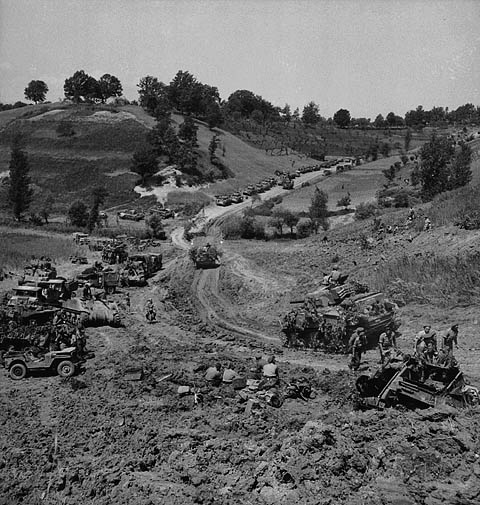
The horrible burning deaths suffered by tank crews in the Second World War, are uncomfortable to comprehend.  The breaking of the HITLER LINE in the Second World War is usually treated as a triumph, but as per usual on the battlefield, tragedy was a part of victory.


Forces canadiennes avançant de la ligne Gustav vers la ligne Hitler.
Credit: Strathy Smith / Canada. Ministère de la défense nationale / Bibliothèque et Archives Canada / PA-140208

The Lord Strathcona's Horse war diary lists the soldiers killed in the confrontation on 24 May 1944. John Milroy recorded the casualties in his CMH article: "The battle cost the Strathcona's 17 tanks for the destruction of five German tanks, eight selfpropelled guns and various other equipment. Two officers and 18 other ranks were killed; seven officers, including the second-in-command and the "A" and "C" Squadron commanders, and nine other ranks, were wounded."

The Strathcona's had advanced by using ground considered not-tank-country, and surprised German Panther tanks and guns on the far side of the Melfa River which were covering a more passable ford.  The action was an anomaly of armoured combat in the Italian campaign as a tank duel erupted between the panthers across the river and 'A' and 'C' squadrons of the Straths.  The confrontation would be a rough initiation to the grim side of warfare for many of the Canadian soldiers.  Some would not live through it.

Four crew would perish in the tank CONNOLLY, reported "hit by 88" on 24 May, and burned with its crew inside.  The men were commanded by Capt R.G. Crimes whose next of kin was listed as his father who lived in Halifax, but may have been from St. Thomas, Ontario.  Captain Crimes commanded a western crew whose driver had the remarkably low army identification number of, H-46. Thirty-year old Trooper Albert P. "Bud" Lee's wife, Mrs. Rita Pearl Lee, lived in Portage la Prairie, Manitoba.  The bow gunner A.A. "Smitty" Smith was said to "chum" with "Bud" Lee.  His father resided in Saskatoon.   Trooper George.T.Davis  "Davey" was the gunner operator.  His father lived in Vermillion, Alberta.

The men were first interned in a cemetery on the Melfa, but were transferred to the Cassino War Cemetery.  They were four men out of the millions who perished in the Second World War.  The Commonwealth War Graves lists 27 men with the name of A.A. Smith alone.  Despite the immensity of the conflict, the individuals who lived and died are important.  A glimpse into their lives gives a human meaning to the casualty figures.
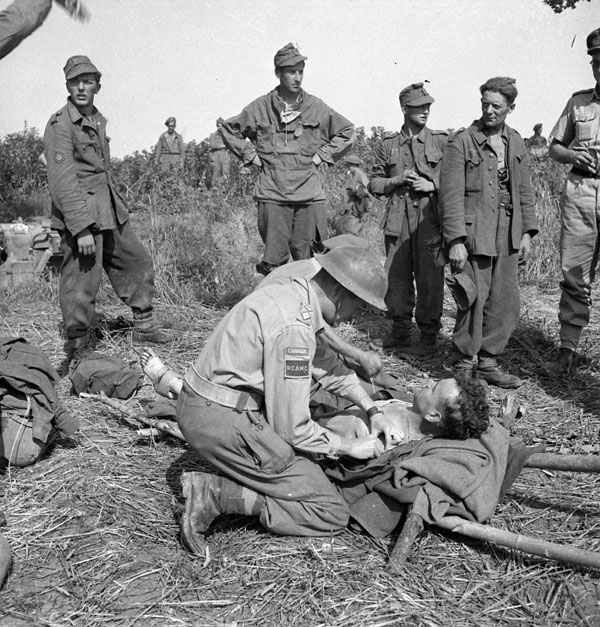
Captain J.A. Gardner talking with a wounded German soldier in the Liri River valley, Italy, 24 May 1944.  Credit: Lieut. Strathy E.E. Smith / Canada. Dept. of National Defence / Library and Archives Canada / PA-144981

Friday, January 6, 2012

Sympathizing with Enemy "Hares": Chris Vokes at Agira, 1943

Chris Vokes DND. LAC #
ZK-845
Chris Vokes' memoirs entitled simply "My Story", are an anecdotal history of one of the most colourful Canadian generals of the Second World War.  Vokes was the forthright and blustery type, with little time for polished buttons and pressed uniforms and a love of booze, brothels, and vulgarity.  The combination makes for an entertaining read.

Vokes' military career has yet to be the subject of a full length academic study.  While he is known as possessing a certain rough charm, his memoirs reveal a more sensitive self-image.  In addresses to the men in the ranks, Vokes would write of killing "Jerries" in a matter of fact manner, yet he did possess a more humane side. An incident in Sicily, as Vokes' 2nd Canadian Infantry Brigade pushed towards the town of Agira, shows that his sympathy for the plight of the enemy could emerge.  As Vokes writes:


"Two of our tanks on the hill were firing at a stalled enemy tank on flat ground about 500 yards ahead.  Two machine guns of the Saskatoon Light Infantry from the Brigade Support Company were also ready to open fire.
     On the hill were a number of war correspondents and other swanners crowding around to watch us as though looking on at Aldershot tattoo.
        Of course the enemy tank was soon hit.  Two Krauts suddenly bailed out and ran like hares for the cover of a small knoll, pursued by the fire of the machine guns.
        They made it ---to loud cheers from me and the rest of the spectators.  Cheering them seemed the sporting thing to do at the time.  Why I don't know to this day.  Inexplicable.  They were the enemy." (Vokes, 115-116)

Friday, December 16, 2011

Affectionate Vehicle Names: Crerar vs. Vokes, 1944.

Crerar goes to France
Department of National Defence /
Library and Archives Canada.
Many of us name our vehicles.  They do seem to be animate enough to deserve a nickname, be it "Ol Betsy", "Rusty", or "The Green Bandit."  Soldiers, too, wished to name their vehicles and for the Canadians in Italy, their right to do so became a contentious issue as the I Canadian Corps was being formed.  General Harry Crerar, known for spit and polish discipline, arrived in the Italian theatre convinced that the 1st Canadian Division needed to shape up, and the painting of non-standard letters on vehicles was one aspect which needed to go.

General Chris Vokes, took a different attitude towards the naming of vehicles.  As Vokes put it, "in war a soldier craves affection.  He also craves something on which to lavish his affection: Jeeps, trucks, dogs, women, any damn thing he can get his hands on, even ducks and geese." (Vokes, My Story, 153)  He noted that for the truck driver, this need to show his affection to his vehicle was an extension from the days of the cavalry, when a soldier loved his horse.  Vokes explained in his direct manner, "he'll paint his girl's name on the engine hood, or his wife's, or some old whore's name, it couldn't really mater.  The vehicle is henceforth called by that name, and given tender loving care - proper maintenance."

Crerar finally yielded on the naming of vehicles, but insisted that names would have to be in letters no more than one inch high, inside the cab, on the dash.  Reportedly, in a weeks time, acts of defiance were all too visible.  Names were scrawled loud and proud, "once more sprouting from engine hoods, in the largest possible letters."

The naming of tanks had long been practiced in the Canadian Armoured Corps.  Tanks usually started with the squadron letter.  Tanks of "A" squadron would all begin with the letter A.  An entry in the 5 Canadian Armoured Brigade diary, noted that in the multi-ethnic Eighth Army, one tank's name would have to be altered for reasons of religious sensitivity.  The intelligence officer wrote, "A tk which was named ALLAH has had the name changed to ATILLA.  Indian tps may have been offended at the original name."

Lance-Corporal M. R. Leonard examining the "Little Henry" painting on a Sherman tank of the Three Rivers Regiment near Lucera, Italy, 21 October 1943.Credit: Lieut. Frederick G. Whitcombe / Canada. Dept. of National Defence / Library and Archives Canada / PA-201363

Saturday, December 10, 2011

Classic 48th Highlanders San Leonardo Picture, 10 December 1943

This 10 December 1943 photo of Canadian troops in San Leonardo, Italy, is an iconic Second World War photo.  The picture has been widely reproduced, in part because it demonstrates the extent of the demolished Italian city-scape that is associated with the soon to be hard fought Battle of Ortona.  It is also helpful in portraying the basic tools of the infantry section.  The picture captures a fire team poised for action, with the Bren gunner ready to shoot from cover.  The soldier with the binoculars is Lieutenant Macdonald who is said to have ordered an attack from San Leonardo after the picture was taken.  San Leonardo was a hard won objective which became the main line of advance for the 1st Canadian Division.  Beyond San Leonardo was the infamous "gully", which was a brutal killing ground for the Canadians.  The town of Ortona itself was only gained by close quarters fighting conducted street by street, and building by building, with severe casualties taken by both the 1st German Parachute Division, and the Canadians.  Several Lee-Enfield rifles are shown, and the soldier standing holds a Thompson sub-machine gun, issued to Canadian troops in the Mediterranean theatre.  In all likelihood, the photo is posed, but that does not diminish its historical interest.
Platoon Commander Lieutenant I. Macdonald (with binoculars) ready to give order to attack at S. Leonardo di Ortona, Italy, 10 December 1943. Left to right, Sergeant J.T. Cooney, Privates A.R. Downie, O.E. Bernier, G.R. Young (kneeling, with Lee-Enfield rifle), Corporal T. Fereday and Private S.L. Hart (lying down with Bren gun) all of the 48th Highlanders.  http://wwii.ca/content-49/world-war-ii/towards-ortona-the-moro/

Further investigation yields a family tragedy.  The man crouched on the far right, directly above the Bren-gunner, is Lance Corporal Terry Fereday.  A survey of the Commonwealth War Graves Commission register shows that Fereday would be killed in action eight days later on the 18th of December.  Fereday is buried in the Moro River cemetery.
Globe and Mail, 24 December 1943, p5.
 The tragedy of Fereday's death is heightened by the death of his brother, Eric J. Fereday, killed in an accident in Prince Rupert the day after Terry. The Fereday family in Scarborough would have a grief-stricken Christmas in 1943.  The fate of Barney, the third son of the Fereday family, and also an airman in the RCAF, is unknown.
Globe and Mail, 31 December 1943. p.2.