Showing posts with label 1st Canadian Division. Show all posts

Friday, December 16, 2011

Affectionate Vehicle Names: Crerar vs. Vokes, 1944.

Crerar goes to France
Department of National Defence /
Library and Archives Canada.
Many of us name our vehicles.  They do seem to be animate enough to deserve a nickname, be it "Ol Betsy", "Rusty", or "The Green Bandit."  Soldiers, too, wished to name their vehicles and for the Canadians in Italy, their right to do so became a contentious issue as the I Canadian Corps was being formed.  General Harry Crerar, known for spit and polish discipline, arrived in the Italian theatre convinced that the 1st Canadian Division needed to shape up, and the painting of non-standard letters on vehicles was one aspect which needed to go.

General Chris Vokes, took a different attitude towards the naming of vehicles.  As Vokes put it, "in war a soldier craves affection.  He also craves something on which to lavish his affection: Jeeps, trucks, dogs, women, any damn thing he can get his hands on, even ducks and geese." (Vokes, My Story, 153)  He noted that for the truck driver, this need to show his affection to his vehicle was an extension from the days of the cavalry, when a soldier loved his horse.  Vokes explained in his direct manner, "he'll paint his girl's name on the engine hood, or his wife's, or some old whore's name, it couldn't really mater.  The vehicle is henceforth called by that name, and given tender loving care - proper maintenance."

Crerar finally yielded on the naming of vehicles, but insisted that names would have to be in letters no more than one inch high, inside the cab, on the dash.  Reportedly, in a weeks time, acts of defiance were all too visible.  Names were scrawled loud and proud, "once more sprouting from engine hoods, in the largest possible letters."

The naming of tanks had long been practiced in the Canadian Armoured Corps.  Tanks usually started with the squadron letter.  Tanks of "A" squadron would all begin with the letter A.  An entry in the 5 Canadian Armoured Brigade diary, noted that in the multi-ethnic Eighth Army, one tank's name would have to be altered for reasons of religious sensitivity.  The intelligence officer wrote, "A tk which was named ALLAH has had the name changed to ATILLA.  Indian tps may have been offended at the original name."

Lance-Corporal M. R. Leonard examining the "Little Henry" painting on a Sherman tank of the Three Rivers Regiment near Lucera, Italy, 21 October 1943.Credit: Lieut. Frederick G. Whitcombe / Canada. Dept. of National Defence / Library and Archives Canada / PA-201363

Thursday, October 27, 2011

Bedwetting as a Ticket Home: Canadian Psychiatrists in Britain, 1940

Psychiatry was a relatively new field when Canada went to war in 1939.  The establishment in 1940 of the No. 1 Neurological Hospital (or No. 1 Nuts as the group was known), in Basingstroke, England, to deal with neuropsychiatric cases was thus a milestone in Canadian Military History.  Here the staff assessed a number of men who had become stress casualties, during the Blitz.  Terry Copp and Bill McAndrew noted in their work Battle Exhaustion, that a number of men riding motorcycles on the wrong side of the road during the blackouts caused not only accidents but post-traumatic anxieties as well.   Some of these unfortunate men were treated to an "electric wire brush treatment", but most were diagnosed, treated to some psychotherapy and sent on their way.
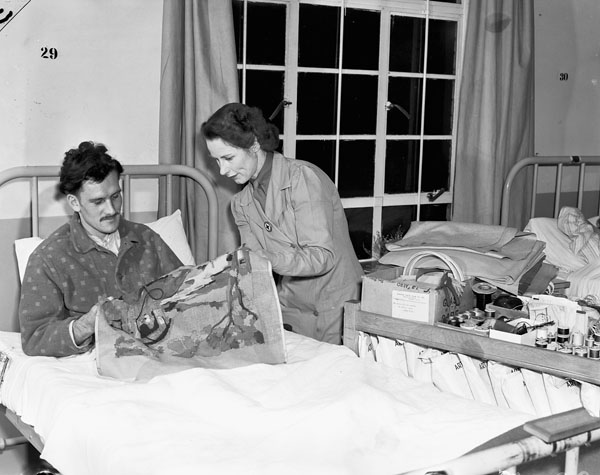
Mrs. M.A. Simpson of the Canadian Red Cross assisting Lance-Corporal L.D. Turner with needlepoint work, No.11 Canadian General Hospital, Royal Canadian Army Medical Corps (R.C.A.M.C.), Taplow, England, 14 December 1944.  Credit: Capt. Jack H. Smith. / Canada. Dept. of National Defence / Library and Archives Canada / PA-128180

With little in the way of psychological screening for the original members of the 1st Canadian Division, a number of soldiers with previous records of neurosis had been enlisted and were visiting the hospital.  H.H. Hyland, who had worked in the Toronto General Hospital in the interwar years, was not convinced anything could be done for these men.  Alcoholics and the occasional psychopath that graced Basinstroke's halls were also deemed incurable.  Hyland was determined that these men should be returned to Canada, but that policy was soon found to be troublesome.  When administrators told one "chronic bedwetter" that he would be returned to Canada, the other patients soon caught wind of the news.  As Copp and McAndrew note, "by next morning word had spread and the ward stank of urine."

A wartime article by Hyland on neuroses cases at No. 1 Neurological Hospital:
http://www.ncbi.nlm.nih.gov/pmc/articles/PMC1827527/pdf/canmedaj01696-0113.pdf

Friday, October 7, 2011

Dumbo takes a Bullet: Odd Duties of a Second World War Staff Officer

Wanted Scrap Metal...To Make Tanks, Guns, Ammunition :  Canada's war effort and production sensitive campaign. Credit: Library and Archives Canada, Acc. No. 1983-30-72
Austerity measures during the Second World War meant tightening belts and conserving materials.  One such sacrifice was made by a local zoo near Aldershot, England, where beginning in the bitter winter of 1939-40 the 1st Canadian Division was stationed overseas.  The zoo phoned the Canadians to inform them that they were unable to feed their elephant, and that the services of a soldier were needed to put the animal down.

John  Buchan, 2nd Baron Tweedsmuir PostalHistoryCorner Blog
John Buchan, later Baron Tweedsmuir, was the unfortunate officer to whom the deed fell to.  Buchan had proven an excellent shot during service in Africa, and was assigned to perform the unfortunate execution.  As Dominick Graham writes in The Price of Command, "permission was granted by CMHQ, but [GSOI] Turner made it a condition that the entry in the war diary show that it was in response to a request.  The sad deed was done.  Later the war diary was found to have the bald entry under the date "Leatherhead, 1531 hours.  The G 3 Intelligence shot an elephant."
Belfast Zoo's elephant managed to survive the war in a friendly zookeeper's backyard. BBC story.