Showing posts with label John A. Macdonald. Show all posts

Friday, April 19, 2013

Burned in Effigy: The Vagaries of Symbolic Arson

Nothing voices disapproval like building a mannequin, parading it about town under abuse, and torching the thing in public.  When it comes to over-the-top antagonistic symbolism, it is hard to beat the power of incineration.  And who doesn't like a roaring bonfire?

Over the years Canadians have taken to the streets in protest for scores of reasons.  Most often, politicians are the source of public ire, and so scarecrows in their likeness have faced the flames.  At other times, the more creative members of unruly mobs have worked artful metaphor into the performance.  A handful of protests over a hundred years of Canadian history prove that economics was often a cause that brought the torch to the tinder.

Revolutionary Lego Men protest British Taxation
without Representation.
Cooperman Brick Foundry

While trade and tariffs may not seem like a topic that could kindle the ritualistic arson, the student of Canadian history will know the subject has raised ire since the colonial era.  One need not be an expert to know that taxes have provoked their fair share of revolt over the years.

An early account of symbolic arson arose in the colony of New Brunswick when the British mercantile system was teetering on the breach.  Timber became a profitable export after Napoleon's European blockade halted the supply of Baltic wood to Britain.  After the War of 1812, the lumber barons of New Brunswick were quick to press authorities for a preferential tariff against non-imperial timber so they could still turn a profit.
 
"View of the Town of St. Andrew's with its magnificent Harbour and Bay", ca. 1840.
 Coloured lithograph by William Day (Day and Son Lithographers) after a sketch by Frederick Wells. Credit: Library and Archives Canada/C-016386.Family Heritage


An 1831 description of pyrotechnics in St. Andrews, New Brunswick, shows the great enthusiasm for news of a British ruling which maintained the tariff.


A boat said to be Baltic built, was filled with a cargo of combustibles and ... towed into the harbour, where she was moored. The Effigy of a distinguished supporter of the Baltic interests was suspended from the mast with a paper in his hand bearing the superscription "Baltic Timber Bill" - several pounds of gunpowder were concealed under his waist coat, and there was a large quantity in the boat. The combustibles were set fire to, and in due seasons, poor ______ was blown to atoms." (Cited in Graeme Wynn, "On the Margins of Empire", Illustrated History of Canada, 2007, p.199)


The protectionism of Sir John A. Macdonald's National Policy proves tarriffs were still a pressing issue after confederation.  In the Conservatives last electoral victory with The Old Chieftain, reciprocity in trade (free trade on many goods) was on the receiving end of a symbolic scorching.  Historian D.J. Hall noted that when John A. Macdonald's Conservatives won the 1891 election, supporters in  Brandon, Manitoba, hit the streets in a victory parade.  The procession included the burning of a bin of "Liberal" rubbish labelled "Unrestricted Reciprocity."   Hall notes that "the Liberals were consoled when, despite the Tories' best efforts, it resolutely refused to ignite." (Hall, The Young Napoleon, p.50)


Glenbow Museum and Archives File number: NA-3561-1
Title: Social Credit rally poster, Fort Macleod, Alberta.
Date: July 2, 1935
During the deprivations of the Great Depression, there is no wonder that ordinary people again vented their frustrations at an economic system that had left them desititute.  When Alberta's Social Credit party under William "Bible Bill" Aberhart won an astounding majority in the provincial election of 1935, the village of Chancellor was witness to a conflagration.  As John Irving notes in his work The Social Credit Movement in Alberta (1959),


To celebrate the victory they piled up packing cases, boards, and poles in the main street and built a huge bonfire.   They made a straw man, to represent the former member and defeated U.F.A. candidate for Bow Valley, Jonathan M. Wheatley.  Around this effigy they wrapped the election posters of all the opposing parties, and heaved it into the flames with a pitchfork.  This act, they explained, was not to be understood as an attack on Mr. Wheatley.  They meant nothing  personal: they were burning the monetary system. (Irving, 332)

Mr. Wheatley's reaction to his stunt double's use in this fiscal allusion is not recorded.  The crowd's sentiments suggest the specious dogma of Social Credit financial ideology had taken a firm grasp of the Albertan psyche.  Wheatley's treatment shows there could be sinister undertones to such pageantry, with the threat of violence directed at the effigy's mold.

Protest of Maine Liquor Laws in Saint John N.B.
featured burning effigies of US authorities.

Economics and symbolic arson is just one theme in the fascinating history of Canadian public ritual.  When the mob takes to the streets one never knows what allegories the more creative participants may procure.  Fire is a powerful symbol in all cultures, and has the added bonus of offering a little light in the days before electrification.  While the burning of figures as economic symbols seems innocent enough, a more malevolent side to these rituals arises with the burning of models of politicians or local people.  No matter how jovial a crowd of revellers may seem, one MUST feel attacked when observing one's own likeness go up in flames!

Tuesday, April 3, 2012

A Noose too Long: An Early Trial of John A's

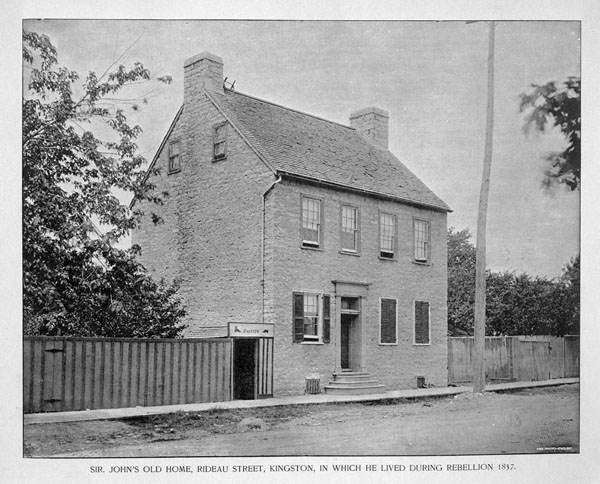
John A.'s Kingston Home, where he lived in 1837
Credit: Miscellaneous / Library and Archives Canada / C-004509
In the late 1830s, John A. Macdonald practised criminal law in Kingston.  Richard Gwyn notes in his recent biography John A : The Man Who Made Us, that the dramatic cases that the future prime minister took gave him exposure far beyond the local courthouse. (Gwyn, 2007, p.49)  The particulars of one early case of the late 1830s, are particularly dramatic, if slightly ghastly.
 
John A Mac, 1842-43 :LAC C-004811
Droit d'auteur: Périmé
William Brass, the respectable  offspring of a  Loyalist, was accused of the heinous crime of the rape of an eight-year-old girl.  Despite Macdonald's arguments that he was the victim of a conspiracy and insane, the verdict came up guilty and Brass was sentenced to be hung from the neck until he was dead.


Gwyn notes that the circumstances of this punishment were particularly macabre:


"At Brass's execution, the rope proved to be too long and the wretched man fell to the ground from the gibbet, landing in his own coffin.  He screamed out, 'You see.  I am innocent; this gallows was not meant for me.'  The sentence was nevertheless carried out, the second time with a rope of the proper length."

Tuesday, December 21, 2010

Sir John A. of Ebrius: No Stomach for the Opposition

Another legend of John A. Macdonald's drunken capers has come to my attention through Christoper Moore's 1867: How the Fathers Made a Deal.  It really is a shame that JAM is remembered for his drunkenness, but here I am contributing to such immaturity.

Andrew Hutchinson.
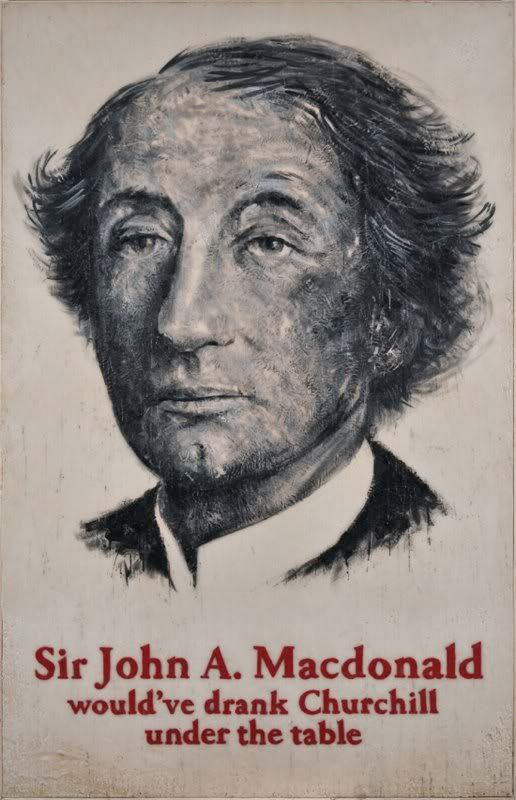
Magpie and WhiskyJack


Moore writes, "Weeks into a progressive drunk, Macdonald once horrified an election crowd by vomiting on the stage when he got up to answer his opponent - and then won them back by saying, 'I don't know how it is, but every time I hear Mr. Jones speak it turns my stomach.'"

Andrew Hutchinson places Macdonald's penchant for the bottle in the context of legendary big-drinkers. In the interesting medium of  encaustic, the colourization of beeswax, Hutchinson has completed a whole series of fun and flippant Canadian historical portraits.  The encaustic paintings are 1 meter wide and nearly 1.5 meters high.  Check out Hutchinson's work at his website.

Sir John the Scrapper

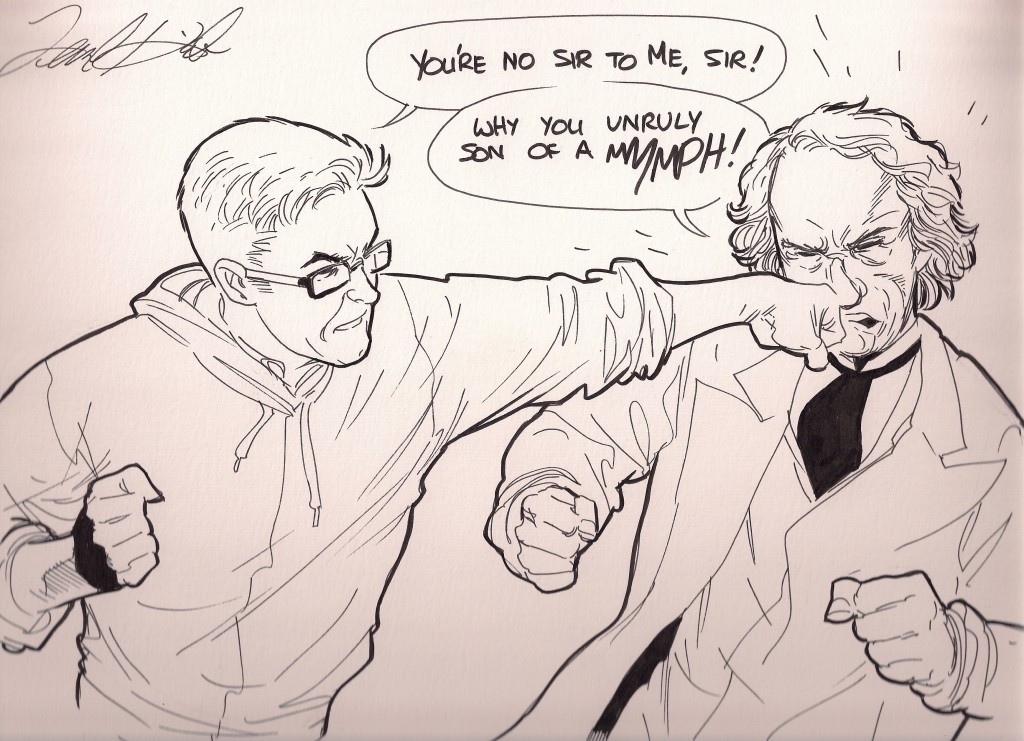
One may not think of John A. Macdonald as the type of man to resort to blows, but there were times when the red Scottish temper would boil over and get the better of him.  In a session of the parliament of the Province of Canada in 1861, Macdonald's future rival and former legal pupil, Oliver Mowat, was the target of a violent outburst from the future Prime Minister Sir John.


Oliver Mowat  H104-09
Macdonald had taken his seat after a speech which argued for a powerful central government.  The breakout of the American Civil War, with the cannons firing at Fort Sumter only a week before lent a credence to his suggestion for the federal government to hold robust overarching powers. In Macdonald's speech he had chastised Mowat for supporting representation by population, but Mowat took offence to being misrepresented.  Donald Creighton describes the ensuing furor in The Young Politician (1956):

"There must have been some provocation in his remarks - some charge that Macdonald had wilfully falsified his views.  Macdonald gasped.  These impertinences were actually coming from the fat boy who had been his inky junior at school and his respectful apprentice at law!  Suddenly, as the plump bespectacled, rather self-important little man finished his statement, Macdonald's brittle temper was shattered into splinters as at a blow.  In a minute - as soon as the Speaker had left the chair - he walked quickly across the gangway.  Blind rage in his heart, he confronted Mowat.

'You damned pup,' he roared, 'I'll slap your chops!' 
Pete DeCourcy gives Sir John a hard left.  Drawn by Leonard Kirk.  ComicBookDaily

Thursday, December 16, 2010

John A. Macdonald and the Dancing Bear

Most Canadians when asked to describe something about their first Prime Minister, Sir John A. Macdonald will report that he was a drunk.  It must be admitted that the man had a particular affinity for the bottle, and legendarily was caught clutching his desk for stability during the crisis of the Fenian raids.  It is reported that when delivering a particularly tricky oration in the parliament of the Province of the Canadas, that a number of his supporters, not knowing of each other's efforts, delivered a glass of gin to the speaker, cleverly disguised as a glass of water.  John A. Macdonald (not yet knighted for his service to Britain as architect of confederation) was inspired by the juniper juice and treated his listeners to a rousing speech.  For all these myths of debauchery, however, it seems slightly sad that a man whose later life was so dedicated to the national dream should be primarily remembered for falling off the waggon.

This being said, a recent read of the first volume of Donald Creighton's classic 1956 biography of the PM, The Young Politician provoked a contribution to the legend of JAM's party life.  Apparently Macdonald befriended a young Scotsman by the name of John Rose, living in Montreal in the early 1840s or late 1850s.  The following is Creighton's amazing description of a badly behaving man in his thirties:

http://jswagblog.wordpress.com/
"They were lighthearted and still fairly irresponsible young men who enjoyed life to the full without taking it very seriously; and once, when Macdonald at least was old enough to know better, they went off on an absurd adventure in the United States, and wandered around as travelling showmen, with Rose capering around as a dancing bear, and Macdonald playing some 'rude instrument' in accompaniment."  (Creighton, 243).