Showing posts with label elections. Show all posts

Friday, September 28, 2012

Canada's Military Voters and the Lusitania sinking, 1915

The Military Voter’s Act of 1917 is one of the most notorious political manoeuvres of the Borden government in the First World War. The act would extend the vote to soldiers families, deny the franchise to certain ethnic groups, and would presumably secure further support for the government.  Prior to this monumental legislation, in 1915, the right to vote by mail was given to military members overseas.  As Desmond Morton noted that the postal ballot, “excluded women and minors in the CEF from the franchise, allowed soldiers to choose any constituency in which they had spent at least thirty days prior to enlistment or, if that failed, any other.” (Morton, p.131)  In 1917, with the Wartime Elections Act and the Military Voters Acts, the vote was given to all active or retired members of the Canadian armed forces, including women, minors, and First Nations.  Men who were not landowners, yet had a son or grandson in the forces were extended the franchise, as were women with relatives who were soldiers.

In 1915, an interesting connection between the postal ballot and the sinking of the Lusitania is noted by Morton. He writes, “On 5 May the British cabled their approval but two days later the soldiers’ vote was, quite literally, sunk. Armed with a militia commission and a large supply of ballots, Harold Daly, a former Vancouver lawyer and now a Hughes aide and all-purpose fixer, had embarked on the Lusitania."
The Globe, 8  May 1915

The Globe, 8 May 1915, p.7.
On 7 May 1915, Daly's voyage ended in the frigid waters of the Irish Sea. Unlike 1,198 of his fellow passengers, Daly survived to cable Minister of Public Works Robert Rogers from London: “I am still quite willing to die for the Conservative Party but am glad I didn’t drown for it.” Morton notes that Daly’s “vestigial rank” could have given the Germans justification for claims that the ship was full of soldiers and munitions, so the mission was kept hush-hush.  The Globe reported that Daly was on the ship, but had sent the ballots via another boat.  The discerning reader may have wondering why this was the case if he "was to look after them".

Daly was the son of a former mayor of Brandon Manitoba, and the Daly House there is now a museum.  Family lore has recorded his last moments upon the ship, as interpreted here by the Lusitania Resource:

On the day of the disaster, Daly was playing solitaire, which another passenger had taught him to play. During the last few moments, he bought a cigar from the bartender who told him to get out. No sooner did Daly exit the door of the lounge, the water washed him overboard. He said the curious thing was that he was among a different set of people than who he had seen on deck when the ship sank, to which he attributed to the ship striking bottom, before she sank.
The sinking of the Lusitania inflamed public opinion against the Germans, and served as a major propaganda coup.  Posters of women and children sinking in the waters were used for enlistment purposes which channelled the revenge instinct over outrage at the torpedoing of a civilian liner.  The attack on the ship has been cited as a cause of the American entry into the war.
Mais Quelle Flotte Formidable a pu Conduire Ici Une Parelle Armée? - Le Lusitania / But! What Tremendous Fleet Could Ever Have Brought Over Such An Army? - The Lusitainia.  Crédit: Library and Archives Canada, Acc. No. 1983-28-3486

Wednesday, March 28, 2012

Laurier's Electoral Brawl for Arthabaska, 1877

Wilfrid Laurier, M.P. (Drummond-Arthabaska, 
Quebec)  Apr. 1874Credit: William James Topley
 / Library and Archives Canada / PA-026430
When appointed to Alexander Mackenzie's cabinet in 1877, Wilfrid Laurier hoped to gain the federal seat from Arthabaska by acclamation.  Laurier had just become a national sensation, when his address to the Young Men's Liberal Association was publicized broadly, serving as a manifesto of reform based liberalism.  Fortunately coincident with the event, was the announcement by the clergy of Quebec that the "Catholic Program", church policy which fought against Catholic Liberalism, was not to discriminate against any specific political party.  With Laurier as the beaming Rouge ray of liberalism in Quebec, the Conservative party would rally its unseemly electoral goons to try to damper the glare.


Bourbeau, 1879. Topley Studio;LAC;PA-028311
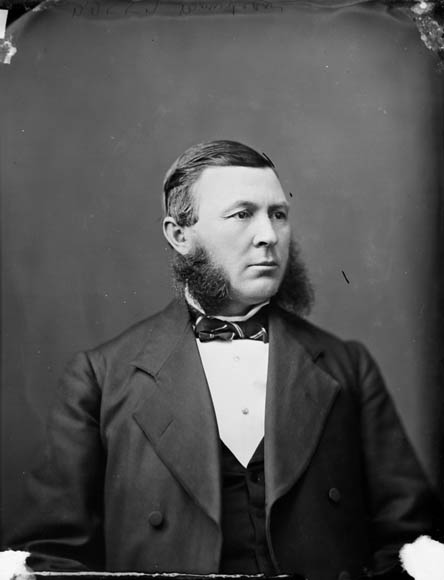
Desire-Olivier Bourbeau emerged as the opposing candidate, whom Joseph Schull in his Laurier: The First Canadian (1967), described  as "tall, bearded, and heavy, principally distinguished for a cane that rattled the wooden sidewalks and a voice that shook the windows of the church when he sang." (p.123)  One contemporary noted that Bourbeau addressed the tariff, "like a blind man speaking of colours [and] talked of hay, oats , and buckwheat and was stopped by his friends at the moment he was going to pass the potatoes."  Bourbeau found himself supported by a host of Conservatives who flooded in from other constituencies.  Laurier would later claim he was defeated due to the fact that 3,800 votes had been placed in a a constituency of 3,200 registered voters. (p. 132)

The election itself exposes the unseemly side of 1870s Canadian democracy.  The priests opinions were still well known and there would be no separation of the Quebec clergy from politics.  Schull writes that, "brawls and broken heads were a feature of every meeting and at one of the loudest of them a Rouge supporter was kicked to death." (p.124)  One supporter was noted as being "seemingly equipped with seven-league boots, certainly with a thunderous voice, and possessed of a portable grandmother who had been born within a mile of every stump he spoke from."  In one municipality a Bleu secretary failed to post the electoral lists for registration, and thus nullified many Rouge voters.  Bribery was used in three large parishes, as Laurier himself described it "railway contractors of the provincial government came there on the night of Friday to Saturday and went on buying votes as in the good old times."
Last of the Open Ballots, 1872.  Canadian Illustrated News. Elections Canada.


Laurier would lose the close battle for Arthabaska, but the new minister needed a seat.  In East Quebec, where he would earn his place in parliament, the authorities were called out to protect the peace.  Schull notes, "Early in the morning a battery of artillery and several squads of police were drawn up in Jacques Cartier Square.  Gangs of election 'whackers' moved restlessly about, but under the mouths of the guns and the eyes of the constabulary not a club was lifted.  Polls opened at nine with the strong-arm men of the parties standing by at the ready and again there were only glares." (Schull, p. 128)