Showing posts with label historical memory. Show all posts

Thursday, October 18, 2012

Che the Failed Guerrilla

"Che" by Flick User JFabra. License
AttributionNoncommercialShare Alike Some rights reserved by JFabra
Che Guevara has become the ultimate symbol of counter-culture resistence and revolution. Ian Beckett in Modern Insurgencies and Counterinsurgencies, (2001), however, has little praise for the actual success of Che as revolutionary.  Beckett's critique is founded on the failure of Che to spread global revolution.  Others have expressed ethical reservations about Che's pop-hero status.  Writing for Slate magazine in 2004 upon the release of the acclaimed biographical film "The Motorcycle Diaries", Paul Berman moves beyond effectiveness in his critique of "The Cult of Che", calling his fame, "an episode in the moral callousness of our time."  To Berman, "Che was a totalitarian.  He achieved nothing but disaster."  Berman suggests that Che was central to the "hardline pro-Soviet faction" in the Cuban revolution, and was neither tolerant nor discriminant when it came to violence.
Che presided over the Cuban Revolution's first firing squads.  He founded Cuba's 'labor camp' system - the system that was eventually employed to incarcerate gays, dissidents, and AIDS victims.  To get himself killed, and to get a lot of other people killed, was central to Che's imagination.
Ernesto Guevara did not have a particularly revolutionary youth, beginning training in 1947 as a medical doctor at the age of nineteen, and spending summers working as a male nurse on merchant ships. Oddly, in 1950, he failed in an attempt to market an insecticide.  In his youth he travelled across South and Central America and observed the poverty there first hand.  Such experiences hardened his belief in Marxist revolution.
The 1954 American involvement in the overthrow of the Guzman government in Guatemala was a formative experience for Guevara. It was then that he received his nickname “Che”, which was Spanish for “buddy”, due to his frequent use of the term in his speech. In 1955, Che joined Castro in his revolutionary efforts, and led a guerrilla column into the Havana. With Castro's success over Batista in 1959, Che would become president of the National Bank of Cuba and minister of industry, working for the Castro government for a number of years.

Bookworld.
One of Beckett’s main arguments is that insurgency is a product of its time and place, and theory developed to counter insurgents is also a product of its historical setting. He sees Guevara’s revolutionary theory, heavily influenced by the French Marxist philosopher Debray, as failing to note that corruption, inefficiency, military ineffectiveness, and unpopularity were the real causes in the end of the Batista regime  (p. 171) Beckett cites a number of attempts at rebellion in the 1960s which failed to replicate the Cuban revolution in countries such as: Argentina, Brazil, Bolivia, Colombia, the Dominican Republic, Ecuador, Guatemala, Paraguay, Peru, and Venezuela.  Che would leave Cuba in 1965, due to friction there with certain leaders.  He hoped to foment global revolution, but attempts at training guerrilla forces in the Congo failed.


Beckett reserves the title of “the greatest failure of all” for that of Guevara’s attempts in Bolivia. (p. 173) In 1966 Guevara arrived there in hopes to organize resistance, but the 1950s had seen land reform and nationalization of the mining industry which denied Guevara the necessary bedrock of discontent. That Bolivia president Rene Barrientos, was of peasant origin did not help Che’s cause. Even the Bolivia communist party leaders objected to Che’s insistence on military control of the revolution, and abstained from support. Difficulties in the rugged terrain resulted in problems of manoeuvre, and as Beckett puts it, Guevara's force, "spent much of its time lost in the jungle.” (p. 174)
Guevara’s ultimate demise was a product of this lack of support, and the operations of a American Special Forces Mobile Training Team, under Major Robert “Pappy Shelton”. The Green Berets trained a ranger battalion for the Bolivian army which was deployed in fall of 1967. By 8 October 1967, Che’s remaining eighteen guerillas were surrounded at La Higuera. The wounded Che was captured and executed, and his body exhibited in Vallegrande.  Declassified American documents relate the final hours of his life.  A Lieutenant Perez was given the order to kill Guevara, but apparently did not have the heart to do so.   Perez asked Guevera what his last wishes were.
Guevara replied that he only wished to 'die with a full stomach'.  Perez then asked him if he was a 'materialist', by having requested only food.  Guevara returned to his previous tranquil manner and answered only 'perhaps'.  Perez then called him a 'poor shit' and left the room.  By this time, Sgt Terran had fortified his courage with several beers and returned to the room where Guevara was being held prisoner. [...]  'Willy', the prisoner taken with Guevara, was being held in a small house a few meters away.  While Terran was waiting outside to get his nerve back, Sgt Huacka entered and shot 'Willy'.  'Willy' was a Cuban and according to the sources had been an instigator of the riots among the miners in Bolivia.  Guevara heard the burst of fire in his room and for the first time appeared to be frightened.  Sgt Terran returned to the room where Guevara was being held.  When he entered, Guevera stood and faced him.  Sgt Terran told Guevara to be seated but he refused to sit down and stated, 'I will remain standing for this.'  The Sgt began to get angry and told  [...] him.  'Know this now, you are killing a man.'  Terran then fired a burst from his M2 Carbine, knocking Guevara back into the wall of the small house.  "Debriefing of Officers of Company B, 2nd Ranger Battalion"(www.gwu.edu)

The order to kill Guevara was made by General Ovando, the Chief of the Bolivian Armed Forces.  Walt Rostow wrote President Johnson of the execution, "I regard this as stupid, but it is understandable from a Bolivian standpoint.On the 13th of October, Rostow wired the president that Che was confirmed as dead.  It was long thought the body was discarded into the jungles via helicopter, but in 1997 Guevara’s remains were found under an airstrip in Vallegrande and re-interned in Cuba.
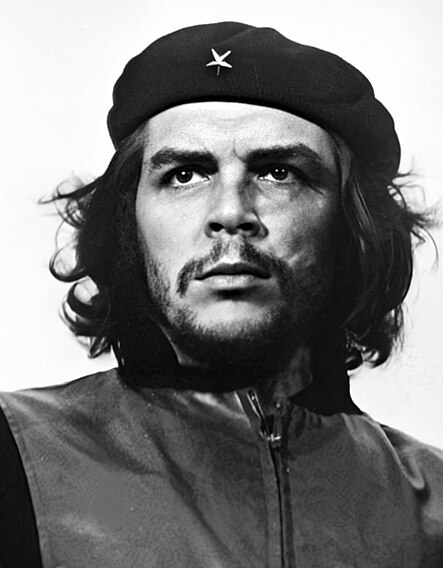
Date     Photo taken on 5 March 1960;
Source     Museo Che Guevara, Havana Cuba
Author     Alberto Korda Copyright

Che's beret-clad and bearded head has been said to be the most repoduced image in the world.  It seems that given his success as revolutionary, that Che as symbol, the Che of the rock t-shirts, and flags adorning teenage bedrooms across the world, is a fairly unlikely figure.  Indeed, one might say that he has inspired many more revolutionaries merely through the religious passion that his idol has evoked, more than any actual savvy regarding guerilla war.  In speaking of the Che's portrayal in "The Motorcycle Diaries", Berman notes "the entire movie, in its concept and tone, exudes a Chistological cult of martyrdom, a cult of adoration for the spiritually superior person who is veering toward death - precisely the kind of adoration that Latin America's Catholic Church promoted for several centuries, with miserable consequences."  The romantic ideal of Che as martyred revolutionary will probably never be excommunicated from the public mind.
"Che Guevara Monument and Mausoleum_Cuba 224" By James Emery.  License
Attribution Some rights reserved by hoyasmeg

Tuesday, March 6, 2012

FO Martin Palmer Northmore, RCAF, Grave Vandalism

Toronto Star, 2 Nov 1943, p.2.
The sad news  of the desecration of a commonwealth war cemetery in Benghazi, Libya, is the latest shocking instalment in the unrest in Africa and the Middle East.  (Globe story, Star Story) One Canadian airman's grave was smashed, and has been identified as that of Flight Officer Martin Palmer Northmore.  Northmore was flying hurricanes with No. 94 Squadron in late 1943.  The Toronto Star reports that his final flight was escorting a convoy "over Italy" when his aircraft went into a spin.  The Star reports a touching poem composed by Northmore's aunt Leila Bishopp Martin when she learned of his death.

Your love so fond — your spirit true and gay,
Soared high to reach the stars beyond the night;
But groping still — along our dusty way —
We search the skies, above a broken flight.”


Northmore's surviving family reported their shock upon learning of the vandalism and the Star has published a few of his letters from the war.  While the tragedy of the desecration of this pilot's last resting place is not to be played down, at least the event can be used to commemorate his war service. The outrage across the nation shows that Canadians care deeply about the memory of their fallen soldiers, sailors and airmen.  By reflecting on his war service and experiences, citizens  show that they will not forget  Flight Officer Northmore and his fellow pilots.
AIRCRAFT OF THE ROYAL AIR FORCE 1939-1945: HAWKER HURRICANE.
Hurricane IICs of No. 94 Squadron, operating out of El Gamil Egypt 1942-43 © IWM (CM 3653)

Wednesday, January 11, 2012

Riel the Statuesque Strange Attractor

Riel 1870. UofManitoba Libraries
What is it that attracts Canadians to Louis Riel? The impetuous wag might quip, Riel's rebellion was a brief but bloody outbreak in Canada's otherwise pallid past.  Jennifer Reid has opted for a more cerebral explanation in Louis Riel and the Creation of Modern Canada : Mythic Discourse and the Postcolonial State (2008).  Reid suggests that for Canadians, Riel functions like the "strange attractors" used in chaos theory which make patterns discernible within complex systems.  The struggle for a Canadian national identity must work across the complex variations in region, language and ethnicity, and Riel may offer a way to understand these nuances.


As Reid writes, "Straddling the dichotomies of the Canadian social body, the man and the myths that have attached themselves to him (as well as to the resistance of 1869-70 and the Rebellion of 1885) might also present themselves to us a 'repeating' elements, signalling a different kind of order to be discerned within a history of disjunction.  From this vantage point, it is Riel as the emblem of 'in-between-ness' who expresses a most basic fact of the Canadian experience: that of cultural hybridity or...metissage." (Reid, 81)


Mackenzie Art Gallery
Riel has served as a bedrock of controversy in his numerous incarnations in Canadian culture, and no less so when his most intimate features are chiselled in stone.  The first of the Riel statue controversies occurred shortly after the 1968 unveiling of John Nugent's sculpture at the Saskatchewan legislature.  As Reid writes, "the virtually naked representation of Riel, right arm raised, genitals clearly visible, and neck angled upward as in prayer was presented to a public that was relatively unanimous in its displeasure for the piece." (Reid, 3)  It took until 1991 to have the statue removed and donated to Regina's Mackenzie Art Gallery.


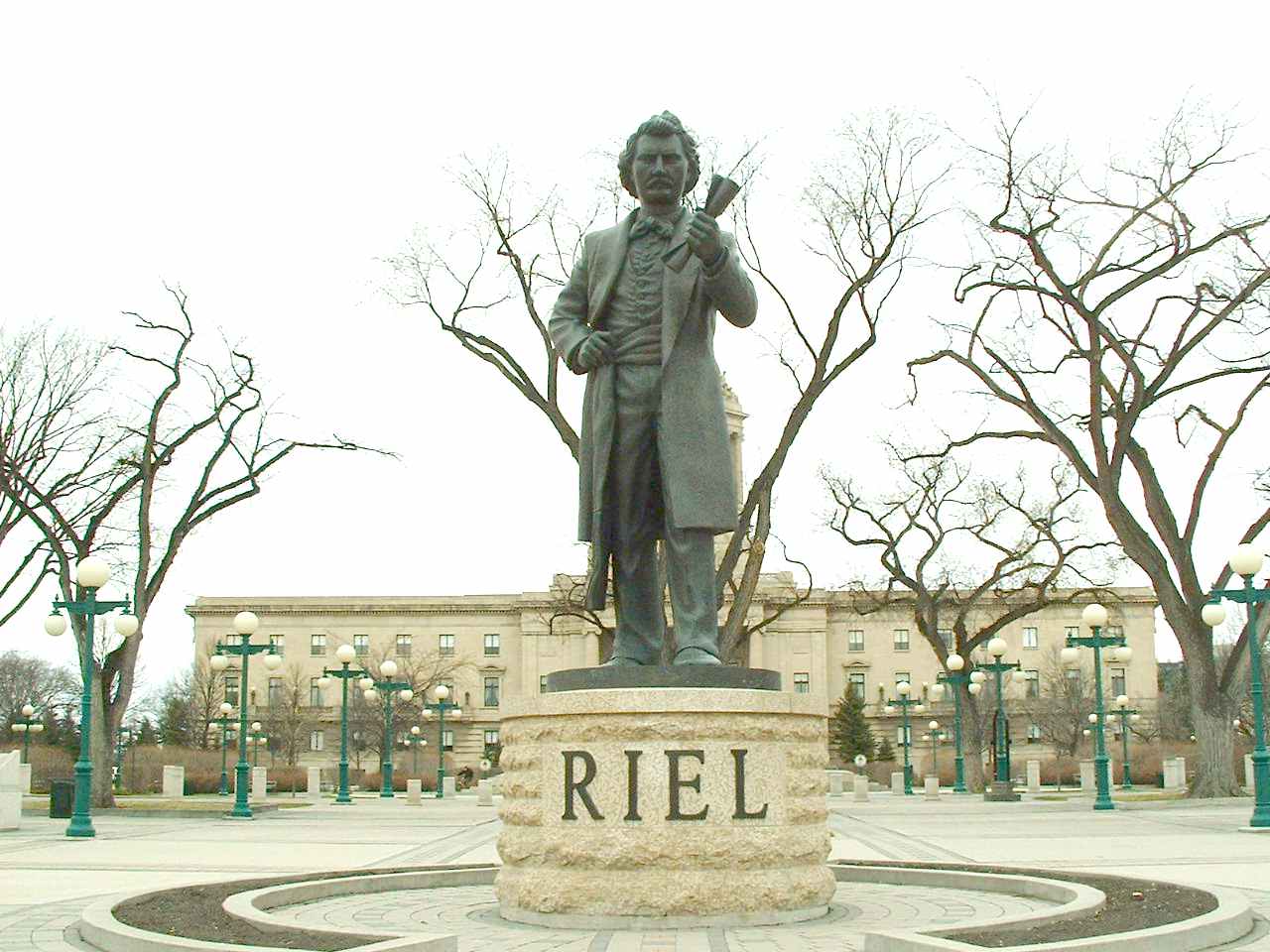
Another statue, created by Marcien Lemay and Etienne Gaboury, and displayed to the public in 1971 at the Manitoba legislature, was also "naked and tormented", and drew the ire of politicians and the Manitoba Metis Federation, whose former president dubbed it an "undignified...incongruous monstrosity." (Reid, 4) In 1994, the statue was removed from the grounds to the College universitaire de Saint-Boniface.


Finally, an acceptable statue created by Miguel Joyal was unveiled at the Manitoba legislature in 1996, which, after a full generation of controversy on the grounds was met with general approval of the public.  Unanimity is impossible to achieve, however, in historical interpretation as well as aesthetic taste.   Reid notes that one pundit claimed Joyal's work was, "just as boring and constipated as the other statues that dot the grounds." (Reid, 4)

Further Reading

Shannon Bower, "Practical Results": The Riel Statue Controversy at the Manitoba Legislature Building", Manitoba History
Sean Kheraj, "Representing and Remembering Louis Riel" Blogpost

Wednesday, June 1, 2011

Military History at the 2011 CHA Annual Meeting

Some have criticized institutions such as the Canadian Historical Review and the Canadian Historical Association as having abandoned military, political, and economic history in favour of culture, gender, and labour topics, but a glance at the 2011 conference program shows a great number of military papers. This year's theme for the Fredericton gathering was, "History, Memory, People and Place", and it will be seen that while many military topics follow "softer" topics such as war memory, there are even some strictly operational topics for those whose narrow definition of the field only include combat.


Humpries. UTP.
As for the CHR, Mark Osborne Humphries won the 2010 prize for his article,“War's Long Shadow: Masculinity, Medicine, and the Gendered Politics of Trauma, 1914–1939”, which looks suspiciously militant! So much for Military History as a fringe genre!


Here are the papers presented on military history (broadly defined):


Roundtable on Alan Tayor’s The Civil War of 1812: American Citizens, British
Subjects, Irish Rebels, and Indian Allies / Table ronde sur le livre The Civil War
of 1812: American Citizens, British Subjects, Irish Rebels, and Indian Allies de
Alan Taylor MMH 203

Cecilia Morgan, OISE, University of Toronto
H. V. Nelles, McMaster University
Julia Roberts, University of Waterloo
With a reply from / Avec commentaires de Alan Taylor, University of California at
Davis
Facilitator / Animateur: Allan Greer, McGill University

The Lessons of War and History: A Tribute to Professor D. S. (Toby) Graham /
Les leçons de la guerre et de l’histoire: Hommage au Professeur D. S. (Toby)
Graham BMH 205

David Zimmerman, University of Victoria
Educating Scientists and Soldiers: The Graham Thesis and the Origins of the
Scientific-Military Revolution
David Ian Hall, King’s College London
Re-discovering the Operational Level of War: British and German Lessons Learned
after the 1940 Battle of France
Roger Sarty, Wilfrid Laurier University
D. M. Schurman and The Education of a Navy: How a Cape Bretoner Cane to Lead
Studies of British Naval Strategic Thought
Chair / Président: David Charters, University of New Brunswick
Facilitator / Animateur: Marc Milner, University of New Brunswick

Susan Cahill, Queen’s University
Afghan War Rugs, Conflict, and Culture-as-Resource

Jon Sufrin, York University
The Canadian Dystopia: Civil Wars, Invasions, and Language Tests

Canada’s Airforce as a Learning Organization / Une organisation du savoir : la
Force aérienne du Canada BMH 205
Richard Goette, Canadian Forces College
Air Power Education at the RCAF Staff College During the 1950s
Rachel Heide, Centre for Operational Research and Analysis
From Individual to Institution: The Professionalization of Institutional Leadership
in the Royal Canadian Air Force, 1916-1946
Bill March, Canadian Forces Aerospace Warfare Centre
Oops, We Did It Again’: Small ‘Wars’ and Their Impact on the Canadian Air
Force
Facilitator / Animateur: Randall Wakelam, Royal Military College

Julia Roberts, University of Waterloo
War Stories, Local History, and the Construction of Memory

24. New Perspectives on the British Navy and the War of 1812 / Nouvelles
perspectives sur la marine britannique et la Guerre de 1812 BMH 205
Martin Hubley, Nova Scotia Department of Justice
‘…in Consequence of the Inhumane treatment I daily saw and felt myself’: Mass
Desertion Mutinies on the North American Station of the Royal Navy, 1775-1812
Keith Mercer, Saint Mary’s University
Celebrating the Shannon-Chesapeake Battle in Halifax during the War of 1812
Thomas Malcomson, George Brown College
From Runaway to Refugee: American Slaves and the British Navy during the War
of 1812
Facilitator / Animatrice: Cheryl Fury, University of New Brunswick

Bonnie White, St. Francis Xavier University
Retrospection, Memorialization, and the Women’s Land Army in First World War
Britain

Karen Priestman, Wilfrid Laurier University
The Myth of the Waldorf Schools in Nazi Germany: Remembering a Past Long
Forgotten

Don Nerbas, McGill University
Engineering Canada: C. D. Howe and the Transformation of Canadian Capitalism,
1935-1947

Valerie Hébert, Lakehead University
The Politics of Memory: The United States, the Cold War, and West Germany’s
Campaign to Free Nazi War Criminals

Julia Torrie, St. Thomas University
Pre-occupation: Remembering World War I among Germans Stationed in France,
1940-1944

Barbara Lorenzkowski, Concordia University
Remembering Father: Wartime Stories from Atlantic Canada, 1939-1945

Ryan Kirkby, University of Waterloo
Unlikely Rebels: Vietnam Veterans Against the War and the Anti-Authoritarian
Tradition, 1967-1971

Melissa Ptacek, University of New Brunswick
The 'bonne guerre de la part des amis du F.L.N.': The Torture Memoir and
Opposition to the French-Algerian War of 1954-62

Recruitment, Rebellion and Historical Memory: Loyalist Responses in the
Carolinas and New Brunswick during the American Revolution / Recrutement,
rébellion et mémoire historique: Réponses royalistes dans les Carolines et au
Nouveau-Brunswick durant la Révolution américaine BMH 205
Carole Watterson Troxler, Elon University, North Carolina
Cornwallis’ Complaints and the Historical Memory of Loyalist Response in the
Southern Backcountry
Todd Braisted, United Empire Loyalist Association of Canada
New elements to understanding the recruitment of Provincial Regiments during the
American Revolution
Gary Campbell, Independent Scholar
Rebellion Suppressed: New Brunswick’s Role in the American Revolution
Facilitator / Animateur: Amani Whitfield, University of Vermont
Sponsored by the Loyalist Research Network / Parrainée par le Réseau de
recherche loyaliste

Series Celebration and Book Launch / Célébration d’une série et lancement de livre
BMH 318 Routunda
Please help us celebrate the New Brunswick Military Heritage Book Series co-published
by the Gregg Centre’s New Brunswick Military Heritage Project and Goose Lane Editions
and please help us launch volume 17: / Veuillez vous joindre à nous pour célébrer la série
d’ouvrages sur le patrimoine militaire du Nouveau-Brunswick et le lancement du volume
no. 17:
Joshua M. Smith, Battle for the Bay: The Naval War of 1812 (NBMHP and Goose Lane,
2011)

Jack Little, Simon Fraser University
From Borderland to Bordered Land: Reaction in the Eastern Townships Press to
the American Civil War and the Threat of Fenian Invasion

Contested Memories of the First World War / Souvenirs contestés de la
Première Guerre mondiale BMH 205
Geoff Keelan, University of Waterloo
Catholic Neutrality: The Great War and the Peace of Henri Bourassa
Jonathan Minnes, Wilfrid Laurier University
Flavelle in the News: A Study of Joseph Flavelle’s Public Image, 1914-1920
Kellen Kurschiniski, McMaster University
Once a Soldier, Always a Man’: The Department of Soldiers’ Civil Reestablishment
and the Image of the Disabled Canadian Great War Veteran,
1918-1928
Brian MacDowall, York University
The Surroundings are Congenial’: Planning a Disabled Soldier Settlement on the
Kamloops Reserve, 1918-1922
Facilitator / Animateur: Scott Matheson, University of New Brunswick

Gene Allen, Ryerson University
Another North Atlantic Triangle: Canadian Press, Associated Press and Reuters,
1917-1950
Mary Vipond, Concordia University
Nazi Eyes on Canada: Wartime Propaganda at the CBC

Jerry Bannister, Dalhousie University
Revolution in the Loyalist Era: The Remaking of British America, 1745-1800

Series Launch / Lancement de la série BMH 318 Rotunda
Please join us for the official launch of the Canadian Historical Association and University
of Toronto Press International Themes and Issues Book Series / Vous êtes cordialement
invité au lancement officiel de la série de courts ouvrages sur des thèmes et enjeux
internationaux de la SHC et des Presses de l'Université de Toronto:
David MacKenzie, A World Beyond Borders: An Introduction to the History of
International Relations (University of Toronto Press, 2010);
Sean Kennedy, The Shock of War: The Civilian Experience, 1937-1945 (University of
Toronto Press, 2011).

Representations of Violence in Canadian Collective Memory / Représentations
de la violence dans la mémoire collective canadienne MMH 202
Matthew McRae, University of Western Ontario
Spectacular Entertainment’: History, Memory and Meaning in Public Discussion
of the CBC’s 1979 Epic Film, Riel
Christopher Schultz, University of Western Ontario
The Self Separated from Violence: Spectacle, Material Appropriation, and Voices of
Resistance on the Western Front, 1914-1918
Jon Weier, University of Western Ontario
Canadaʼs Sacrifice: Collective Memory, the First World War and Canadaʼs
Golgotha
Facilitator / Animateur: Scott See, University of Maine

Distance, Danger and Domestic Life in Twentieth-Century Canada / Distance,
danger et vie domestique au Canada au vingtième siècle BMH 102
Amy Shaw, University of Lethbridge
Fathers and Sons of Empire: Letters home from the South African War
Kristine Alexander, York University
Mother says you are angry at me for not answering your letters’: Canadian
Children’s Responses to Absence and Death during the First World War
Tarah Brookfield, Wilfrid Laurier University
Navigating War, Memory, and Identity: South East Asian Adoptees on Growing up
Canadian
Facilitator / Animatrice: Barbara Lorenzkowski, Concordia University

Jaqueline Cannata, University of Guelph
Military Memories: Recollections of the Fort Erie Fenian Raids, 1864-1906

Elaine Young, University of Guelph
A Spirit of Grateful Memory’: Place, Memory, and the Battle of Lundy’s Lane