Showing posts with label progressives. Show all posts

Monday, June 18, 2012

Theodore Roosevelt's Muckrakers, 1906

Theodore Roosevelt's soft hand towards the business trusts, those great demons of turn-of-the-century America, make questionable the president's commitment to reforming American capitalism.  This being said, Historian Richard Hofstadter, no progressive sympathizer, noted that TR's commitment against corruption, civic indifference, and materialism, qualify him in some respects as a progressive.  He certainly is a closer cut to the archetypal reformer than other presidents of his age.
  • Title: [Theodore Roosevelt photomontage]
  • Creator(s): Underwood & Underwood, photographer
  • Date Created/Published: c1908 Jan. 28.LC-USZ62-131821
Roosevelt was wary of the literature of criticism that was emerging in the first decade of the twentieth-century, hoping that a revolutionary sentiment was not overtaking the nation.  In a speech of 1906, Roosevelt coined the term for the growing clamour of expose journalism, exemplified by Upton Sinclair's The Jungle. (Hofstadter, Richard, ed. The Progressive Movement, 1900-1915. New Jersey: Prentice Hall, 1963, p. 11, 18)

In Bunyan's 'Pilgrim's Progress' you may recall the description of the Man with the Muck-rake, the man who could look no way but downward, with the muck-rake in his hand; who was offered a celestial crown for his muck-rake, but who would neither look up nor regard the crown he was offered, but continued to rake to himself the filth of the floor.
         In 'Pilgrim's Progress' the Man with the Muck-rake is set forth as the example of him whose vision is fixed on carnal instead of on spiritual things.  Yet he also typifies the man who in this life consistently refuses to see aught that is lofty, and fixes his eyes with solemn intents only on that which is vile and debasing. [...] the man who never does anything else, who never thinks or speaks or writes, save of his feats with the muck-rake, speedily become, not a help to society, not an incitement to good, but one of the most potent forces for evil."
(Roosevelt, 14 April 1906)

Friday, May 25, 2012

Wall Street: The Embodiment of Evil in the 1880s

The portrayal of Wall Street as the embodiment of an evil capitalist is as familiar to the reader of 2012, as to an American of the mid-west in the late nineteenth-century.  Russel B. Nye's Midwestern Progressive Politics (1959), notes that it did not take long for the alienated Midwest to strike back against the colonial pressures of "the triple alliance of railroads, banks and tariff-protected industry." (Nye, 12)  Nye noted that

 'Wall Street' became very real to the Midwest as a general term including the entire body of Eastern influence - the moneylender, the high-tariff manufacturer, the market speculator, the railroad king, the trust holder, the mortgage owner.  It might mean Minneapolis, Chicago, Kansas city, St. Louis, or Boston as well as New York, but "Wall Street" was a living entity, a major influence in Midwestern thinking after 1865.


The evil Rockefeller depicted in"What a Funny Little Government" Horace Taylor 1899 Haley Ghiringhelli's Blog

One Granger writer wrote of the Midwestern concept of a meeting of the directors of one of these nefarious corporations.  The sinister meeting agenda would read thus:

"Order of Business:
bankrupt farmers,
form new monopoly,
rig market,
fix prices;

Resolutions Passed:
raise interest rates,
lower farm prices,
instruct business through interlocking directorates to raise prices on all goods sold to farmers,
order newspapers to support regular party candidates,
allot money to 'educate' legislatures,
declare dividend,
adjourn."


Nye notes that Midwestern Americans of the late nineteenth-century expressed, "the feeling that the average Midwesterner had entertained for some time, that something (he was not certain what) was riding him hard.  He called it variously the Money Power, the Rich, Invisible Government, Plutocracy, Wall Street, the Trusts, the Interests, or the Gold Bugs." (Nye, 106)

Tuesday, May 8, 2012

Upton Sinclair's THE JUNGLE: Slaughterhouse Expose, 1906

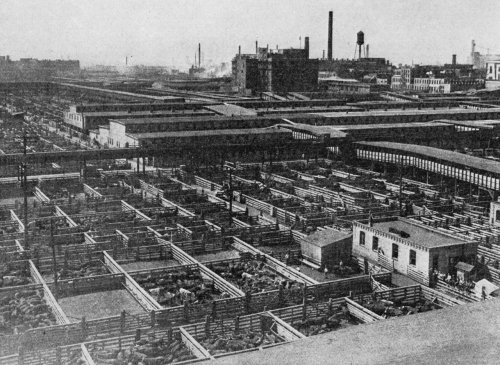
The muckraking journalists of the progressive era set their sights on the worst facets of industrialization and urbanization.  They sought to expose the exploitation of the workers and the working and living conditions of the urban poor.  A classic example, and one that led to reforms in the food industry was Upton Sinclair's The Jungle (1906) which sought to show the world the  conditions in the Chicago slaughterhouses.
Union Stockyards, Chicago 1920 Pax Canadiensis

One particularly revolting facet of the industry was the use of beef which had developed cysts due to the use of cheap fodder.  Upton wrote

"It seemed that they must have agencies all over the country, to hunt out old and crippled and diseased cattle to be canned.  There were cattle which had been fed on "whisky-malt," the refuse of the breweries, and had become what the men called "steerly" - which means covered with boils.  It was a nasty job killing these, for when you plunged your knife into them they would burst and splash foul-smelling stuff into your face; and wean a man's sleeves were blood, and his hands steeped in it, how was he ever to wipe his face, or to clear his eyes so that he could see? It was stuff such as this that made the 'embalmed beef' that had killed several times as many United States soldiers as all the bullets of the Spaniards, only the army army beef, besides, was not fresh canned, it was old stuff that had been lying for years in the cellars."  As quoted in (Hofstadter, Richard, ed. The Progressive Movement, 1900-1915. New Jersey: Prentice Hall, 1963.)