Saturday, April 7, 2012

Depression era Prairies as Great War Battlefields, 1931

The writings of EH Oliver during the Great Depression show that the landscape of the ruined First World War battlefield was a reference point for desolation long after the fighting was over.

Oliver at Benhill-on-sea 1917
Edmund Oliver, was a professor of history and principal of St. Andrew's College, Saskatoon, when he set out overseas during the Great War.  Oliver enlisted in the Canadian Forces, becoming chaplain to the 196th Battalion.   In 1917, he was instrumental in setting up the "University of Vimy Ridge" in France, a school for the soldiers of the Canadian Corps.

David Marshall's Secularizing the Faith (1992) argues that in the long period of secularization of the evangelical Protestant churches in the nineteenth and twentieth centuries, that the Great War was a reactionary period.  The men who experienced the misery of the trenches were not comforted by the message of the importance of moral and social deeds which came to typify the church's liberal theology.  Instead men looked to the earlier evangelical message of personal salvation, and empathized with the notion of the suffering of the innocent.


Marshall shows that EH Oliver's experiences of the Prairie West during the Great Depression were shaped by what he saw in the muddied fields of France and Flanders.  Marshall writes that, "Images of the First World War were recalled by Oliver, for the ruination of that war was the only thing within his experience that he could refer to which was similar to the wind-whipped, sun-scorched, desert-like 'Garden of Saskatchewan'" (Marshall, 234)
Saskatchewan 1930-34
Oliver attempted to portray what he observed of his 1931 tour of the arid Saskatchewan prairie.  He asked his readers to imagine,  "if it was possible,  the choicest wheat fields of our modern plains churned into yawning gravel pits, streaked with long rows of zigzag, gleaming,chalk trenches with an occasional tree trunk standing, twisted and bent and smashed." (McKinnon, The Life of Principal Otter, Toronto, 1938, 35, as quoted in Marshall)
"Dugout on the Somme" Hamilton, Mary Riter, 1873-1954.LAC Acc. No. 1988-180-3


Oliver wrote, "It left me weak and sore afraid, as though I had turned the corner of our street, eager and expectant to catch a glimpse of home and found it wrecked by a bomb or burned to the ground. 'An enemy hath done this,' was the thought that leaped into my mind, as thought the devastating hand of a malignant spirit had waved a wand over the great Prairie to spread desolation and drought and death.  If there were added to the scene a battered house here and there and an occasional trench it would be like the desolation of the western front." (National Emergency Relief Committee Papers, as quoted in Marshall)


Marshall noted that the tensions of the Great Depression caused Oliver to return to the traditional emphasis on the Bible and what God would provide, and question the power of the social gospel.  Like the Great War, the depression made some clergy abandon the liberal theology and embrace a more conservative God-oriented faith.

Thursday, April 5, 2012

Eurocentric Interpretations of Native-American Torture

A. Walker. LAC, Acc. No. R9266-2362
In the seventeenth and eighteenth centuries, grisly tales of torture performed by the so-called "savages" of the New World, were read with delight by a European audience whose arrogance and pride were reinforced by torrid tales of "barbaric" action.


One such account was aghast at the role of women in torture ritual, yet clearly delighted in the details: "You should have seen these furious women, howling, yelling, applying fire to the most sensitive and private parts of the body, pricking them with awls, biting them with savage glee, laying open their flesh with knives; in short doing everything that madness can suggest to a woman.  They threw fire upon them, burning coals, hot sand; and when the sufferers cried out, all the others cried still louder, in order that the groans should not be heard, and that no one might be touched with pity." (Miller, p.60)


Jim Miller's Skyscrapers Hide the Heavens notes that this "ethnocentricaly inspired misunderstanding" discounted that most captives of war were adopted by the families of the victors to replace kin killed in battle, or enslaved for work or barter with the French. (p.60)  Miller writes that when torture was used it was as a part of sun-worship, and was used to break the enemy's will.  The Natives treated women captors much better than the Europeans.  For the white newcomers, Miller claims the spoils of war included "brutal rape and collective violence." (p.61)
"Indians Returning From War" P. Rindisbacher, 1825. LAC Acc. No. 1981-55-72
Europeans were particularly shocked at the cannibalism involved in Native torture ceremonies.  As CJ Jaenen suggests, Christians were particularly short-sighted in not understanding the spiritual side of cannibalism, what with the beliefs in "transubstantiation and literally eating their Lord in their communion service." (Cited in Miller, p.61)  Miller notes the taking of scalps for trophies should have been more comprehensible, given that Europeans "guillotined, hanged, drew, and quartered those guilty of any hundreds of offences, and who put heads on pikes as warning to others." (p.61)

Tuesday, April 3, 2012

A Noose too Long: An Early Trial of John A's

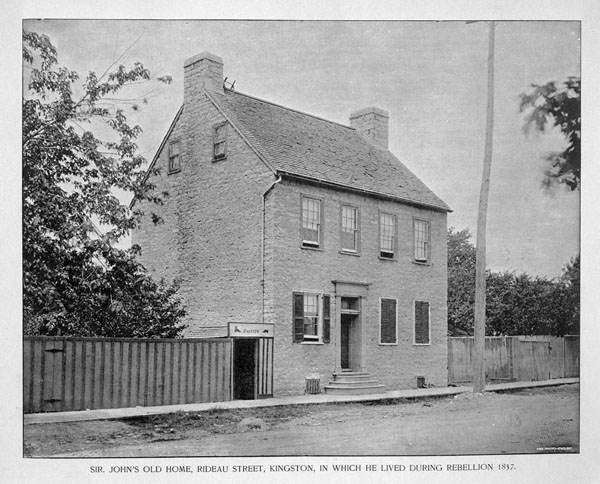
John A.'s Kingston Home, where he lived in 1837
Credit: Miscellaneous / Library and Archives Canada / C-004509
In the late 1830s, John A. Macdonald practised criminal law in Kingston.  Richard Gwyn notes in his recent biography John A : The Man Who Made Us, that the dramatic cases that the future prime minister took gave him exposure far beyond the local courthouse. (Gwyn, 2007, p.49)  The particulars of one early case of the late 1830s, are particularly dramatic, if slightly ghastly.
 
John A Mac, 1842-43 :LAC C-004811
Droit d'auteur: Périmé
William Brass, the respectable  offspring of a  Loyalist, was accused of the heinous crime of the rape of an eight-year-old girl.  Despite Macdonald's arguments that he was the victim of a conspiracy and insane, the verdict came up guilty and Brass was sentenced to be hung from the neck until he was dead.


Gwyn notes that the circumstances of this punishment were particularly macabre:


"At Brass's execution, the rope proved to be too long and the wretched man fell to the ground from the gibbet, landing in his own coffin.  He screamed out, 'You see.  I am innocent; this gallows was not meant for me.'  The sentence was nevertheless carried out, the second time with a rope of the proper length."