Wednesday, May 9, 2012

CP Stacey on the tardy American entry into the First World War

C.P. Stacey is a giant among Canadian military historians, and rightfully so.  Having penned the official histories of the Canadian Army in the Second World War, and innumerable works on the Canadian armed forces, his impressive oeuvre speaks for itself.  One would not expect Stacey to share the common knee-jerk anti-Americanism that is so wrapped up in Canadian identity.  In Canada and the Age of Conflict. Stacey's sober analysis notes that in 1903, the Alaska boundary dispute sowed seeds of distrust for Americans which may have played a role in Canadian rejection of the Liberal's 1911 reciprocity plank.  Stacey notes that the First World War did little to warm Canadian-American relations, and uses a autobiographical anecdote to prove his point:


Toronto Normal School. 1911? 
William Jame Fonds 1244, Item 1702
City of Toronto Archives
"In the school year 1918-19 the writer was in the top form of the Normal Model School in Toronto.  One of our academic exercises was known as 'oral composition'.  A classmate of mine took as his topic 'The United States in the War'.  My recollection is that it was a pretty scarifying presentation, and that it was universally acclaimed.  I remember specifically one point, the story with which the boy ended.  It concerned General Pershing in Paris.


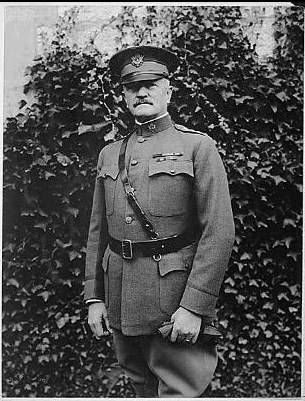
General John J. Pershing. General Headquarters

 Chaumont, France., 10/19/1918. NARA.

The general, it seems, called a taxi, and it did not arrive quite on time.  When it did arrive, Pershing protested to the driver, who was a female: 'My good woman, you're three minutes late.' And the lady replied, 'My good man, you're three years late.' We twelve-year-olds thought that a sparkling piece of repartee; and I am sure that in this we were fairly representative Canadians of that day." (Stacey, 1977, p.234)

Stacey seems little effected in the long run by his peer's anti-American rhetoric.  The scholar earned his PhD in Princeton, and lectured there from 1933-1940.
Tuesday, May 8, 2012

Upton Sinclair's THE JUNGLE: Slaughterhouse Expose, 1906

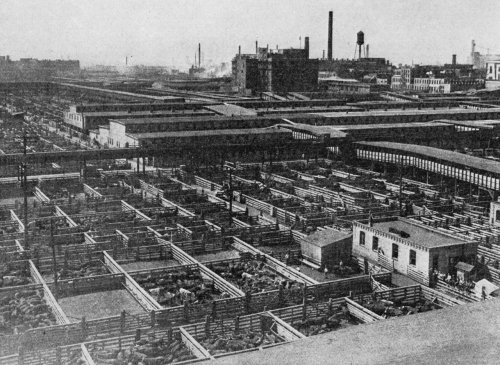
The muckraking journalists of the progressive era set their sights on the worst facets of industrialization and urbanization.  They sought to expose the exploitation of the workers and the working and living conditions of the urban poor.  A classic example, and one that led to reforms in the food industry was Upton Sinclair's The Jungle (1906) which sought to show the world the  conditions in the Chicago slaughterhouses.
Union Stockyards, Chicago 1920 Pax Canadiensis

One particularly revolting facet of the industry was the use of beef which had developed cysts due to the use of cheap fodder.  Upton wrote

"It seemed that they must have agencies all over the country, to hunt out old and crippled and diseased cattle to be canned.  There were cattle which had been fed on "whisky-malt," the refuse of the breweries, and had become what the men called "steerly" - which means covered with boils.  It was a nasty job killing these, for when you plunged your knife into them they would burst and splash foul-smelling stuff into your face; and wean a man's sleeves were blood, and his hands steeped in it, how was he ever to wipe his face, or to clear his eyes so that he could see? It was stuff such as this that made the 'embalmed beef' that had killed several times as many United States soldiers as all the bullets of the Spaniards, only the army army beef, besides, was not fresh canned, it was old stuff that had been lying for years in the cellars."  As quoted in (Hofstadter, Richard, ed. The Progressive Movement, 1900-1915. New Jersey: Prentice Hall, 1963.)

Monday, May 7, 2012

Algonkin Toll Booth, 1650

In theory, toll booths are used to pay for the expensive upkeep of infrastructure.  They can also be used for local authorities to extort those passing through.  Anyone who has been forced to pay a toll motivated by the armament of the checkpoint constabulary will know that coercion can at times be an important facet of "user fees".


Jim Miller's Skyscrapers Hide the Heavens notes that coercive toll booths in North America go back at least to the seventeenth-century.  Miller wrote,


"Particularly well-situated groups, such as the Algonkin of Allumette Island in the Ottawa River, used their position and power to exact tolls from canoe brigades, including those of traders, who passed through their territory.  The mastery they exercised was demonstrated graphically by their leader Le Borgne in 1650.  Offended by the efforts of a group of Huron under Jesuit leadership to evade his toll collection, Le Borgne had the priest 'suspended from a tree by the arm-pits.'  He told 'him that the French were not the masters of his country; and that in it he alone was acknowledged as chief.'" (p.37)
Champlain with Astrolabe on the West Bank of Ottawa River, 1613 (C.W. Jefferys, Library and Archives Canada/Charles William Jefferys fonds/C-073632) Champlain visited Allumete Island in 1613. Ontario Heritage Trust