Friday, February 17, 2012

A Whiskey Shaking Patron visits Goldwin Smith, 1890s

Alcohol consumption is embalmed in a host of societal mores.  For the upper crust, it is only socially acceptable to drink certain types of alcohols at certain times, paired with the correct plates, and never to overindulgence.  A visitor to Goldwyn Smith's Toronto home in the late nineteenth-century, shows that different drinking customs could appear strange to the uninitiated, but it was not always high-class customs that perplexed.


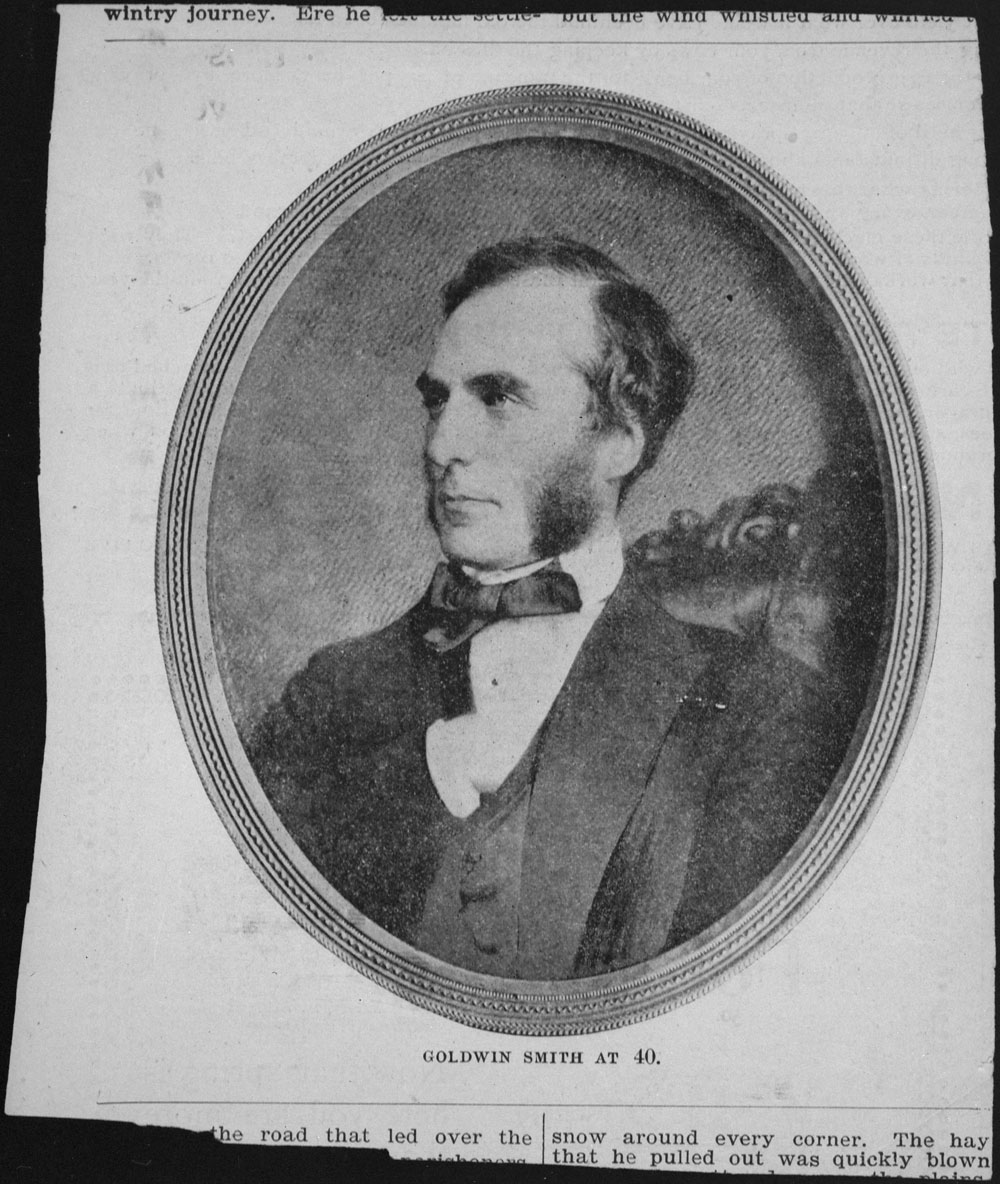
"Goldwin Smith at 40" by G.E. Perine. NAC
Goldwin Smith moved to Toronto in 1871, and began a long career in Canadian public life, which in the words of Ramsay Cook, was "designed to make Canada over in the image of his mid-Victorian liberal mind." (Cook, The Regenerators, 27)  Cook lists the causes that Smith embraced as: "Canada First, contintentalism, voluntary relief of poverty, Sunday streetcars, and, above all, an improved intellectual life."  It was to promote these causes in 1896, that Smith had acquired The Canada Farmers' Sun, a newspaper controlled by the farmer's political party, the Patrons of Industry.


Joe Haycock is described by Cook as an "ineffectual" leader of the Patrons of Industry in the late 1890s.  He had failed to reconcile the agrarian and labour elements in the Ontario party, and what power they had in the legislature would soon come to an end.  When Smith invited Haycock to his Toronto home, it became apparent that, "his guests were not always familiar with the standards of the Oxford common room." 
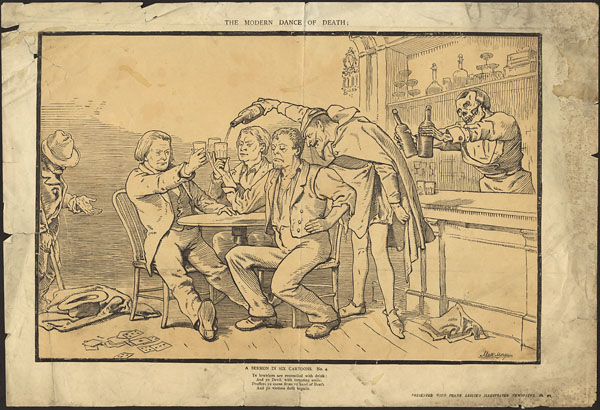
Death serves a stiff one in an early temperance cartoon.   Credit: Library and Archives Canada, Acc. No. 1989-406-45 Source: Molson Portrait Collection, Molson Archives, Montreal, Quebec


A bottle of whiskey was procured and when set upon the table the curious customs of the farm leader were observed.  Edward Farrer, who had introduced the two men from different walks of life, had to explain to Smith the farm leader's customs.  A witness of the event reported:


"Joe took the bottle and shook it vigorously before pouring out the whiskey into his glass.  Afterward the Professor [Smith] asked Farrer how it was that Haycock shook the bottle so.  Farrer told him that in the country hotels the whiskey was often adulterated and that the water rose to the top and it was customary for farmers, when getting a drink at the bar, to shake the bottle before pouring out the whiskey into their glass and that Joe had acquired the habit..." (Cook, 27-28)


It may be assumed that Smith was serving unadulterated whiskey, but it seems when it comes to drinking, old habits die hard despite the demands of respectability.

Sunday, February 12, 2012

The Adventures of Johnny Canuck: WWII Dime Comics

Canadian patriotism inspired by the Second World War led to the birth of the big three of Canadian nationalist super-heroes.  Nelvana of the Northern Lights, Johnny Canuck, and Canada Jack, would all battle the Nazis and their sympathizers at home and abroad.  War economies also played a role in the publication of home-grown Canadian comics. Concern about balancing the exchange of American dollars lead the the 1941 War Exchange Conservation Act, which banned the import of American "fiction periodicals" into Canada.  The need for Canadian heroes, and concern over a balance of foreign currency led to the dawning of the Golden Age of Canadian comic books.


Nelvana of the Northern Lights, Adrian Dingle,
front cover, Nelvana of the Northern Lights,
ca. 1945 © National Archives of Canada/Nelvana Ltd.

In August, 1941, the first super-hero with a distinctly Canadian identity was introduced.   Adrian Dingle's Nelvana of the Northern Lights, co-created with Franz Johnston of Group of Seven fame, was a super-symbol of the Canadian North. As Mary Louise Adams noted, in The Trouble with Normal: "based on a character from Inuit mythology, Nelvana was, nevertheless, portrayed as a white goddess, the personification of the North. She drew her supernatural powers from the Northern Lights and dressed in a short, fur-hemmed skirt, tall boots, and a cape. She had just about everything a superhero could want: she was immortal, she could fly, travel at the speed of light, melt metal, disrupt radio communications, make herself invisible, and alter her own shape and that of her brother (with whom she communicated telepathically). She put her powers to use fighting supernatural villains with nasty ties to the Nazis." (Adams, 143)  Nelvana stands out from her heroic Canadian cohorts in that she had bonafide super powers.  The following two nationalist super heroes were just plain tough.

The next national super hero to arise was the now legendary Johnny Canuck.  Johnny or Jack Canuck had been portrayed in Canadian political cartoons, beginning in the nineteenth-century.  Once portrayed as a French-Canadian habitant, the figure became increasingly western, donning high leather boots and a stetson.  
"Canada's Answer to Nazi Oppression", Leo Bachle, Dime Comics No. 2, p. 23, March 1942
© National Archives of Canada/Nelvana Ltd.
 Johnny Canuck's Second World War reboot has an interesting origins story of its own.  In 1942, the sixteen-year-old Leo Bachle was browsing some Dime Comics when that company's financial backer John Ezrin asked the young man what he thought of the comics.  Bachle candidly criticized the artwork, and when asked to produce a better depiction of two men fighting, he promptly did.  Ezrin told him to dream up a new comic book character, and that night Johnny Canuck was born.

Leo Bachle (script and art), Dime Comics No. 1, p. 23, February 1942  Super ITCH
Unlike Nelvana, Johnny Canuck had no super powers to speak of, but travelled to exotic climes, met with the resistance (and inevitably a beautiful woman), and usually escaped from his Nazi captors by highly improbable means. While Canuck fought evil overseas, a super-hero soon emerged to keep the home-front safe from Nazi sympathizers.

Canada Jack appeared in 1943, and was the first fictional addition to the Canadian Heroes comic books.  Canadian Heroes was the creation of Montreal's Educational Products, which had a wholesome educational mandate legitimized by letters of endorsement by Canadian cabinet ministers.  Canada Jack's exploits were largely restricted to foiling the dastardly plans of saboteurs on the Canadian home-front.

When the war ended, the ban of American comics in Canada also ceased, and the fledgling industry all but collapsed.  The transition to colour was another barrier to a home-grown comics industry.  Crime and mystery comics began to grow in popularity, and were the subject of considerable backlash from those who felt their message was unsavoury.  By 1947, the Golden Age of Canadian comics had all but come to an end.

Sources/Links
Adams, Mary Louise (Author). The Trouble with Normal: Postwar Youth and the Making of Heterosexuality.
Toronto, ON, CAN: University of Toronto Press, 1997. p 144.
http://site.ebrary.com/lib/calgarypublisher/Doc?id=10200841&ppg=171

Johnny Canuck's entire adventures summarized on an archived Library and Archives Canada page:
http://epe.lac-bac.gc.ca/100/200/301/lac-bac/guardians_north-ef/2009/www.collectionscanada.gc.ca/superheroes/t3-301-e.html

English Canadian Comic Books from the Canadian Encyclopedia:
http://www.thecanadianencyclopedia.com/articles/comic-books-in-english-canada

Saturday, February 11, 2012

Hunting Jackals as the Cure to the Scholar's Stoop: ELM Burns at Quetta, 1928-29

Emblem of the Quetta Staff College.
The hunched back of the scholar may be considered a trait contradictory to the ramrod soldierly disposition, but with the considerable schooling to be completed as the army officer climbs through the ranks, a peace-time staff-officer may be more likely to suffer from a papercut than a thrusting bayonet.  In the interwar years, there must have been numerous casualties of book smarts in the ranks of the fifty-odd Canadian officers sent overseas to British Staff College to learn lessons in the military art.  ELM Burns noted in his memoirs, General Mud, that his 1928-29 service in Quetta, India was typified by sporting events of upper-middle class respectability.  Burns claimed that such gentrified leisure could prevent the strains of scholarship from wearing a young officer down:

"These were very pleasant years, during which the military instruction was ingested in a fairly relaxed atmosphere, wherein the students, mostly of the rank of captain with twelve or more years service and war experience, were encouraged to maintain their physical fitness with tennis, golf, polo, riding to hounds (after the jackal) and other exercises suited to ward off myopia and the scholar's stoop."
Hunting Jackals at Quetta.  Date Unknown.  Swetenham Ancestors.