Showing posts with label Canadian homefront. Show all posts

Tuesday, March 5, 2013

Airminded Patriotism: Second World War social history takes flight

Studies of the Canadian home-front in the Second World War are becoming increasingly frequent, indicating that military historians in the country are becoming comfortable with the previously terrifying methodologies of social history. The wartime citizens of Saskatoon, Winnipeg and Verdun have all been the subject of recent scholarly examination and the University of Calgary has a brand new edition to the literature in Sarah Sewell's masters thesis, "Making the Necessary Sacrifice: The Military's Impact on a City at War, Calgary, 1939-1945."


A rising star in the constellation of published works is Jeff Keshen's Saints, Sinners and Soldiers, which is finding its way onto the lists of graduate seminars and comprehensive examinations alike. Keshen's work is a mirror image of your typical Second World War survey, as it crams the fighting overseas into a single chapter, a treatment traditionally reserved for the impact of the war at home. Keshen challenges the notion of a patriotic consensus, showing resistance to growing government control by farmers and workers, along with the selfish actions of profiteers. In Keshen's account, "The Good War" loses much of its moral lustre.


Another recent work by an undisputed heavyweight champion of Canadian military history, who has long sparred with social theory, is Jonathan Vance's Maple Leaf Empire. Vance's work is beginning to be assigned as an undergraduate text, as it concisely surveys the Canadian military relationship with Mother Britain from confederation to the Second World War. While Vance does touch on moments of dissent, noting friction and misunderstanding between Canadians and Britons in the early years of the second war, his account is largely focused on Anglo-Canadian solidarity. The major Canadian presence in Aldershot, the Vale of York and Londonderry, are shown as a kind of reverse colonization, where, (especially after those damn Yankees arrived), the Canadians were welcomed with open arms.


Members of the "Eager Beavers" entertainment troupe from Montreal, who are visiting Aldershot, England, 4 July 1945.  Lieut. Arthur L. Cole / Canada. Dept. of National Defence / Library and Archives Canada / PA-152136


Vance notes that one expression of solidarity with Britain on the Canadian homefront was particularly air-minded. With the major threat to Britain in the early war coming from the Luftwaffe, it is no surprise that Canadians wished to purchase aircraft to do their part in defence. In 1939 the Wings for Britain Fund was established to channel patriotic contributions to the Air Ministry, and in August 1940 the cause was given a great leg-up by Canadian millionaire Garfield Weston. Upon hearing of the loss of 16 Spitfires in August 1940, Weston signed a cheque for ₤100,000. Weston claimed, "As a Dominion man, I've dug deep into my jeans to help with the war [...] But I've got my money on a winning horse." (Cited in Vance, p. 164) Others soon stepped forward, with the publisher of the Montreal Star J.W. McConnell donated $1 million for a whole squadron built in Canada.


Even prisoners contributed! Globe 1940
Elites were not the only ones to respond to the call for money for machines. A particularly novel approach came from one Dorothy Christie of Montreal, who sold some of her finer apparel to start a mailing campaign to every other "Dorothy" she could find. Her card's read, "Is your name Dorothy? If so, rally around and help buy a Spitfire for Britain." (Vance, p. 166) Dorothys across the country held some 20,000 tea parties, concerts, car washes and yard sales.  Presumably the presentation Spitfire named "Dorothy of the Empire and Great Britain" was the result.

The UK film "The First of the Few" was known as "Spitfire" in the United States. http://thegoldenagesite.blogspot.ca/2013/01/blog-post_808.html


Wings for Britain eventually purchased more than 2,200 aircraft, including 1,600 Spitfires, speaking to that model's ability to capture the public imagination. Similar campaigns such as the Buy-A-Tank campaign, capitalized on the popular fascination with the machines of war, and contributed to a discourse of mechanization which pervaded the era. Added incentive for those that purchased a whole plane (the Air Ministry put the cost of a fighter at ₤5,000 for fighter, which actually only payed for the airframe), was selection of the name of the craft. Vance notes a puzzling choice of one Herbert Morris, who dubbed his spitfire "Dirty Gerty Vancouver"!


Advertisements featuring "Canada's New Mechanized Army", stirred the imaginations of young Canadians as well. As Cynthia Comacchio notes in her chapter, "To Hold on High the Torch of Liberty: Canadian Youth and the Second World War." in a recent edited volume, Canadian youth supported the war effort with an eye to the skies. Around 40,000 high school boys worked on modelling ninety different aircraft for British Commonwealth Air Training Plan purposes. (Comacchio, p. 43) The models were to be used to familiarize aircrew with a variety of allied and enemy planes. Comacchio notes that girls got in on the building as well, perhaps tiring of knitting socks for soldiers overseas. In some schools girls protested that boys were delegated modelling duties, and demanded participation. As Saturday Night magazine noted, "In these cases the knitting needles are idle while the young ladies cut patterns and paint up the finished models." (Saturday Night, 19 December 1942, as cited by Comacchio) Comacchio, as can be expected for a scholar with a keen eye for the construction of gender roles, notes, "Their participation, however, clearly stayed within the domain of traditional feminine skills."


The "Little Happy Gang" children's knitting club, who are knitting for Canadian soldiers and for the Canadian Red Cross Society.  Victor Bull / National Film Board of Canada. Photothèque / Library and Archives Canada / C-053880

These patriotic responses offer a counter to Keshen's mirror image of the "Good War"Far from offering a black or white picture of the conflict, however, new works show that, despite the tankers of ink spilled examining the Second World War, complex new approaches may still be found. For Vance, "The speed and efficiency with which the Canadian community in Britain mobilized to support charitable causes like the Wings for Britain Fund demonstrates that Canada's empire in Britain from the First World War had never really disappeared." (Vance, p. 166) With a nod to Veronica Strong-Boag's A New Day Recalled, Comacchio's study notes that "what imprints individual and collective memory, is not the universality of experience so much as the fundamental elements of age and life stage." (p.28) War could become a shortcut to adulthood, yet also "inspired generational solidarity". (p.56) There is no questioning that the shared experience of the war shaped the Class of '45 in schools across the nation.


Further Reading:

A article from Legion magazine further elaborates on the Spitfire funds and patriotic contributions:

http://legionmagazine.com/en/index.php/2012/09/the-gift-of-air-power/

One of the Garfield Weston spitfires was discovered in an Irish bog:
http://www.dailymail.co.uk/news/article-2009347/Spitfire-recovered-Irish-peat-bog-70-years-crashing-Ireland.html 


Hayes, G., M. Bechthold, and M. Symes. Canada and the Second World War: Essays in Honor of Terry Copp. Wilfrid Laurier University Press, 2012. http://books.google.ca/books?id=ksabpwAACAAJ.


Keshen, Jeff. Saints, Sinners, and Soldiers: Canada’s Second World War. Vancouver: UBC Press, 2004. http://catdir.loc.gov/catdir/toc/fy051/2004541329.html


Vance, Jonathan.F. Maple Leaf Empire: Canada, Britain, and Two World Wars. OUP Canada, 2012.

Wednesday, October 17, 2012

White Feathered Zeal: Accosting Shirkers in the Great War

In 1915, problems meeting the manpower commitments of the Borden government were quickly discovered by the Canadian army.  Jack Granatstein and JM Hitsman noted in Broken Promises(Oxford: 1977), their fundamental account of conscription in Canada, that standards were quickly lowered when men failed to flock to the recruiting stations.  Medical standards were reduced, the height restriction dropped an inch down to 5'2", minimum chest measurements were decreased, and married men no longer needed permission from their wives to enlist. (p.35)

Chief Justice TG Mathers noted that the strongest motivation to serve was the social pressures put on Western men who were still strolling  civvy-street.  Mathers, a Manitoban pro-conscriptionist, noted that
It is absurd to speak of enlistment at the present day as voluntary.  In the cities of the West the man who is not in uniform is made to feel that he is a sort of social outcast.  No man who joins the ranks today does so voluntarily.  He does so because he can no longer resist the pressure of public opinion.  (Granatstein, p. 38)
 Pierre Van Paassen NYPL th-60174
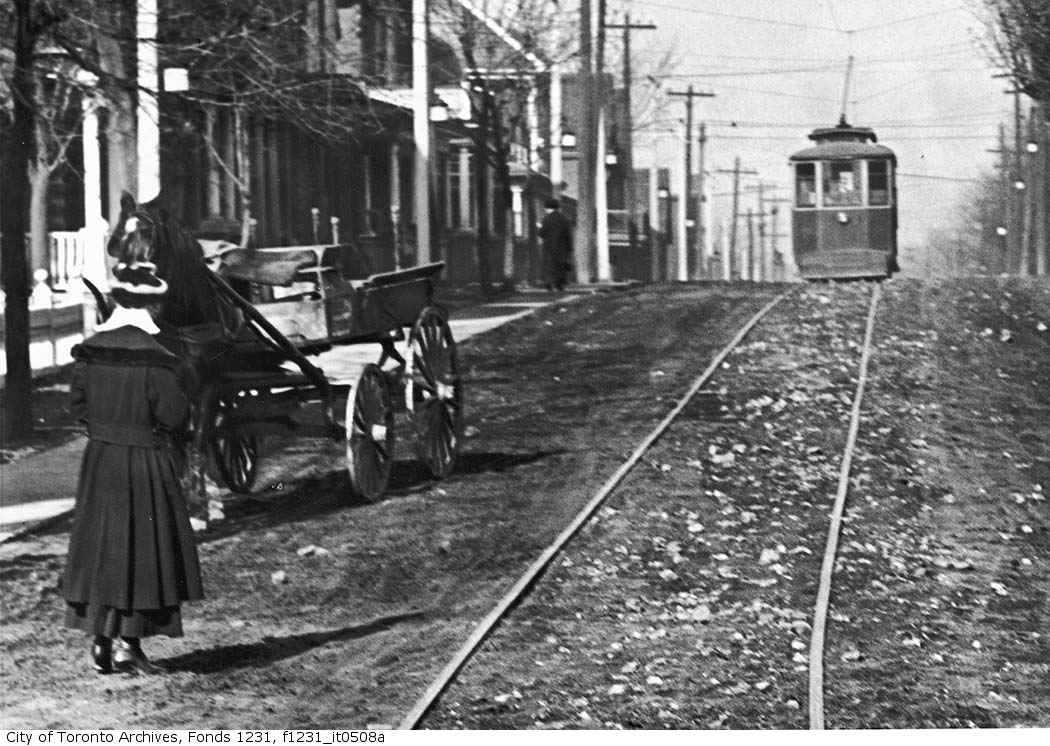
Patriotic souls took it upon themselves to organize pressure against those not yet serving.  Some women would search for workers and offer to take their place on the job if they would join the army.  As Granatstein noted, "often these patriotic ladies could get carried away."  The memoirs of Pierre van Paasen, a dutchman living in Toronto, testify to the fervour with which shirkers were sought out:
One afternoon I was accosted on the rear platform of a streetcar by a woman, who was dressed in mourning.  She told me that three of her sons had been killed at the front.  She showed me their photographs.  Suddenly she began to talk very loudly.  'Why aren't you in khaki?' She demanded.  'Why do you dare to stand there laughing at my miser? Why don't you go over and fight? Fight, avenge my boys!' she screamed.  'Madam,' I tried to calm her, 'I am not a Canadian.'  That remark set her yelling at the top of her voice.  She screamed that she, the mother of three heroes who had died for their king and country, had been insulted by a foreigner, a slacker, a German spy, a Red, and I don't know what else.
City of Toronto Archives      Fonds 1231, Item 508a
    Close up of 508, T.S.R. Car No. 6
   November 22, 1916
I pulled the cord to bring the street car to a halt.  I alighted. But the woman followed me off and she kept up her screaming about spies and Germans.  A crowd gathered....Somebody stopped me just at the moment when I thought of taking to my heels as the best way out of the predicament.  I was immediately surrounded by a mob.  A group of business men, who had managed to stay five thousand miles away from where the poppies grow, and who were at that moment emerging from the hotel, gallantly rushed to the woman's aid and forced me to submit, as she pinned a white feather through my coat into my flesh: the badge of white-livered cowardice. The last I saw of her was through a pair of badly battered eyes as she laughingly picked up some of the feathers which had dropped from her bag in the scuffle.
...The following day I enlisted.  (Cited in Granatstein, p. 39)
City of Toronto Archives Fonds 1244, Item 687
Title Mother of military personnel, World War I
Date(s) of creation of record(s)        [ca. 1916]
When in 1917, the Borden government finally acknowledged that the robust commitments of Canadian troops would necessitate conscription if the war were to continue grinding on, the position of Canadian women was far from clear-cut.  The attitude of women whose sons were still in Canada would, of course, be much different from that of the mourner Paasen encountered.  In February 1917, the journal Everywoman's World had organized a "woman's parliament", which stated that a 6:1 ratio of members were against compulsory service (Granatstein, p. 80).  The national women's organizations were broadly in support of Union government and conscription, but one should not assume this meant that half the nation's population to have a unanimous opinion on the matter.  The women's groups of feminist legend may not have had the influence on public opinion that historians at times ascribe to them.  It does seem clear, however, that women whose sons were lost in the war were given a status which was leveraged to promote conscription and shame "shirkers".

Monday, July 16, 2012

Canadian Zoot Suiters

12 June 1944 Globe
The zoot suit, was a Second World War fashion trend that begs explanation.  Young men would don what Jeff Keshen describes as "wide-brimmed gangsterish-looking fedoras, long and loose-fitting jackets with padded shoulders, high-waisted baggy trousers pegged at the ankles, and brightly coloured shirts with huge bow ties."  (Keshen,Saints, Sinners and Soldiers,p 207).  During the war in North America, zoot-suiters' wild fashions and spastic swing jazz rhythms were associated with juvenile delinquency and frivolous waste.


Due to wartime controls on dyes and textiles, the very suits themselves were considered unpatriotic.  Keshen notes that the backlash against these bombastic youths had much to do with the panicky press coverage of the 1943 Los Angeles, zoot-suit riot.  Sailors from the Chavez Ravine naval base, doled out some extreme beatings, and tore clothes from the civilian youth, who were perceived to have attacked sailors. 

Canadian press associated zoot suiters with the jitterbug, clearly a spastic expression of loose morals.  Tensions between servicemen and zoot suiters were greatest in Toronto and Montreal.  In the later city, violence was meted out to both sides, spilling over to Verdun, where the Dance Pavilion was raided by mob of 400 sailors.

In the summer of 1943, Toronto servicemen had ripped the clothes off the youngsters and tossed them in the lake.  A Globe and Mail article which predicted the swift end of the fad, patriotically ridicules the outlandishly clad youngsters.  One "youthful veteran of this war" is quoted as a representative of enlisted men:
I know how the servicemen feel.  They have exchanged their civilian clothes for a uniform of which they are very proud.  They feel a lot of these kids wearing the funny clothes should be either in the army, navy or air force.  And when, as was the case at Sunnyside recently, one zoot-suit wearer 'took a crack' at a fellow in army uniform - well what could you expect?"("Zoot Suit's Day Wanes in Opinion of Tailors", Globe and Mail, 12 June 1943, p.5 )
Globe and Mail 19 June 1943, p.3
Interestingly, the same article suggests a First World War parallel to the phenomenon.  A Toronto psychologist is quoted as saying that, "back in 1917 and 1918, all the younger fellows who had not reached army age were making big money in ammunition plants, just as they are today.  They turned to silk shirts with wide, 'noisy' stripes."

Globe and Mail. 6 July 1944. p.3
The Globe and Mail reinforced the moral consensus that the zoot-suiters were juvenile delinquents.  One article chose to report on school-ground bullying to show the moral regressions of these rebellious youths. It is not often that the playground pecking order makes the news!  The response to the trend in wartime Canada shows the strong forces of conformity at work, and the efforts of youth to break from these mainstream norms.


During the 1990s swing revival, the Cherry Poppin' Daddies broke onto the international stage with their hit "Zoot Suit Riot".  The song holds up better than the music video.

Wednesday, June 6, 2012

D-Day Prayer in Calgary, 6 June 1944

Crowds on 1st Street SW, Calgary 6 June 1944
Canadian thoughts on the anniversary of D-DAy, are focused on the beaches of Normandy.  Those on the homefront during the Second World War also gave their thoughts to the men in France, and many took to the streets to show their solidarity.  Calgarians on 6th June 1944, took time from their day for a public prayer, in a show of concern for the soldiers, hopes for victory and a lasting peace after the conflict.

The display was not exactly spontaneous, having been organized by the Calgary Ministerial Association, and sanctioned by the mayor of Calgary.  An estimated 15,000 people who gathered on 1st Street West at 7-8th Avenues abandoned their daily duties to join in prayer.  Author Grant MacEwan, in his Calgary Cavalcade : From Fort to Fortune (1975), estimated that one sixth of the city's total population showed up that day to show their support. MacEwan wrote,
As if by magic the word went around downtown Calgary.  Stores closed at 11.20 a.m., and at 11.35 a military band led the huge host of earnest people in the singing of "O Canada." Usual street noises having ceased, the singing could be heard at Mount Royal College, almost a mile away.   (MacEwan, p.174)
The Calgary Herald  reported that the ceremony had a number of symbols familiar to Remembrance Day.  One Reverend Morley noted that it had been twenty-six years since the, "fallen heroes of the last war" in John McCrae's "immortal poem" had pleaded "to you from failing hands we throw the torch, be yours to hold it high." In keeping with Remembrance Day rituals, a minute of silence was held.


The Herald recorded the reaction from a cross section of Calgarians, most of whom were confident of success.  Worried mothers were happy, if concerned, and servicemen wished they were with their buddies on the beaches of France.  The Herald noted that there had been great anticipation of the event,
The announcement that today was D-Day did not surprise many Calgarians.  Most of them had expected that the invasion would be timed by the capture of Rome.
'Besides being a moral victory for us, the fall of Rome proved that our force in Italy do not need further support, and that our troops are now free to concentrate on France,' said a man who had been a major in the last war.
Advertising for War Savings Certificates shows the invasion was much anticipated.  6 June 1944 Calgary Herald.
The public ceremony, and its press reportage, is interesting for the what it does and does not say.  Were the protestant hymns happily sung by those who did not practice the faith? Did Calgarians really have the confidence of success that news articles portrayed? Some may not have believed this was the real show at all after false rumours of the invasion had been previously leaked.

As an instance when the fighting in Europe and the Canadian homefront are clearly linked, the public display frames an interesting moment in the Canadian experience of the Second World War.  Yet, as might be expected, the historical record cannot answer a myriad of questions regarding how thousands of diverse citizens understood the war.