Showing posts with label women. Show all posts

Friday, October 19, 2012

War is a Drag: Female Impersonators in the First World War

The phenomenon of the Great War drag show is somewhat perplexing.  Some argue that soldiers were not just laughing at the gender-bending performances but were actually aroused by the shows.  A broad array of explanations are offered for the cross-dressing phenomenon, ranging from desires for the portrayal of normalized femininity, to sublimation of homosexuality.
 
'The Dumbells' Concert Party. Formed from
 3rd Canadian Division in France.  'Marjorie'
(R.D. Hamilton), and 'Marie' (A.G. Murray),
the two girls of the Dumbells show,
 with the manager, Captain M.W. Plunkett,
 Credit: Canada. Dept. of National
Defence/Library and Archives Canada/
JG Fuller's Troop Morale (Oxford, 1990), notes the importance of music shows to the soldiers when they were at rest, and among these theatrical revues, drag shows were fairly common.  Analyzing a broad range of soldiers' journals, Fuller writes that , "curiously these female impersonators seem to have generated considerable sexual excitement.  He quotes one of the men in the ranks as claiming, "judging from the way [the men] sat and goggled at the drag on stage it was obvious that they were indulging in delightful fantasies that brought to them substantial memories of the girls they had left behind them in London, Manchester, Glasgow, wherever." (As cited in Fuller, p.105)
Apparently, many impersonators did not make a caricature of their roles, but played their parts with candour.  Fuller notes that many journals accounted for the realism of the concert party "girls".  One soldier wrote that, "it all seems to show that English beauty is essentially masculine."  Fuller is more critical of the illusion: "judging from the photographs, it shows the intensity of the desire to believe." (p. 106)


Big Beauty Chorus, Marie and the Boys.  Dumbells troupe.  Library and Archives Canada.  PA-005741
Fuller wonders why this desire to believe in the gender-bending charade was so strong with the relative ease of access to women in the rear areas.  It is true that after the spring of 1917, troops may have gone for weeks without seeing a woman in the farms, hospitals, shops and estaminets. Yet, Fuller suggests that the appeal of the entertainers was likely, "their emphasis put on glamour [not] the sheer fewness of females."  He notes that "peasant girls, working hard at practical tasks with their menfolk away, were often the reverse of 'feminine' in the restricted sense of the age."  A quote from an Australian journal lamented, "Women of shattered Picardy, Why are your boots so flat and vast?"

Of this desire for fancy femininity, Fuller writes
The trappings of elegance and luxury were the negation of war and squalor and, as such, a potent fetish of peace.  The female impersonators therefore took care over the fripperies, having lingerie sent out, or going on special leave to London or Paris to select the items themselves.  On stage they sang the sentimental songs which represented the greatest frippery of all, asserting the idealized stereotype of soft and vulnerable romantic femininity. (Fuller, p.106)

Historian David A Boxwell, in his article "The Follies of War: Cross-Dressing and Popular Theatre on the British Front Lines, 1914-1918" Modernism/Modernity 9.1 (2002) 1-20, disagrees with the thesis that drag performance was strictly a desire for  idealized heterosexual relations.  He identifies two forms of female impersonation which had already developed on British stages by 1914.  He notes that, "Mimicry was most visibly embodied in the pantomime "dame" tradition, a comedic effort to render the female form in its most hypercarnivalized manner: the grotesque, oversized, and voracious body of the raddled, "ugly" woman presented on stage out of a misogynistic animus" (Boxwell, p. 13).   The other form of impersonation was mimesis, which historians have traced back to the 1860s.  Mimesis represented "idealized femininity as closely as possible (Boxwell, p. 14).

'The Dumbells' Concert Party. 
 'Marie' (A.G. Murray)PA-005743
Boxwell argues, "the complex dynamics of men objectifying other men as women does not occur completely within a heterosexual matrix." (Boxwell, p. 16)  Boxwell's argument is formed in analysis of the HC Owen quote that, "it all seems to show that English beauty is essentially masculine."
[Owen] may well have intended to define female beauty in masculine terms, to suggest that British women were at their most beautiful when they most looked like men. The slippage that inheres in the statement effectively eradicates women's existence: male beauty not only exists, but cannot be conceived of in anything other than "masculine" terms. Thus there was an ineradicable trace of homoeroticism at the heart of drag during the Great War.[...] A man watching another man in drag must, at some level, self-reassuringly avow that the "woman" has a penis. But this act of speculation threatens to put the male spectator beyond the boundaries of the heterosexual matrix. (Boxwell, p. 16)
For Boxwell, enjoying a drag show was a cathartic way of releasing homosexual anxieties in a homophobic society.  As may be expected, other historians disagree.


Laurel Halladay, in "A Lovely War: Male to Female Cross-Dressing and Canadian Military Entertainment in World War II Journal of Homosexuality Volume 46, Issue 3-4, 2004 traces drag performances in the Canadian military, and identified in the Great War period, an attempt to reconstruct a heterosexual community.  (Hallady, p.  21)   For Hallady, drag performance was either comedic or dramatic, either mocking perceived female foibles or respecting femininity.  On the issue of sexualization, Halladay writes that, "Perhaps contrary to more modern expectations, drag performers were not the least bit threatening to the taken-for-granted heterosexual practices of their comrades and both contributed to and
enjoyed the homosociability of the battlefield." (Halladay, p.23)  For Halladay, it was only when women were recruited into the Canadian military in the Second World War, that female impersonation was broadly considered deviant.


The debate over the meanings of female impersonators in the First World War is by no means over.  How could it be when analyzing the subjective reception of gendered performances by a broad variety of men?  The work yet to be written on the complex nuances of drag performance is bound to be exciting historical work, addressing the overlap between social, sexual, and gender history.
From John to Jack, Susannah to Susie, Punch (1916).

Wednesday, October 17, 2012

White Feathered Zeal: Accosting Shirkers in the Great War

In 1915, problems meeting the manpower commitments of the Borden government were quickly discovered by the Canadian army.  Jack Granatstein and JM Hitsman noted in Broken Promises(Oxford: 1977), their fundamental account of conscription in Canada, that standards were quickly lowered when men failed to flock to the recruiting stations.  Medical standards were reduced, the height restriction dropped an inch down to 5'2", minimum chest measurements were decreased, and married men no longer needed permission from their wives to enlist. (p.35)

Chief Justice TG Mathers noted that the strongest motivation to serve was the social pressures put on Western men who were still strolling  civvy-street.  Mathers, a Manitoban pro-conscriptionist, noted that
It is absurd to speak of enlistment at the present day as voluntary.  In the cities of the West the man who is not in uniform is made to feel that he is a sort of social outcast.  No man who joins the ranks today does so voluntarily.  He does so because he can no longer resist the pressure of public opinion.  (Granatstein, p. 38)
 Pierre Van Paassen NYPL th-60174
Patriotic souls took it upon themselves to organize pressure against those not yet serving.  Some women would search for workers and offer to take their place on the job if they would join the army.  As Granatstein noted, "often these patriotic ladies could get carried away."  The memoirs of Pierre van Paasen, a dutchman living in Toronto, testify to the fervour with which shirkers were sought out:
One afternoon I was accosted on the rear platform of a streetcar by a woman, who was dressed in mourning.  She told me that three of her sons had been killed at the front.  She showed me their photographs.  Suddenly she began to talk very loudly.  'Why aren't you in khaki?' She demanded.  'Why do you dare to stand there laughing at my miser? Why don't you go over and fight? Fight, avenge my boys!' she screamed.  'Madam,' I tried to calm her, 'I am not a Canadian.'  That remark set her yelling at the top of her voice.  She screamed that she, the mother of three heroes who had died for their king and country, had been insulted by a foreigner, a slacker, a German spy, a Red, and I don't know what else.
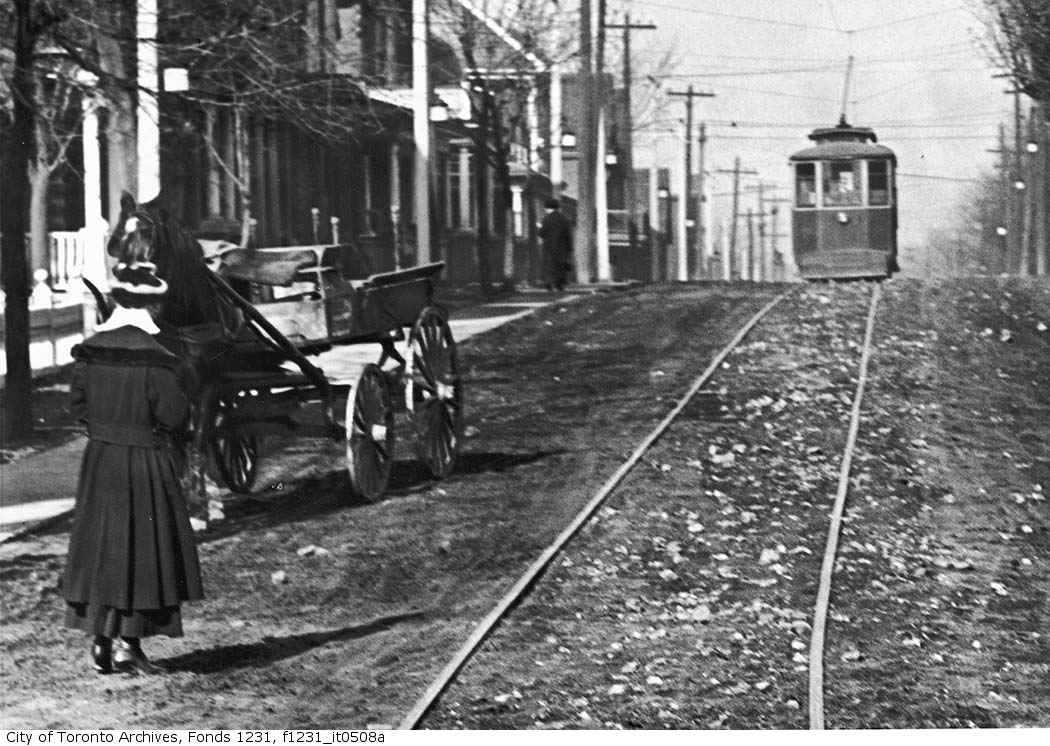
City of Toronto Archives      Fonds 1231, Item 508a
    Close up of 508, T.S.R. Car No. 6
   November 22, 1916
I pulled the cord to bring the street car to a halt.  I alighted. But the woman followed me off and she kept up her screaming about spies and Germans.  A crowd gathered....Somebody stopped me just at the moment when I thought of taking to my heels as the best way out of the predicament.  I was immediately surrounded by a mob.  A group of business men, who had managed to stay five thousand miles away from where the poppies grow, and who were at that moment emerging from the hotel, gallantly rushed to the woman's aid and forced me to submit, as she pinned a white feather through my coat into my flesh: the badge of white-livered cowardice. The last I saw of her was through a pair of badly battered eyes as she laughingly picked up some of the feathers which had dropped from her bag in the scuffle.
...The following day I enlisted.  (Cited in Granatstein, p. 39)
City of Toronto Archives Fonds 1244, Item 687
Title Mother of military personnel, World War I
Date(s) of creation of record(s)        [ca. 1916]
When in 1917, the Borden government finally acknowledged that the robust commitments of Canadian troops would necessitate conscription if the war were to continue grinding on, the position of Canadian women was far from clear-cut.  The attitude of women whose sons were still in Canada would, of course, be much different from that of the mourner Paasen encountered.  In February 1917, the journal Everywoman's World had organized a "woman's parliament", which stated that a 6:1 ratio of members were against compulsory service (Granatstein, p. 80).  The national women's organizations were broadly in support of Union government and conscription, but one should not assume this meant that half the nation's population to have a unanimous opinion on the matter.  The women's groups of feminist legend may not have had the influence on public opinion that historians at times ascribe to them.  It does seem clear, however, that women whose sons were lost in the war were given a status which was leveraged to promote conscription and shame "shirkers".

Saturday, May 26, 2012

Western Canadian First Nations Midwives

The role of the plains Native midwife is an interesting aspect of aboriginal life, which offers insight into spiritualism, medicine, and early native-newcomer contact. Maureen Lux’s Medicine that Walks: Disease, Medicine, and Canadian Plains Native People, 1880-1940 (2001) is largely a social history of medicine which plots the devastating demographic effects of disease and malnutrition. Lux notes that aboriginal birth has been largely unstudied, due the morbid focus inherent in the tragedy of the early-reserve era.
Glenbow Museum File number: NA-1241-296
Title: Mrs. Thomas Lefthand, Stoney.
Date: [ca. 1940]

Lux notes that many aboriginal midwives were also considered healers with connections to the spirit world. The details of the birthing process show that birth was a group effort.

The mother kneeled with her back against a chest-high support and was attended by three other women. The primary midwife stood behind the mother and supported her; another received the newborn and cut the umbilical cord; the third assisted the other two. To speed the birth of the placenta, hot water was placed under the woman as she knelt. The umbilical cord was cut ‘at a point one hand grip and one thumb’s breadth’ from the abdomen. A light dressing made from the powdery centre of the prairie puffball (Lycoperdon gemmatum batsch) was applied to the navel; this acted as a styptic (Lux, p.92)

The umbilical cord itself was considered a special part of the process. As Blackfoot elder Russell Wright noted,

When a child was born, it was traditional for the midwife to cut the umbilical cord and the child’s aunt or older sister would clean and dry it. Then she made a hide pouch in the form of a turtle or some other animal, beaded it, and sewed the cord inside. The child wore it for the first five years of life at special occasions when people gathered together. The pouch reminded people the child had many parents and everybody was responsible to help the child grow to become worthy to the tribe.

Image No: NA-1271-2
Title: Mrs. Adam Callihou, Metis at Hazelmere, Alberta.
Date: 1955
Remarks: Mrs. Callihou, nee Veronique Gladu, was born at Lac St. Anne in 1856
. First married to Francis Hambler and after his death to Adam Callihou.
 They farmed at Flying Shot Lake, southwest of Grande Prairie, Alberta and
 Mrs. Callihou acted as midwife and nurse for the first settlers in the area.

An interesting cultural facet of the childbirth itself was the expectation that a mother would show no pain. Women were expected not to announce that they were in labour until the last moment. Independence was emphasized and women were to prepare for the moment by themselves. They were to maintain their composure and remain quiet during the birth. (Lux, p.94) Europeans often mistook such control for a painless or effortless childbirth.

File number: NA-1030-4
Title: Mrs. David McDougall.
Newcomers also benefited from the experience of plains Native midwives. In Manitoba, Annie McKenzie McDougall married the trader David McDougall in 1871 and shortly thereafter birthed their first child. She remembered her native friend Mary Cecil acting as her midwife. In the Rocanville district of Saskatchewan, a Cree woman by the name of Bastien acted as midwife to new immigrants. One woman recalled she was the “nearest thing to an angel on earth”. (Lux, 98) Later, in the 1930s, women reportedly used Native midwives when they couldn’t afford going to the hospital.

Midwifery is still an important factor of First Nations life.  The National Aboriginal Health Organization released a series of pamphlets on the subject in 2009.

Sunday, April 3, 2011

Review - Cameron Duder - Awfully Devoted Women

Duder, Cameron. Awfully Devoted Women: Lesbian Lives in Canada, 1900-1965. Vancouver: UBC Press, 2010.

Cameron Duder's Awfully Devoted Women: Lesbian Lives in Canada, 1900-1965, traces same sex relationships of middle-class women from the period of early-twentieth century romantic friendship, through to the post-Second World War era of working-class lesbian bars. The work uses several collections of letters and interviews of middle-class and lower-middle-class women to correct a historiography which focuses largely on post-war bar scene and the rise of political and community groups from the late 1960s. Awfully Devoted Women notes that the experiences of women need not fit into the dichotomy framed by the literature of the allegedly nonsexual "romantic friendship" or sexually charged butch-femme relationships. Duder also notes that, contrary to the historiographical consensus, there is evidence that women in pre-war romantic friendships were physically intimate.
Dr. Duder.  Photo: Social Photography
        Duder's goal is to describe women's lives not to theorize about lesbian identity, yet identity issues are breached in addressing the "medicalized discourses of sexuality" in the post-war era and especially in the power of social expectations. For lower-middle-class lesbians, concerns of respectability, class and safety meant that the bar scene was an unacceptable place to socialize. As the author states, "it would be incorrect to portray these women whether as closeted middle-class women whose place in lesbian history is therefore marginal or as [...] faultless heroines who countered the odds and formed community in the face of homophobia. They are at once both of these things and neither. Their stories indicate, rather, that class and sexual orientation are always entwined and that they can work with and against each other in the same individual and simultaneously."
       Sources are a tremendous limitation for those who would wish to take Duder's emotional and personal analysis further in the pre-war period. In this way, Awfully Devoted Women may be a one-off study. The question arises as to whether universal conclusions can be drawn about visibility and physicality of pre-war lesbian lives from Frieda Fraser's papers at the University of Toronto archives (the "richest collection" of papers in Canadian lesbian history), and the handful of smaller collections available. Duder may be content with correcting historiographical notions, which posit that there was no genital contact in romantic friendships, by offering select cases which suggest otherwise. The reader is left wondering if the few relationships that Duder features were typical of the time. In showing the sexual naivety of lower-middle-class women in the post-war years, the Lesbians Making History collection of interviews, and personal testimony from women themselves, allows Duder to assert a more authoritative statement, from a wider body of evidence. Despite the rise of sex education, a lack of knowledge about sexuality meant that women necessarily experimented when forming sexual relationships.
"Queer Affair" Lori Newdick. Heroines Series. Library and Archives Canada.
        Awfully Devoted Women traces the history of same-sex relationships on emotional, sexual, and social levels. The narrative is driven by the voices of the women subjects, in their letters and interviews, which makes for a very readable account. Bedroom details of genital contact are sure to keep pages turning, but details of how lesbians remained visible to like-minded women, yet still remained respectably distanced from the bar-scene, as well as  relationships with families who were still expected to provide for their lesbian children, are equally interesting. Academics will perhaps rail for more gender-theory, but Duder does address interesting historiographical and theoretical currents without writing explicitly for the expert. A particularly interesting theoretical construct is seen in the use of queer theory in analyzing how pre-war lesbians used Freudian language to describe their "libidinal desires", yet remained aloof from these text's pathological implications of deviant sexually.
        Awfully Devoted Women was selected for the 2011 Over the Rainbow Book List, by the Gay, Lesbian, Bisexual, and Transgendered Round Table of the American Library Association. As an important work in Canadian gender history, and perhaps the book on early-twentieth century middle-class lesbianism, it is sure to also grace the reading lists of graduate seminars for some time.


Wednesday, January 5, 2011

Sten Gun Grannies

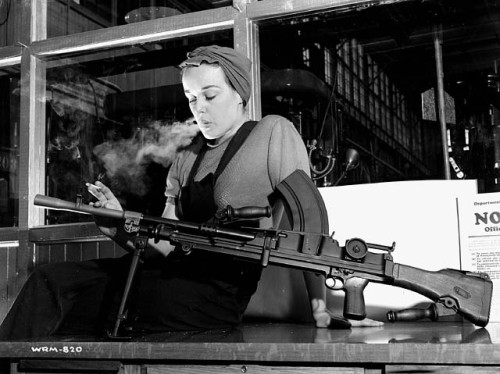
Nothing like a smoke after a hard days work.


Perhaps you've heard of the Bren Gun Girl? Veronica Foster was a worker at the John Inglis Company plant in Toronto which manufactured the Bren Light Machine Gun.  "Ronnie" the Bren Gun Girl's image was used for propaganda purposes to boost the war effort. 


Less familiar will be this group of Sten Gun Grannies, who worked at the Lakeview Small Arms Munitions factory.  The Sten submachine gun was generally not admired by front line troops, due to its tendency to misfire, fire on fully automatic when in the semi-auto position, or discharge an entire clip when dropped.  The accompanying article from the Toronto Star of 1943 noted that some 70 "grandmas" worked the factory and were eager to show they could shoot as well as make guns. 
None of these matriarchs shot from the hip.
While propaganda depicting women in the workforce was used to recruit more workers, the idea that the Second World War opened the manufacturing industry up to women is not universally accepted by historians.  Conservative print media during the war suggested that women in the workforce would undermine family values, which, in part, explains their general retreat from industry at the close of hostilities.  Women were a valuable source of labour during the war, however, and their wartime integration into the industrial sector helped later arguments for equality.