Showing posts with label Western Canada. Show all posts

Wednesday, November 21, 2012

Chief Crowfoot's Military Youth

Title: Earliest known
 illustration of Crowfoot.
Date: 1875
Photographer/Illustrator:
Nevitt, Richard Barrington 
Glenbow Image No: NA-51-1
Chief Crowfoot of the Blackfoot, is generally not known as a generalissimo.  After his abstention from the 1885 North-west Rebellion, he rose to notoriety as an emblem of loyalty, or in the parlance of the late nineteenth-century, a "good Indian."  Yet like any resident of the West in the nineteenth-century, Crowfoot did not live a life devoid of violence.  Hugh Dempsey's biography, Crowfoot: Chief of the Blackfoot (1972, 1982) recorded the problems discerning the details of the future chief's youth as an occasional warrior.  Dempsey wrote in the early 1970s, "Blackfoot tales of war often were embellished with supernatural acts, while the date and place were not considered worthy of recall. For this reason, the telling of [Crowfoot's] first and subsequent war exploits can only attempt to follow a logical path through the maze of fact and legend." (Dempsey, p. 13)

Crowfoot's youth shows numerous examples of his skill at warfare.  In several raids on enemy camps during the 1840s, he was shot by the enemy.  In one instance, Crowfoot daringly ran into an enemy camp and touched a lodge of the enemy Crow tribe.  Subject to Crow gunfire, a ball hit Crowfoot in the arm, but passed through without shattering any bone.  In another raid on the Shoshoni tribe, Crowfoot was more seriously injured by gun fire, necessitating help to return to his own camp.  The lead ball had lodged in Crowfoot's back, and as it was never removed, caused him problems in later life.

Title: Combat between Blackfoot, Assiniboine and Cree people, Fort McKenzie, Montana.
Date: August 28, 1833
Photographer/Illustrator: Bodmer, KarlGlenbow Archives Image No: NA-2347-1

Crowfoot was by all accounts a brave warrior, and several episodes narrated by Dempsey enforce the claim.  On one occasion, Crowfoot was out with a party which hoped to steal horses from the Crees, but encountered an enemy band wandering the windswept prairie on their own horse-stealing foray. As Dempsey wrote,
Crowfoot was among the first to rush into the fight, where he singled out a Cree warrior who was running toward the trees.  To travel more quickly, Crowfoot hurled aside his rifle as he ran after his enemy.  The Cree reached the dense bushes, but Crowfoot followed him.  Risking ambush, he plunged along the trail until he came close enough to grab the Cree by the hair.  Wrenching him backward, Crowfoot plunged the knife into his chest and killed him on the spot.  He then hacked the scalp from the Cree's head and returned to his comrades, who had also been victorious.  (Dempsey, p.18)
Glenbow Image No: NA-1241-10
Title: Chief Crowfoot, Blackfoot.
Date: 1885
Photographer/Illustrator:
Gully, F., Calgary, Alberta
Another violent encounter with the Crees later developed into a shooting match between rifle pits. When stalemate seemed to threaten, Crowfoot left his defences and crawled forward towards the enemy.  Dempsey writes that "[a]rrows and balls whistled past him, but he kept moving forward until he found a shallow depression midway between the two lines.  Then reaching into his firebag, he withdrew his pipe and turned to his comrades, shouting, 'Oki, come and smoke with me!" (Dempsey, p. 18)  Crowfoot's calm in the face of danger inspired his followers to start crawling forward towards his position, and when the Cree saw this movement, they assumed the worst, turned and fled.  Leading by example had won the day.

A bloody confrontation in 1873, shows that revenge could be the causus bellus of First Nations warfare.  Crowfoot's eldest son had left the camp at Three Hills and headed to war.  The son was Crowfoot's only healthy son.  One son suffered from developmental issues and the other had poor vision.  The eldest would never return to his father's camp, having been shot by the Cree north of the Red Deer River.

As Crowfoot mourned, his anger grew.  Dempsey notes, that Crowfoot's one true flaw was his fiery temper, and in this case his wrath was directed towards the Cree tribe. (p. 67)  As Dempsey wrote, "Revenge did not have to be upon the actual killer of Crowfoot's son; it was knowledge enough that the Crees were responsible.  The blood of a Cree, any Cree, would avenge the loss."  (p. 71)  After searching the prairies, a small group of Cree were discovered.  One man was killed, his body "scalped and mutilated, satisfied Crowfoot's desire for revenge."  (p. 71)  Later on, when a peace treaty was in effect between the two tribes, Crowfoot adopted the future Cree chief, Poundmaker, as his son.  Given the previous revenge killing of a Cree man, the choice of Poundmaker as a "replacement" for his eldest son is particularly ironic.


Title: "Crowfoot", Chief of the
 Blackfeet Indians. 
Credit: O.B. Buell/Library
 and Archives Canada/C-001871
Date 1886
Crowfoot's power in the 1870s and beyond were not due to his military prowess.  When chiefs such as Big Swan and Old Sun rode out against their enemies, Crowfoot remained in his lodge.  This being said, Crowfoot's reputation of bravery in his earlier years could not have hurt him in later life.  The 1870s were the last gasp of Crowfoot's power amongst his tribe.  During this period he had a large herd of around 400 horses, and still enjoyed the esteem of his people.  Even at the signing of Treaty No. 7, however, Crowfoot was not considered the greater leader of the Blackfoot confederacy.  Both Red Crow and Rainy Chief of the Bloods had larger followers, and Red Crow was closer to what one might call the leader of the combined Blackfoot, Blood and Piegan tribes. By 1881, whisky had crushed the organization of Crowfoot's people.  Dempsey notes that it was only "with the old order changing [that] he emerged as Crowfoot the peacemaker."  (p. 81)

Sunday, November 18, 2012

Jean L'Heureux: Itinerant Imposter Priest

Some claim that Canadian history is boring.  While it may lack grandiose figures like Abraham Lincoln, or, (thankfully), megalomaniacs like  Adolph Hitler, it does have some colourful characters whose biographies offer material for edutainment.  One such figure in the early history of the Canadian West is Jean L'Heureux.  Rejected by fur-traders and the clergy alike for both pretending to be a priest and practising homosexuality, L'Heureux enters mainstream Canadian history as a treaty interpreter.  His personal life and beliefs largely remain a mystery, but what is known suggest a man on the distant fringes of society, who felt most comfortable with the First Nations of the foothills and plains.

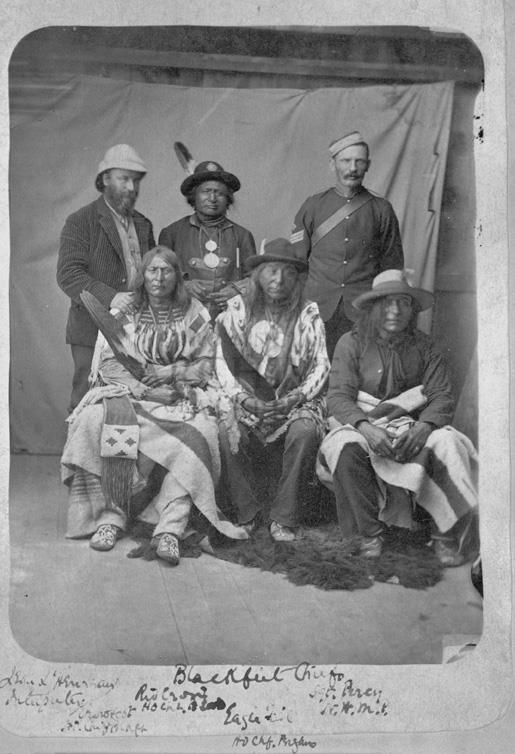
Title:     John Le Heureux, Red Crow, Sgt. Percy,
Crowfoot, Eagle Tail, and Three Bulls.
Provincial Archives of Alberta Number:     A16120
L'Heureux's early life is a mystery.  Sources claiming he was born in L'Acadie, Trois-Rivieres, near Saint-Hyacinthe, at Longueuil, or even in France.  Hugh Dempsey's entry for the Dictionary of Canadian Biography simply states that he was born around 1837 in Lower Canada. He was well educated, having trained for the priesthood as a young man but was kicked out by the Oblates.  Sources vary as to the reason for his displacement, but homosexuality or theft have both been suggested by historians.

L'Heureux arises in the history of the Canadian West in 1861, when he was staying at the St. Albert mission (near Fort Edmonton).  From the priests' perspective, L'Heureux's term in the region was inglorious.  After being discovered engaged in sodomy, he was quickly sent south.   The priests arranged for him to head to Montana with a band of Blackfoot.  Not one to follow others' plans, L'Heureux was quickly donning a cloak of authority.  By wearing a cassock, he told the Blackfoot that he was working for the Oblates, and managed to trick the Jesuits in Montana into believing he was a secular priest.

As Hugh Dempsey describes, L'Heureux found the Blackfoot more understanding that the Euro-Canadians:
Over the next several years L’Heureux lived with the Blackfoot, often wearing a cassock and performing baptisms and marriages. He was despised and vilified by the clergy and fur traders both for being homosexual and for pretending to be a priest. He was also mistrusted because of his complete devotion to the Indians who, he had discovered, did not condemn homosexuality. He took the Blackfoot name of Nio’kskatapi, or Three Persons, after the Holy Trinity. (CDBO)

Title: Group of Blackfoot Confederacy natives.
Remarks: L-R: One Spot [pipe bearer of Crowfoot],
 Blood; Red Crow, Blood; Jean L'Heureux, interpreter;
 North Axe, Peigan; Date: [ca. middle 1880s] 
GlenbowFile number: NA-2968-4
It was perhaps this acceptance by the Blackfoot that made L'Heureux such an advocate for the First Nations of the region. Throughout the 1860s to 1883 he routinely lobbied for help against epidemics, starvation, and the American army.  In 1877, at the Treaty No. 7 signing,  L'Heureux refused to translate for Lieutenant Governor David Laird as he would be interpreting for Crowfoot and other Blackfoot chiefs.  Frank Oliver, noted that L'Heureux, "stood unswervingly with the Indians as an Indian."  (Dempsey, CDBO)

L'Heureux worked for the Department of Indian Affairs during the 1880s, but was dismissed in 1891 for favouring the Roman Catholics.  His autumn years were spent in Father Lacombe's hermitage at Pincher Creek, and later he moved further into the foothills where he lived in seclusion.  In 1912, he was accepted into the Lacombe Home in Midnapore, "still wearing his cassock and clerical collar." (Dempsey, CDBO)  In 1919 he passed away and was recorded by the church as a "lay missionary."

Elsewhere Dempsey summarizes L'Heureux's mixed reputation among the principle groups in the early Canadian West.  The comments may serve as unfortunate epitaph for a wild and mysterious character who was an outsider to all cultures of the frontier.  "Throughout his life he was a controversial figure, despised and distrusted by many fur traders, an asset and embarrassment to the Oblates, and received by the Blackfeet with the mixed emotions they had for crazy people."  (Dempsey, Crowfoot: Chief of the Blackfeet, 1988, p. 83)


L'Heureux on far right.  Title: Blackfoot on visit to Ottawa, Ontario.Date: 1886
Photographer/Illustrator: Woodruff, John, Department of the Interior
Remarks: L-R back row: Father Lacombe, Jean L'Heureux (interpreter). L-R middle row: Three Bulls (Blackfoot), Crowfoot (Blackfoot), Red Crow (Blood). L-R front row: North Axe (North Peigan), One Spot (Blood).Image No: NA-13-2

Saturday, October 27, 2012

Buffalo Roundup: Montana Bison for Elk Island and Banff National Parks

Image No: PA-702-33
Title: Eleanor Luxton.
Date: 1928
The story of bison in Banff NationalPark is an interesting tale of the display of wilderness for both conservation and profitable tourism Like many aspects of Banff’s history, the story can be linked to the Luxton family. Eleanor Luxton’s work Banff Canada’s First National Park: A History and a Memory of Rocky Mountains Park (Banff: Summerthought, 1974, 2008) is a curious history of the town by an amateur historian and long-term resident.  It features a chronicle of Banff events, and reminiscences regarding the personalities and stories of the region. As an appendix to the work, a piece written by her father, Norman Luxton, “The Pablo Buffalo Herd”, tells the tale of the roundup of a large herd of bison from Montana destined for Banff and Elk Island parks.

The origins of the herd, can be linked to a 1873 hunting trip of  Walking Coyote, of the Pend d’Oreilles (or Kalispel) tribe. Coyote had killed a number of bison, and four calves followed him after the slaughter of their mothers. These beasts were kept as “pets” by the family and by 1884 had bred among themselves, expanding to a small herd of thirteen. (Luxton, p. 145) Ten of these animals were purchased by Michel Pablo, and C.A. Allard, and these were supplemented by the purchase of twenty-six other bison along with eighteen cattalos.  Luxton learned of the possible sale of the herd through a letter from Alex Ayotte, a Winnipeg Free Press writer, and immigration agent at Missoula. After some discussion with the minister of the interior, it was decided to purchase the herd.

Eleanor Luxton notes the idea was to purchase the bison for shipment to Canadian parks for, “conservation, tourist attraction and a possible source of food for the Indians.” An agreement was made to ship them north to Elk Island Park, and in 1907 Banff Park's superintendent Howard Douglas joined Norman Luxton and Ayotte on the trip. In a characteristic nod to the "real ol' West", Luxton recalled during the railway trip, “getting off at the stations to examine the bullet holes in the platform, put there by cowboys making tenderfeet dance.” (Luxton, p. 146)
Glenbow File number: NA-3581-10
Title: Buffalo cows and calves during Pablo-Allard round-up, Montana.
Date: [ca. 1906-1908]
Upon arriving at the Buffalo Camp, near Missoula, the men met up with a rough and ready crew of around thirty-five “mixed-blood” [presumably métis] cowboys. Eager to test the Canadians' mettle, one of the men asked Luxton to pick out a horse. A rangy grey was saddled for him, and he managed to stick to the bronc show that ensued. As Luxton recalled, “that lucky ride did me more good in the estimation of those cowboys than if I had presented them with a keg of liquor.” (p. 146)  Presumably, very few of the cowboys were teetotallers.

GMA File number: NA-3581-1
Title: Messieurs Ayotte, 
Allard and Douglas after
Buffalo round-up Ravalli,
 Montana.
Date: 1908
Staying at the mission at the Flathead reservation, an incident occurred which casts light on Luxton’s opinion of Ayotte, his rough sense of humour, and his techniques of “conservation”. Luxton had decided to sleep in a tent outside the mission, but Ayotte opted to inspect the mission house for a bed. Luxton was none too generous in his description of the man noting that, “he weighed 275 pounds, every ounce a tissue of selfishness added to an over-bearing manner.” It seems that Luxton knew that Ayotte would quickly discover that the beds in the mission were also inhabited by bed-bugs, and prepared to repel the man from his tent when the bites began to register. As Luxton records the event,
When I saw Ayotte leave for the house I hiked for the tent. I always carried a small twenty-bore shotgun on my trips to collect natural history specimens. Taking two shells I cut them in half leaving only the thin cardboard wad holding the powder. […]Ayotte [came] from the direction of the house, talking and swearing in French. […] Ayotte all but tore the tent-flap off, we saw his face splashed with dead bed-bugs, and I pulled one trigger. I fired the second shot as Ayotte was scrambling to his feet and running as he probably hadn’t done for some years. […] Alex slept in the stable from then on. Our night’s show amused the cowboys and raised us in their estimation. (Luxton, p. 146)
Glenbow Museum Image No: NA-3581-5 Title: Cowboys circling during Pablo-Allard buffalo round-up, Montana. Date: [ca. 1906-1908] Photographer/Illustrator: Luxton, Banff, Alberta
As might be expected, rounding up a herd of bison is no easy task. The group formed a horseshoe of around forty cowboys, and slowly tried to drive them off their homelands. As Luxton wrote,
Just about the time we thought we would really get them off their regular ground, suddenly, the whole herd would halt as if by command. They would turn around and face the way we had come, stand, not an animal moving in perhaps the hundred we had been following. All the cowboy’s horses stood – no sound. Then from a jump start the buffalo would charge right into the horse-show of riders, never swerving, as if possessed with the devil riding them. Never once was this charge broken, nothing stopped them, not even the river. (Luxton, p. 147)
GMA File number: NA-3581-11
Title: Buffalo being loaded at
 Ravalli, Montana.
Date: [ca. 1906-1908]
The plan was to load the animals into boxcars at Ravalli station. Again, with the beasts weighing up to two tons, this was not quite the same as herding sheep. The cars themselves were custom-built with plenty of reinforcement. As Luxton put it, “the joke was to get the buffalo into the car, for that matter it was a joke to get a buffalo to any wanted place.” A system of ropes was designed to pull the animals into place, but the best laid plans do not always survive first contact with bison! “One bull went straight through the car, he just took the side out as if it had not been there. Another bull broke his legs – well, the Indians had a feast out of that.” (Luxton, p. 148) Eventually driving around twenty-five head at a time, a total of 200 bison were loaded and bound for Canada.

Up to 1912, Eleanor Luxton notes that Elk Island Park received 708 buffalo from Montana. In 1911, the Banff bison paddock received seventy-seven of the beasts. Techniques changed, but the task of rounding them up was never easy. Eventually a system of loading individual bison onto wagons to transport them to the Ravalli station. The results were not always successful.
 ...he strung these wagons together, the crates open at each end except the last one. Four cowboys were on top of each crate to let down a gate effect as soon as a buffalo was in that crate. Sure the buffalo went in – even to the end of the train. Then things happened no one could describe. Talk about cyclone pictures of a town blown to pieces. In minutes not a wagon was on four wheels, kindling wood and cowboys scrambling for ponies were all that one could see.
Glenbow Image No: NA-1241-806
Title: Norman Luxton at Banff Indian Days, Banff, Alberta.
Date: 1942Photographer/Illustrator: Gully, F., Calgary, Alberta
Remarks: At Stoney tipi village, Cascade Park, Banff.
Luxton would long foster a sense that the last vestiges of the old West could be found in Banff.  By promoting Banff Indian days, and keeping the bison paddock stocked with quintessentially Western game, the Wild West was safely on display. He insured that an experience of the romantic West familiar to readers of Fenimore Cooper and admirers of the art of Charlie Russell was obtainable by all who came to the park.  Few visitors who noted the bison grazing from the train would know the hard toil involved in procuring the herd!

Friday, October 12, 2012

Banff's Bison: Hooked horns history in Banff National Park

The bison is the iconic symbol of the West, and its associations with a bygone romantic age has long been capitalized upon by boosters, promoters, and the tourist industry.  In the early days of Rocky Mountains Park, (which would officially be renamed Banff National Park in 1930), bison were displayed by the railway in a deliberate effort to evoke feelings of nostalgia and awe over the wilderness.  As Pauline Wakeham argues in Taxidermic Signs (University of Minnesota, 2008), bison were kept as "another railside attraction that catered to the CPR's promotional agenda of enabling tourists to encounter wildlife from the safety and comfort of their coach or car." (p.52)


Whyte Museum V263 / NA - 2966     Buffalo
Animal paddock at Banff
[between 1903 and 1942]     Byron Harmon fonds
Byron Harmon (Banff, Alberta)
In 1898, a 300 acre paddock for nineteen bison was established between the Banff townsite and Cascade mountain.  Within a decade the numbers had expanded to seventy-nine bison and a host of roaming ungulates along with lynx, raccoons, and porcupine kept in cages.  Problems in these early years of the paddock included lack of pasturage and blockage of migration routes through the Bow Valley.   Restriction of the animals inside the paddock made for easy hunting for coyotes sneaking under the wire, which in one year killed seven deer.

In 1907, these problems, combined with concerns of tourist access, prompted a change in the display of animals in the park.  On the grounds of the Banff Park Museum, a "zoological garden" was established to house the animals safely.  The park superintendent's report of 1906 notes the added bonus of ease of access.  "Cages constructed of cement and iron...would be...much more convenient for visitors to the museum.... I am strongly of [the] opinion ...that in a few years the zoological gardens should become one of the leading attractions for visitors to this portion of the National Park." (Wakeham, p. 53)


Whyte Museum V263 / NA - 2906
   97. Polar bear, zoo Zoo at Banff
[between 1903 and 1942]
  Byron Harmon fonds
Byron Harmon (Banff, Alberta)
While originally designed to display a selection of the abundant local wildlife, the zoo expanded to include exotic Mexican squirrels, a Mongolian partridge and even, in 1913, a polar bear. In these acquisitions Wakeham views the zoo as serving a "doubled colonialist function: while it enabled tourists to encounter frontier wildness as a controlled spectacle, thereby dramatizing civilization's mastery of the west, it simultaneously symbolized the Dominion's enduring connection to empire and 'the conquest of all distant and exotic lands.'" (Wakeham, p.53) Wakeham is particularly disturbed by the curious conservationist justification for keeping animals in the zoo and collecting their taxidermic counterparts in the Banff Park Museum.  She argues that these animals served as metonyms for the bountiful animal populations associated with the western frontier.  Paradoxically, the animals distanced the viewer from wildlife, heightening the animal's absence from the surrounding environment.  As Susan Willis argued,
zoo animals are body doubles, stand-ins for the real animals existing (or becoming extinct) elsewhere.  Visit a zoo and you walk through a living cemetery of all that is diminishing, disappearing, and soon to be gone.  Look at the animals...they are living taxidermy." (Quoted in Wakeham, p. 56)

V469 / 2792     Banff National Park Museum
Pertains to Government Museum, Banff
[ca.1918]     George Noble fonds
The animals in Banff, however, had more than a symbolic connection to taxidermy.  The Banff Park Museum, like many other Victorian natural history museums, featured stuffed animals which sought to educate and entertain visitors.  While a rhetoric of preservation surrounding these "artifacts", Wakeham argues that, "the traffic in animal bodies that connected the spaces of the natural history museum, the paddock, and the zoo hinged upon the consumption rather than conservation of nature." (p. 57)  This interconnection of these sites is highlighted in the superintendent's report of 1904.  "A fine four-year-old was killed in June last [year] while fighting with another bull. His head has been mounted, and now adorns the walls of the museum, where it attracts the attention of admiring visitors." (Quoted in Wakeham, p. 57)  In 1908, an elk that died while fighting and a bison which succumbed to pneumonia were also added to the museum's specimens.

While the Banff zoological gardens were closed in 1937, when the expansion of urban zoos across the world made the site seem out of place, the paddock continued to operate until 1997.  Then it was determined that the paddock, (along with an airstrip, horse corrals, and army cadet camp) were impededing wolf and bear migration between the Vermillion Lakes and the Cascade Valley.  The last ten bison were moved to Elk Island Nation Park in October, 1997. (Wakeham, p. 59)


Pauline Wakeham,
 Taxidermic Signs, (2008)

These animal's eventual demise, while not proven by irrefutable evidence, serves as a surreal post-script to the macabre story of animal display in the park.  Wakeham noted that when the bison were transferred to Elk Island, Parks did not intend these beasts to chew cud happily there until the  end of their days.  The herd was instead to be sold off, with the profits returned to Parks Canada.  Wakeham writes,
While the trail of Banff's bison becomes somewhat hard to track after this point, evidence suggests that the animals were purchased by the Oil Sands magnate Suncrude for display on the environmentally 'reclaimed' land north of Fort McMurray.  Although the 'Bison Viewpoint' just outside the borders of Suncrude's current mining sites deploys the animals as a symbol of ecological regeneration in the wake of industrial apocalypse, the herd has suffered form anthrax and tuberculosis due to environmental mismanagement.  Rather than constituting a triumph for conservationism, the closure of the Banff paddock set in motion further traffic in animal bodies that perpetuated the exploitation of wildlife. (Wakeham, p. 59)
A contemporary group, Bison Belong, wish to reintroduce bison into the park, and presumably would take issue with Wakeham's post-colonial critique.  While their plan would include the use of bison fencing to give the animals a much larger area to roam than the old paddock, Wakeham would still take offence to management of animals in this way.  Problems with disease, and visitor safety work against the group, but great demand for the bison may enable these to be surmounted.  Should the plan go through, however, it is highly unlikely that the heads of these woolly beasts will be hung in the Banff Park Museum.

Wednesday, October 10, 2012

General James Dickon's Indian Liberating Army

"General" James Dickson, the so-called "Liberator of the Indian Nations", is a curious character, who goes down in Western Canadian history as a brief sojourner with more passion than sense.  Dickson's lineage is vague, but he has been claimed to be the "mixed-blood son of a British trader and Toto-win, sister of Sisseton Sioux Chief Red Thunder."  (Thomas Ingersoll, To Intermix with Our White Brothers , p. 104)  The governor of the Hudson's Bay Company, George Simpson described him as "covered with huge whiskers and mustachios and seamed with sabre wounds."  Elsewhere it has been noted that,
a bizarre character appeared in fashionable circles in New York and Washington in the winter of 1835-36, endeavoring, as he then said, to secure recruits to aid the Texans in their struggle for independence.  He called himself General James Dickson and told fascinating stories of his life in Mexico and of his service in the Texan army. His striking military dress and a very nice attention to the amenities of social life secured recognition for him but seem to have brought him few recruits. (Nute, p.352)
Dickson's claim to fame was an attempt at gathering support for the establishment of a aboriginal state stretching from Rupert's Land to Texas. 
Banner from Martin McLeod's "Attestation Papers", Nute

In 1836, Dickson recruited around thirty men from Montreal to join him in his quest.  All were apparently made officers in his army, and granted dress uniforms complete with "showy uniforms and glittering epaulettes." (Lyman C Draper George Simpson would call these men, "wild thoughtless young men of good education and daring character, half-breed sons of gentlemen lately and now engaged in the fur trade."  (Jennifer Brown, Strangers in Blood, p.190)  Elizabeth Arthur, writing for the Dictionary of Canadian Biography, noted that he may not have told these recruits the full story of his plans to travel to Santa Fe, New Mexico, attack the fort and continue on to California, where he would establish a "utopian state in which Indians would hold all the property and where only a few white officials would be permitted."
McLeod County Minnesota.  Wikipedia.

One of Dickson's party was Martin McLeod, whose diary has survived the years.  McLeod was born near Montreal, but would later become a member of several councils in the Minnesota territorial legislature.   His presidency of the fourth council may be the reason why McLeod County, Minnesota was named for him.  Once in Minnesota, he would long function as a booster for the area, writing Canadian newspapers in praise of Minnesota. (Grace Lee Nute ed., The Diary of Martin McLeod, Aug 1922)

As McLeod made his way from Montreal to meet Dickson, he travelled Lake Ontario to Toronto, where he spent the day.  From his diary entry of 20 July 1836, it may be said that he did not enjoy his stay:
Remained one day at Toronto, do not like the place.  Saw Al[exander] Robertson of Inverness (an acquaintance at Montreal).  People kind enough apparently, but I think some what pompous.  Why?  God only knows.  What have they to bost of.  Their town or city (as I believe it is call'd) is a muddy hole - but then it is the Capital of [Upper Canada] and they are up to their ears in politics (damn politics) and they have Sir [Francis Bond Head] (whom by the by I saw a cheval) who is very popular &c &c and all that, so you see they are a people of some consequence, and not to be sneezed at, - that is if the d-------d stench of their town would allow a person to take his finger from his nasal organ long enough for that pleasant exercise. (McLeod, p.355)
It was in Black Rock several days later that McLeod would meet General Dickson.  McLeod seemed slightly skeptical of the "General's" abilities noting that Dickson,
privately, informed me of his plans &c relative to the intended expedition to the north via  the great lakes and onwards God only knows where; and where and when it may end.  D[ickson] appears quite sanguine of success. As yet I know little of the man, but if I may judge from so short an acquaintance, he is some what visionary in his views - n'importe I wish to go north & westward and will embrace teh opportunity, but must "look before I leap." (McLeod, p.359)

As Dickson had learned of Cuthbert Grant and the militant abilities of the Métis, he intended to gain recruits for his army in Red River.  He set out from Buffalo with only sixty of the 200 men that were initially proposed for the force.  As they had no money or supplies to speak of, they resorted to stealing and slaughtering some cattle near Detroit.  Unfortunately a sheriff's posse caught up with them, and they were made to pay a fine after some tricky negotiating.

The travelling was hard, and made particularly difficult by Dickson's questionable command decisions. (Anne Hyde, Empires, Nations, and Families, p.132)  Dickson could not help the damage done by a storm to their schooner on the Great Lakes which almost swamped them, but his decision to press ahead of his party in northern Minnesota without adequate supplies was highly questionable.

On the 27th November 1836, McLeod noted the difficulties crossing Cass Lake after the winds had polished the ice.  The party travelled 30 miles that day.  The next day McLeod noted, "Obliged to rest as a number of the party are unable to proceed from the fatigue of yesterday's march and the bruises which they received from frequent falls upon the ice. Indeed all our men were so "done up " that they did not arrise yesterday till near dark." (McLeod, p. 388)

It was when the party's Sioux guides left them on the 9th of December, that Dickson's leadership began to crumble.  They had left Thief River that day and were still around a week's walk to the Red River settlement, yet were not at all familiar with the open prairie.  As McLeod wrote in his diary:
Saturday 10th Decr At day break we were summoned together,and informed by Gen1 D[ickson] that as our guides had desserted and as we had but five days provisions, and had yet to travel near three hundred miles in a strange country of which we had not an accurate map, he left us all to act, each man for himself, to either follow him, as it was his determination to trust to fortune and push forward, or return to Red lake and there wait untill they could procure a guide. I had previously made up my mind to continue my route at every risk, and all the rest with the exception of two preferring to follow Gen1 D., we made immediate preparations to start.
It was several days later that Dickson left the main group without blanket, food, nor means to light a fire. Dickson arrived in Red River, starving and frost-bitten.  As Lyman Draper noted, "the cold weather set in before their arrival at Red river [sic], and Dickson had his toes frozen off, which crippled him as well as the whole enterprise."  (Draper) 

Sir George Simpson, Governor of the
 Hudson's Bay Company, 1857.
Credit: Library and Archives Canada, Acc. No.
1978-14-3 Source: Manuscript Division,
 W.W. Campbell Collection (MG30 D 8)
Governor Simpson was none too amused with the party, refused his bank drafts and quickly employed the men who had been recruited.  Several of Dickson's recruits were in fact the mixed-blood sons of HBC officials.  Their sense of adventure was probably supplanted by their common sense, after the hard travelling in the company of Dickson.  In the spring of 1837, the Indian Liberator left Red River, incredibly, worse off for resources than when he arrived. (Pannekoek, Snug Little Flock, 90).  As Grace Lee Nute put it in 1922, "America has been the land of roseate dreams; but, among all its visions of wealth and power, where is the equal for novelty and adventure of this mad product of Dickson's disordered mind?" (Nute, 352)

Wednesday, October 3, 2012

Rudy Wiebe's Essay, "On the Trail of Big Bear"

The origins of one of Rudy Wiebe's old works has some interesting detail about the writer's own roots.  Wiebe has not been relegated to the has-been dusty classics section just yet.  He was recently featured on the television series Extraordinary Canadians, presenting the case of Cree chief, Big Bear.  As the author of Governor General's Award winning The Temptations of Big Bear (1973), Wiebe was a natural choice to write on this well-known chief for the show's sister series of Extraordinary Canadians books.  His comments in a 1975 collection of essays give an intimate look at the creation of the original ground-breaking biography.  Written in Wiebe's experiential voice, the essay shows that First Nations' history in the 1970s was only beginning to be told.

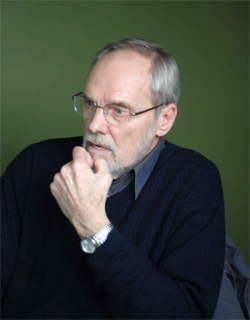
Rudy Wiebe.  Athabaska University
Wiebe's, "On the Trail of Big Bear", published in Western Canada Past and Present, the proceedings of the Western Canadian Studies Conference, is as interesting for its insight into the state of Canadian historical scholarship as it is for providing a window into Wiebe himselfThe essay sheds interesting light on the path by which Wiebe came to Big Bear as the source of his literary non-fiction, and contains some visceral prose in-itself.

Of his difficulties telling the story of Big Bear, Wiebe wrote that when thinking historically the novelist had to attempt to let the senses "be his guide through the maze of life and imagination."
Through the smoke and darkness and piled-up factuality of a hundred years to see a face; to hear, and comprehend, a voice whose verbal language he will never understand; and then to risk himself beyond such seeing, such hearing as he discovers possible, and venture into the finer labyrinths opened by those other senses: touch, to learn the texture of leather, or earth; smell, the tinct of sweetgrass and urine; taste, the golden poplar sap or the hot, raw buffalo liver dipped in gall (Wiebe, p. 183)
Wiebe writes that it was in 1967 that he remembered his earlier reading of William Cameron's The War Trail of Big Bear, and recognizing a connection between the events of the 1885 Rebellion and his own prairie origins.  Wiebe writes,
it was from reading Cameron in the '50s that I first realized that the bush homestead where I was born in northern Saskatchewan probably was traversed in June, 1885, by Big Bear and his diminishing band as among the poplars they easily eluded the clumsy military columns of Strange and Middleton and Otter and Irvine pursuing them; that I first realized that the white sand beaches of Turtle Lake, where Speedwell School had its annual sportsday with Jackpine and Turtleview Schools, right there where that brown little girl had once beaten me in the grade four sprints, a race in which until then I was acknowledged as completely invincible: perhaps on that very beach Big Bear had once stood looking at the clouds trundle up from the north (Wiebe, p. 184)
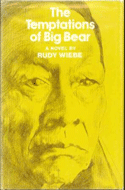
Wiebe's 1973 Temptations of Big Bear
Wiebe's comments also speak of the lack of First Nations in the history taught in schools during his day.  He wrote:
Of course, thanks to our education system, I had been deprived of this knowledge when I was a child; we studied people with history - like Cromwell who removed a king's head, or Lincoln who freed slaves - but I can see now that this neglect contained an ambiguous good.  For in forcing me to discover the past of my country on my own as an adult, my public school inadvertently roused an anger in me which has ever since given an impetus to my writing which I trust it will never lose.  All people have history. (Wiebe, p. 184-85)
Writing in 1975, Wiebe seems to premeditate the direction that Canadian history would soon turn, from the nation-building heroes of the majority towards the untold story of the "other".  He wrote of the difficulty in discovering the life of Big Bear, who had been neglected by the works focused on founding fathers.
Beneath the giant slag heap left by the heroic white history of fur trader and police and homesteader and rancher and railroad builder (O, the heroism of that nineteenth-century computer Van Horne as sung by that twentieth-century computer Pierre Berton Incorporated!), somewhere, under there, is the story of this life.  Can I dig it out? Will I dare to look at it once I have, if I dare, unearthed it? (Wiebe, p. 185)
Wiebe's new work on Big Bear for the Extraordinary Canadians series.

Friday, September 7, 2012

Strychnine and Axe-attacks North of Cochrane Alberta, 1890

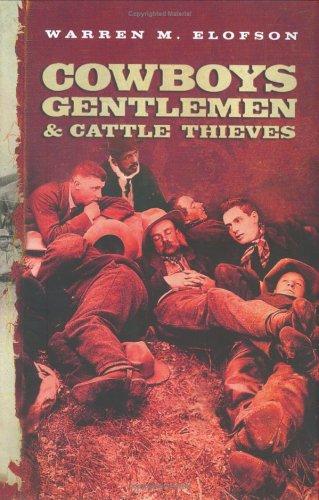
The old myth of the Canadian west as well-behaved and orderly, kept calm by respectable Mounties, and in no way related to the wild and woolly frontier south of the forty-ninth parallel, has not stood the test of time. Warren Elofson's Cowboys Gentlemen and Cattle Thieves (2002), is one work which argues that the image of the tame Canadian west dominated by metropolitan influences from Eastern Canada and Britain is in need of adjustment.  Elofson argues that Canadians could behave, "in astonishingly undisciplined and intemperate ways." He writes,
 
It is time to stop insisting on the absence of factors such as the frontier environment and lawlessness in western heritage. The frontier not only determined to a considerable extent the day to day practices utilized by the ranchers to run, protect and nurture their livestock, but did much to fashion their entire way of life, or culture in the broadest sense. A tendency towards extra-legal and even illegal modes and measures was part of that culture." (Elofson, xvi)

An 1890 North-West Mounted Police patrol report of the Cochrane, Bottrel, and Morley area seems to confirm Elofson's suggestions that the Canadian west could get downright unruly.  Corporal R. Macdonald was the leader of the patrol which set out west from Calgary at 8:30 a.m. on 6 June 1890.  What today takes no more than an hour's drive took the patrol all day, as they arrived in Cochrane at 5pm.  The next day they headed north on what was for some time called the Dog Pound, or Bottrel Road, but is now the Highway 22, (or, if you will, "The Cowboy Trail").  They stayed that evening at the Jenkins Brothers house.  The patrol learned that one of the Jenkins had been party to some spiteful violence which quickly escalated.

Corporal Macdonald's patrol report does not delve into the origins of the animosity between Jenkins and one James McDonough, but presumably a feud had been brewing for some time.  It may be the case that an errant canine was the source of the hostility.  As Macdonald wrote,
 A short time ago Jenkins + Nelson had determined to poison a dog belonging to James McDonough on account of its being in the habit of chasing their cattle.  Information to that effect was carried to him by Botterell - the consequence was a violent quarrel ending in the most abusive language by McDonough + a blow by Jenkins[. The] former then attempted to strike the latter with an axe. (RG18, Vol. 42, File 495)
It seems that McDonough was suspected of some foul play regarding poisonings in the area after the incident.  A horse some distance from Dog Pound Creek was found poisoned and it was discovered that McDonough had been to Calgary to buy fifty cents worth of strychnine.  Macdonald reported:
The bowels of the dead horse were examined by Dr. Heydon[?] of Mitford and strychnine was found in them.  In a conversation that I had with McDonough on the subject he said, "Its lucky that I live so far from him or he would suspect me of having killed them" he then went on to say "Its my opinion that they must have picked up some poisonous herb" and, on my telling him of the Doctors report, he said "Oh" several times in succession.
RG18, Vol 42, File 495. "Patrolling, Calgary District, Reports re."


The verdict on the McDonough poisoning case awaits further research, but the patrol report does provide some evidence supporting Elofson's thesis that the Canadian west could be violent.  The report gives great details on the region north of Cochrane, where in 1890 only twenty-four settler names could be procured in a area of approximately 500 square kilometers.  Corporal Macdonald reported healthy crops and fat sheep and cattle grazing on the open range.


Calgary Condominiums
Today the area is well-fenced, and cattle and a few sheep still placidly wander the grasslands, albeit with the occasional oil pump-jack in the way.  The Bottrel store sells grains and other agricultural goods, but children and adults alike from the nearby provincial campground seem to prefer the ice-cream.  Should one be interested in owning a piece of early western history, the store is up for sale!


Tuesday, August 28, 2012

Mistranslation of Big Bear at Fort Pitt Treaty Negotiations

The mistranslation of treaty negotiations is central to recent First Nations historical scholarship which questions the ability of Dominion negotiators to convey the nature of land surrenders.  In the case of Big Bear's negotiations with Alexander Morris at Fort Pitt, historian Hugh Dempsey suggests that if proper translation of the Cree chief's words had been available, "Big Bear might have received an assurance from Morris that could have changed the course of history." (Dempsey, Big Bear, 1984, p.74)
A none too flattering sketch of Big Bear
Glenbow File number: NA-1353-16
Title: Big Bear, Cree chief, and General T. Bland Strange, with Fort Pitt, Saskatchewan in back
Date: 1885

In 1876, Big Bear came to Fort Pitt after the treaty had been signed, hoping to negotiate better terms for his band, and receive assurances on the conservation of the buffalo herds.  When Cree chief Pakan urged him to accept treaty, and talk to Lieutenant Governor Morris, Big Bear insisted,
Stop, stop, my friends.  I have never seen the Governor before; I have seen Mr. Christie many times.  I heard the Governor was to come and I shall see him.  When I see him I will make a request that he will save me from what I most dread, that is: the rope to be about my neck... (Dempsey, 74)
The likely translator for Big Bear was the Reverend John McKay, who spoke Swampy Cree, and had previous difficulties translating at Fort Carlton.  Peter Erasmus, who had left Fort Pitt immediately after the main negotiations were finished noted, "I knew that McKay was not sufficiently versed in the Prairie Cree to confine his interpretations to their own language."
File number: NA-4774-16
Title: Chief Joe Samson and horse during
 filming of 'The Last Frontier',
 Wainwright, Alberta. Date: 1923

As Dempsey notes, Morris remained fixated on Big Bear's comment about a rope around his neck, which he thought to mean fear of being hung.  Instead it is more likely that he was using an expression of haltering a horse, which was a metaphor for losing his freedom.  The term ay-saka-pay-kinit for "lead by the neck" was being confused with ay-hah-kotit, "hung by the neck".  Morris thought the chief was insisting that his band should be exempt from capital punishment, and told him that no "good Indians" would be executed.


Big Bear did not understand this response, but after re-emphasizing that he did not want to lose his freedom, he still could not get his point across.  His words were mistranslated again: "I have told you what I wish, that there be no hanging."  Morris responded, "What you ask will not be granted.  Why are you so anxious about bad men?" (Dempsey, p.75)


Hon. Alexander Morris, Dec. 1869
Credit: Topley Studio / LAC/ PA-025468

Dempsey suggests that had it been explained to Big Bear that his band would have been allowed to hunt across the plains, that his long struggle for better terms which led to much hardship could have been solved.  It seems clear that Big Bear wished to consult with his people further and did not go to Fort Pitt in 1876 prepared to sign treaty, but the misunderstanding about his rights and freedoms under the reservation system aggravated the distrust between the two parties.

The legacy of the mistranslation led the Dominion's representatives to continue to see Big Bear as wanting special legal circumstances  for his band.  In 1878 Lieutenant Governor David Laird noted of Big Bear,
He still, I am informed, entertains the idea that Indians should be exempted from hanging.  It is said also that he thinks Indians should not be imprisoned for any crime and though he asked Liet. Gov. Morris in 1876 that the buffalo should be protected he did not intend that any law of the kind should apply to Indians.  (Dempsey, p. 80).

Translation issues continued to plague Big Bear as he continued to press for better terms.  After the North-west Rebellion of 1885, at his trial for treason-felony, the charges ended with the statement that the offences were "against the peace of our Lady the Queen, her Crown and dignity."  The translator could not find the right meaning of Crown in the British legal sense, and Big Bear's reply shows his confusion over the term:
These people all lie.  They are saying that I tried to steal the Great Mother's Hat, how could I do that?  She lives very far across the Great Water, and how could I go there to steal her hat? I don't want her hat and did not know she had one. (Dempsey, p. 185)
It is clear that translation problems plagued Big Bear during the hard times of the treaties.  He would not survive long after his trial.  While deemed guilty of participation, he was at least given some mercy and a three-year sentence in Stony Mountain Penitentiary.  In an unfortunate twist, Big Bear became gravely ill while incarcerated, and in 1888 was let out only to die shortly afterwards in his sixty-third year.

Remarks: L-R back row: Father Albert Lacombe; Big Bear, Cree; Sam Bedson, Warden; Father Clouthier. L-R front row: unknown priest; Poundmaker, Cree Glenbow Archives Image No: NA-20-2
Title: Riel Rebellion prisoners at Stony Mountain Penitentiary, Manitoba.
Date: 1886

Friday, August 10, 2012

Of Meteors, McDougalls and Manitou

A 2012 controversy over the question of repatriation of a meteorite considered sacred to Alberta First Nations is making headlines. Members of the Blue Quills First Nation are considering creating a ceremonial space which houses the meteorite should they be able to gain access to the 386 pound chunk of iron.  The meteorite is held today at the Royal Alberta Museum, where it was repatriated from collections in Ontario.  The Methodist roots of what was once Victoria College are the key to how it arrived there.
Glenbow Image No: NA-789-148
Title: Reverend Thomas Woolsey.

The earliest written report of the meteorite was made in 1810 by Alexander Henry the Younger, who noted the placename "Iron Stone".  It wasn't until 1860 when the Methodist Reverend Thomas Woolsey wrote a descriptor of the stone itself:

When with the Crees last August, I visited the locality renowned for having a large piece of iron there.  In fact, an adjoining lake and a rivulet bear the respective designations of Iron Lake and Iron Rivulet.  Well, there the iron is, as pure as possible and as sonorous as an anvil, and weighs, I should judge 200 lbs.  It is on the summit of a mound but whether it is a metoritic phenomenon or indicative of iron in that section, I cannot say.  (Southesk, 1875 as cited in Spratt, "Canada's iron creek meteorite", Journal of the Royal Astronomical Society of Canada 1989. )
One supernatural aspect of the stone was its professed ability to grow in size.  Writing in 1865, explorer Walter Butler Cheadle was told that the stone was the size of a fist when it was first put atop the hill, but could no longer be lifted.


"Manitou Stone"  Aaron Paquette. Print: Society6
The stone itself was considered to have been placed on a hill by the Ojibwa spirit Nanebozo close to the Battle River near present day Hardisty.  Some say one can see the face of Manitou (or the Great Spirit) on its surface.  The stone was said to have protective powers, especially over the buffalo and local aboriginals.  Hugh Dempsey notes in Big Bear: End of Freedom (1984) that offerings were left by the stone when the Cree left for the hunt. (Dempsey, p.37)

Unfortunately for the Cree, in 1866, the Methodist Reverends George and John McDougall decided to take this object of worship from its resting place by the Battle.  George McDougall noted that "for ages the tribes of Blackfeet and Crees have gathered their clans to pay homage to this wonderful manitoo." (Dempsey, p.38)  The McDougall's took the stone to Victoria Settlement.  One account notes that they used it as a part of the church's foundation, but others recall it lying in the church yard. Until this time the missionaries were largely tolerated, but Dempsey notes that the taking of the stone was the beginning of grave doubts about the intentions of the newcomers.

Medicine men predicted sickness, war and starvation, as a result of the removal of the guardian of the buffalo.  By 1873, all had come to pass. (Dempsey, 52).  It has also been suggested that George McDougall would suffer for moving the rock, and that his loss of three children to smallpox the next year was his penance.  Just which McDougall actually removed the stone, seems to be in question.  Sir William Francis Butler wrote in 1872 that David McDougall, a trader son of George's removed the stone.
Glenbow File number: PC-242-1
Title: Reverend George McDougall,
 Methodist missionary.
Date: [ca. 1860s]

After around 15 years at Victoria Settlement (now Pakan, Alberta), the Stone was sent east to the Methodist Victoria College, in Cobourg, Ontario where it adorned a hall.  It found its way to the Royal Ontario Museum, and in the 1970s was repatriated to the Royal Alberta Museum.


The meteorite is the third-largest to be found in Canada, and theories suggest that it is merely a piece of a much larger rock.  One rumour has it that the First Nations buried the rest of the rock so it would not be looted by Euro-Canadians.  The legend of this still remaining meteorite was continued by the Alberta Museum geologist Don Taylor in the 1960s.  Taylor had met with Hardisty local Bill McDonald, who told stories about the stone weighing around 1,500 pounds.  Others presume this to be false and that this larger rock was probably one of the aboriginal rock carvings, called rib-stones, seen in the area.

Various samples have been taken from the rock over the years and were once held in places such as the Smithsonian, the American Museum of Natural History, and the British Museum of Natural History.  Christopher Spratt noted in 1989, that 668.4 grams of the meterorite had been removed, and housed at six museums across Europe and North America.  No mention has been made yet in the media regarding the return of these pieces should the meteor ever leave its home at the museum.

The future of the rock has yet to be decided.  Problems returning the meteorite to one specific First Nation may arise.  Repatriating artifacts sacred to First Nations would not be unprecedented.  The Glenbow Museum has repatriated sacred bundles to the Blackfoot, for example, and loaned parts of its collection out for ceremonial use.  Only time will tell where the Manitou Stone will be headed next, but it is clear that the meteorite, as scientific or sacred object, has aroused interest for over two hundred years.

Thursday, August 9, 2012

Big Bear's vision against Horse Ownership


Big Bear in custody at Regina, 1885.
Credit: O.B. Buell
/ Library Archives Canada / C-001873
Big Bear (1825-1888) was a legendary Cree Chief, whose heritage was both Cree and Ojibwa.  While the Cree, of course, had their own medicine men, the Ojibwa were particularly known for their spiritual abilities.  Big Bear's visions were central to his interpretation of the world around him, and it is said he foresaw the end of the plains peoples' way of life, foretelling times even more troubling that those of frequent epidemic in the early nineteenth-century.

One dream, recounted in Hugh Dempsey's Big Bear: End of Freedom, has been attributed to Big Bear's peculiar stance against acquiring horses.  For the Cree and Blackfoot, horse theft was an art and means to status.  Capturing a herd of thundering horses from one's enemy proved a man's prowess.  Theft was a part of prairie life.  Big Bear, however, while participating in horse raiding, distributed the chargers he acquired to his family and those in need.  Dempsey notes that this was more than just the generosity of a prospective chief, but also "the fulfilment of another vision." (Dempsey, 19)

In a dream a spirit came to Big Bear and led him to a cave filled with horses.  The spirit told him to,
Go to the centre of the herd and take the horse that you find there.  Don't take any other horse, just that one.  The horses will rear up and kick at you, but if you show no fear, they will move aside and let you pass.  But if you show any fear, you won't get to the horse in the middle.  (Dempsey, 19)

Unfortunately when Big Bear neared the middle of the cave, a large black stallion reared up, making at him with its hooves and Big Bear shrunk back in defence.  The herd vanished.  Suddenly alone with the spirit man, he was told, "It's too bad you crouched.  You had your chance but now you'll never be rich in horses as long as you live."
Glenbow Museum and Archives File number: NA-1709-43
Title: Cree people at Poplar Grove [Innisfail]
Date: [ca. 1891]
Big Bear interpreted this to mean that he should never try to accumulate horses, and thereafter only kept as many as he needed for himself.  Dempsey, whose biography of the Cree chief adapted First Nations' stories from numerous reservations in the Canadian West, noted that spirituality was central to Big Bear's life, and that, "he was remembered as much for the supernatural power he possessed as for his political acumen."   His source for Big Bear's horse theft vision come from a 1982 conversation with the Reverend Stan Cuthand.