Showing posts with label animals. Show all posts

Friday, October 12, 2012

Banff's Bison: Hooked horns history in Banff National Park

The bison is the iconic symbol of the West, and its associations with a bygone romantic age has long been capitalized upon by boosters, promoters, and the tourist industry.  In the early days of Rocky Mountains Park, (which would officially be renamed Banff National Park in 1930), bison were displayed by the railway in a deliberate effort to evoke feelings of nostalgia and awe over the wilderness.  As Pauline Wakeham argues in Taxidermic Signs (University of Minnesota, 2008), bison were kept as "another railside attraction that catered to the CPR's promotional agenda of enabling tourists to encounter wildlife from the safety and comfort of their coach or car." (p.52)


Whyte Museum V263 / NA - 2966     Buffalo
Animal paddock at Banff
[between 1903 and 1942]     Byron Harmon fonds
Byron Harmon (Banff, Alberta)
In 1898, a 300 acre paddock for nineteen bison was established between the Banff townsite and Cascade mountain.  Within a decade the numbers had expanded to seventy-nine bison and a host of roaming ungulates along with lynx, raccoons, and porcupine kept in cages.  Problems in these early years of the paddock included lack of pasturage and blockage of migration routes through the Bow Valley.   Restriction of the animals inside the paddock made for easy hunting for coyotes sneaking under the wire, which in one year killed seven deer.

In 1907, these problems, combined with concerns of tourist access, prompted a change in the display of animals in the park.  On the grounds of the Banff Park Museum, a "zoological garden" was established to house the animals safely.  The park superintendent's report of 1906 notes the added bonus of ease of access.  "Cages constructed of cement and iron...would be...much more convenient for visitors to the museum.... I am strongly of [the] opinion ...that in a few years the zoological gardens should become one of the leading attractions for visitors to this portion of the National Park." (Wakeham, p. 53)


Whyte Museum V263 / NA - 2906
   97. Polar bear, zoo Zoo at Banff
[between 1903 and 1942]
  Byron Harmon fonds
Byron Harmon (Banff, Alberta)
While originally designed to display a selection of the abundant local wildlife, the zoo expanded to include exotic Mexican squirrels, a Mongolian partridge and even, in 1913, a polar bear. In these acquisitions Wakeham views the zoo as serving a "doubled colonialist function: while it enabled tourists to encounter frontier wildness as a controlled spectacle, thereby dramatizing civilization's mastery of the west, it simultaneously symbolized the Dominion's enduring connection to empire and 'the conquest of all distant and exotic lands.'" (Wakeham, p.53) Wakeham is particularly disturbed by the curious conservationist justification for keeping animals in the zoo and collecting their taxidermic counterparts in the Banff Park Museum.  She argues that these animals served as metonyms for the bountiful animal populations associated with the western frontier.  Paradoxically, the animals distanced the viewer from wildlife, heightening the animal's absence from the surrounding environment.  As Susan Willis argued,
zoo animals are body doubles, stand-ins for the real animals existing (or becoming extinct) elsewhere.  Visit a zoo and you walk through a living cemetery of all that is diminishing, disappearing, and soon to be gone.  Look at the animals...they are living taxidermy." (Quoted in Wakeham, p. 56)

V469 / 2792     Banff National Park Museum
Pertains to Government Museum, Banff
[ca.1918]     George Noble fonds
The animals in Banff, however, had more than a symbolic connection to taxidermy.  The Banff Park Museum, like many other Victorian natural history museums, featured stuffed animals which sought to educate and entertain visitors.  While a rhetoric of preservation surrounding these "artifacts", Wakeham argues that, "the traffic in animal bodies that connected the spaces of the natural history museum, the paddock, and the zoo hinged upon the consumption rather than conservation of nature." (p. 57)  This interconnection of these sites is highlighted in the superintendent's report of 1904.  "A fine four-year-old was killed in June last [year] while fighting with another bull. His head has been mounted, and now adorns the walls of the museum, where it attracts the attention of admiring visitors." (Quoted in Wakeham, p. 57)  In 1908, an elk that died while fighting and a bison which succumbed to pneumonia were also added to the museum's specimens.

While the Banff zoological gardens were closed in 1937, when the expansion of urban zoos across the world made the site seem out of place, the paddock continued to operate until 1997.  Then it was determined that the paddock, (along with an airstrip, horse corrals, and army cadet camp) were impededing wolf and bear migration between the Vermillion Lakes and the Cascade Valley.  The last ten bison were moved to Elk Island Nation Park in October, 1997. (Wakeham, p. 59)


Pauline Wakeham,
 Taxidermic Signs, (2008)

These animal's eventual demise, while not proven by irrefutable evidence, serves as a surreal post-script to the macabre story of animal display in the park.  Wakeham noted that when the bison were transferred to Elk Island, Parks did not intend these beasts to chew cud happily there until the  end of their days.  The herd was instead to be sold off, with the profits returned to Parks Canada.  Wakeham writes,
While the trail of Banff's bison becomes somewhat hard to track after this point, evidence suggests that the animals were purchased by the Oil Sands magnate Suncrude for display on the environmentally 'reclaimed' land north of Fort McMurray.  Although the 'Bison Viewpoint' just outside the borders of Suncrude's current mining sites deploys the animals as a symbol of ecological regeneration in the wake of industrial apocalypse, the herd has suffered form anthrax and tuberculosis due to environmental mismanagement.  Rather than constituting a triumph for conservationism, the closure of the Banff paddock set in motion further traffic in animal bodies that perpetuated the exploitation of wildlife. (Wakeham, p. 59)
A contemporary group, Bison Belong, wish to reintroduce bison into the park, and presumably would take issue with Wakeham's post-colonial critique.  While their plan would include the use of bison fencing to give the animals a much larger area to roam than the old paddock, Wakeham would still take offence to management of animals in this way.  Problems with disease, and visitor safety work against the group, but great demand for the bison may enable these to be surmounted.  Should the plan go through, however, it is highly unlikely that the heads of these woolly beasts will be hung in the Banff Park Museum.

Sunday, May 22, 2011

Big Top Images: The Circus comes to Canada

Ladies and Gentlemen, Boys and Girls, Children of all Ages, step right up and prepare yourselves for the most Exhilarating Exhibition on Earth! Animals from the far-flung jungles of Africa!  Exotic specimens from around the globe!  We've got the Wild West, Far East, Southern Belles and Natives of the North, all displayed for your amusement and curiosity under the Big Top!

The Circus in popular conception seems to wedded to America, yet one only need to think of the Roman Circus Maximus, where chariot races, animal displays and mock battles were staged, to consider the long human fascination with spectacle.  The modern circus is attributed to a Brit by the name of Philip Astley, whose riding school in the late 18th Century grew to include clowns, domesticated animals, music and acrobatics. Only in 1792 would the circus cross the Atlantic to the new world.  A number of circus posters at Library and Archives Canada show that the circus was a popular event in the twentieth-century dominion.  It was often the lure of the foreign unknown which drew Canadians in droves to the Big Top.

Poster From 1935. Library and Archives Canada, Acc. No. 1980-84-68


Part of the allure of the circus was the exotic animals and people on display.  Elephants, camels, tigers and lions were used to amaze patrons.  A fascination with foreign animals has long appealed to circus-goers, yet with the rise of animal rights activism, the humane treatment of these performers are increasingly scrutinized. Cole Bros. Circus, still active today, was recently fined for violating the endangered species act.


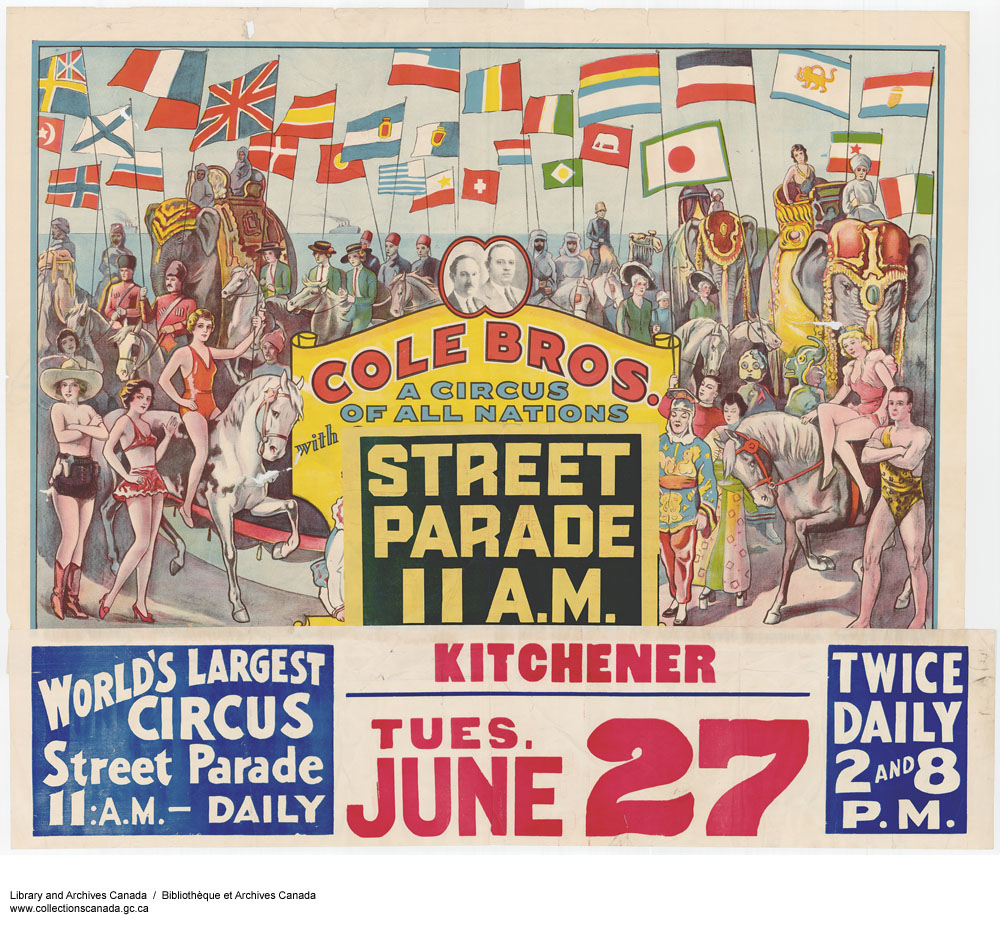
Human performers were another part of the exotic draw.  The Cole Bros. Circus advertised itself as a "circus of all nations", where locals could observe cultures and costume from around the world.
Poster from 1939.  Library and Archives Canada, Acc. No. 1980-84-159

Military display has always been a popular form of entertainment.  Buffalo Bill's Wild West Show, a form of Western circus and rodeo, featured theatrical battles, pitting cowboys versus Indians.  Gabriel Dumont was featured in the show after his role in the North-west Rebellion.  In the Great War, artillery pieces were brought back to Canada, and often featured in drives to recruit soldiers.  In a 1917 circus in Regina, a war exhibition featuring war posters and a captured German howitzer was free to all.
Glenbow Museum Archives.  NA-1574-6


Poster 1930. Library and Archives Canada, Acc. No. 1980-84-69


In international circuses, the Royal Canadian Mounted Policeman was featured as a dashing international figure of adventure.  The mountie has long been the symbol of Canada abroad, especially in the entertainment industry.  In the form of the Wild West show, the black and white division of the colonial world were played out in pantomime, with  brave Mounties standing their ground against the circling savage Indians.
Many of the Circuses travelling in Canada appear to have been American shows, but there were also home-grown Canadian exhibitions as well.  The Garden Bros.  Circus was one Canadian circus, perhaps based in Saskatchewan where its posters were printed.  Canada's most infamous circus, Cirque de Soleil, was not founded until 1984, but Canadians have long been entertained by the foreign spectacle of the circus, alongside more domestic interests in fairs, rodeos, and agricultural exhibitions.  In a world before television and internet, Canadians sought to experience in person the foreign sights, smells, and sounds of the Big Top.
1943 Library and Archives Canada, Acc. No. 1980-84-149