Showing posts with label posters. Show all posts

Saturday, March 10, 2012

German-American Hordes, 1914

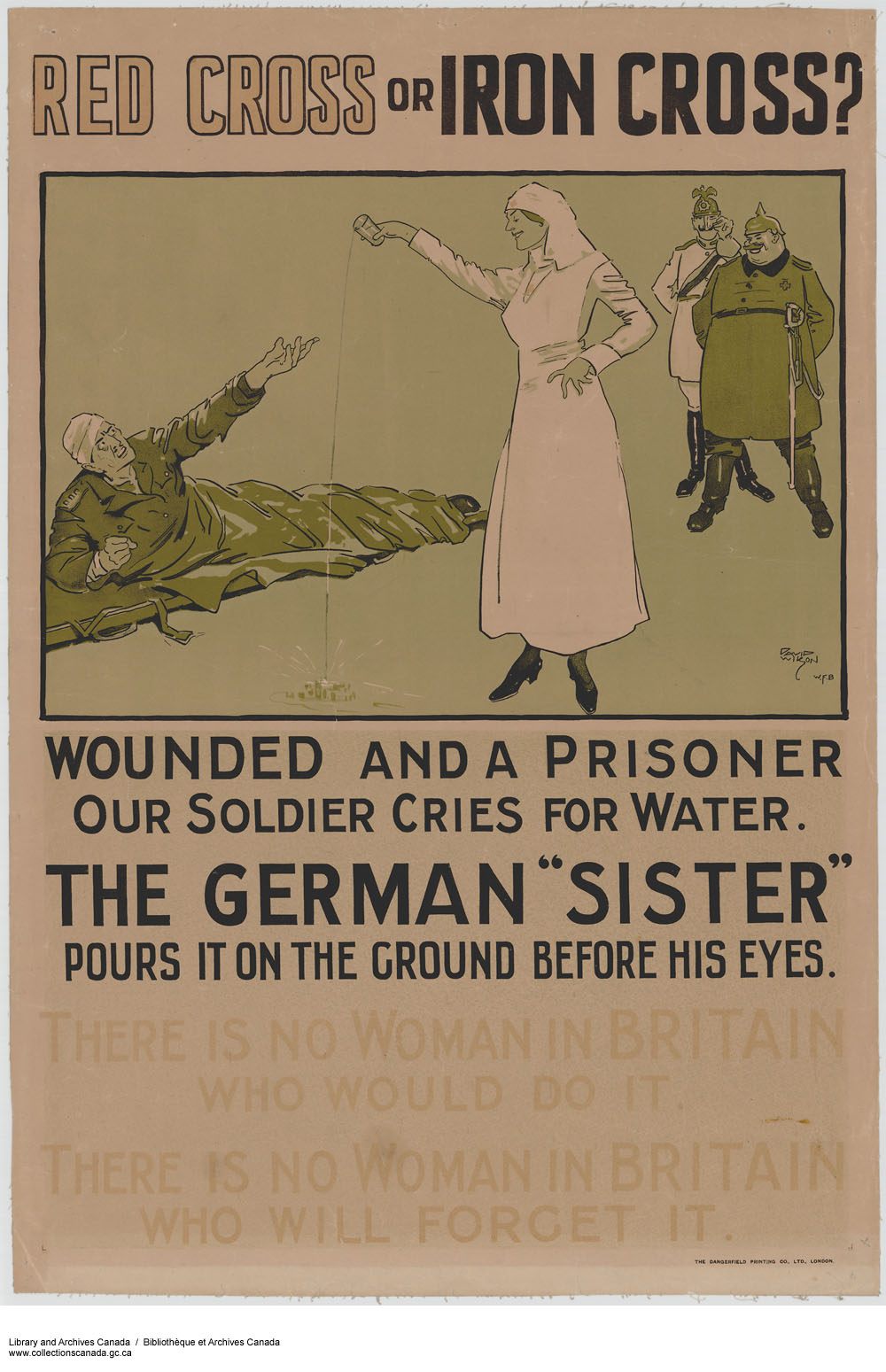
One of the sordid aspects of Canadian social reform in the early years of the twentieth-century was the nativist sentiment which resisted non-white-anglo-saxon-protestant attempts to share in the prosperity of the era.  The Chinese head-tax, and the repulsion of a boat-load of Indians from the Pacific coast are two of the more notorious instances of racism during the period.  Racism was not confined to the "non-White races", however, and Europeans were also discriminated against.  With the advent of the First World War, Germans and Austrians would receive their share of racist ire, having their shops vandalized, being socially ostracized, and in some cases being interned in "enemy alien" camps.
Large Image
File number: NA-838-8
Title: Fireman attacking effigies of German soldiers, Calgary, Alberta.
Date: [ca. 1914-1918]
 Across the desk of JD Hazen,minister for Marine, Fisheries and Naval Affairs, came one particularly inventive account of the alleged conspiracies of German-Americans.  As Ramsay Cook and Robert Craig Brown noted in A Nation Transformed (1972, p.224), anti-German rhetoric could become quite fanciful:

"The Germans all over the United States are holding meetings, their intentions are to invade Canada on the lines of the Fenian Raid...Their headquarters is Milwaukee.  They are getting all the automobiles they can possibly get without causing suspicion; they intend to muster 150,000 men along the border and invade in three or four places, destroy the canals, the railroads and grain elevators; their plans are for inland invasion; they have plenty of money behind this."

British Propaganda Poster. Credit: Library and Archives Canada, Acc. No. 1983-28-38

Sunday, January 1, 2012

Military Propaganda and New Year's Expectations

All soft-caps and no steel-helmets
 in this British Recruitment Poster, 1915.
Credit: Library and Archives Canada,
Acc. No. 1983-28-1325
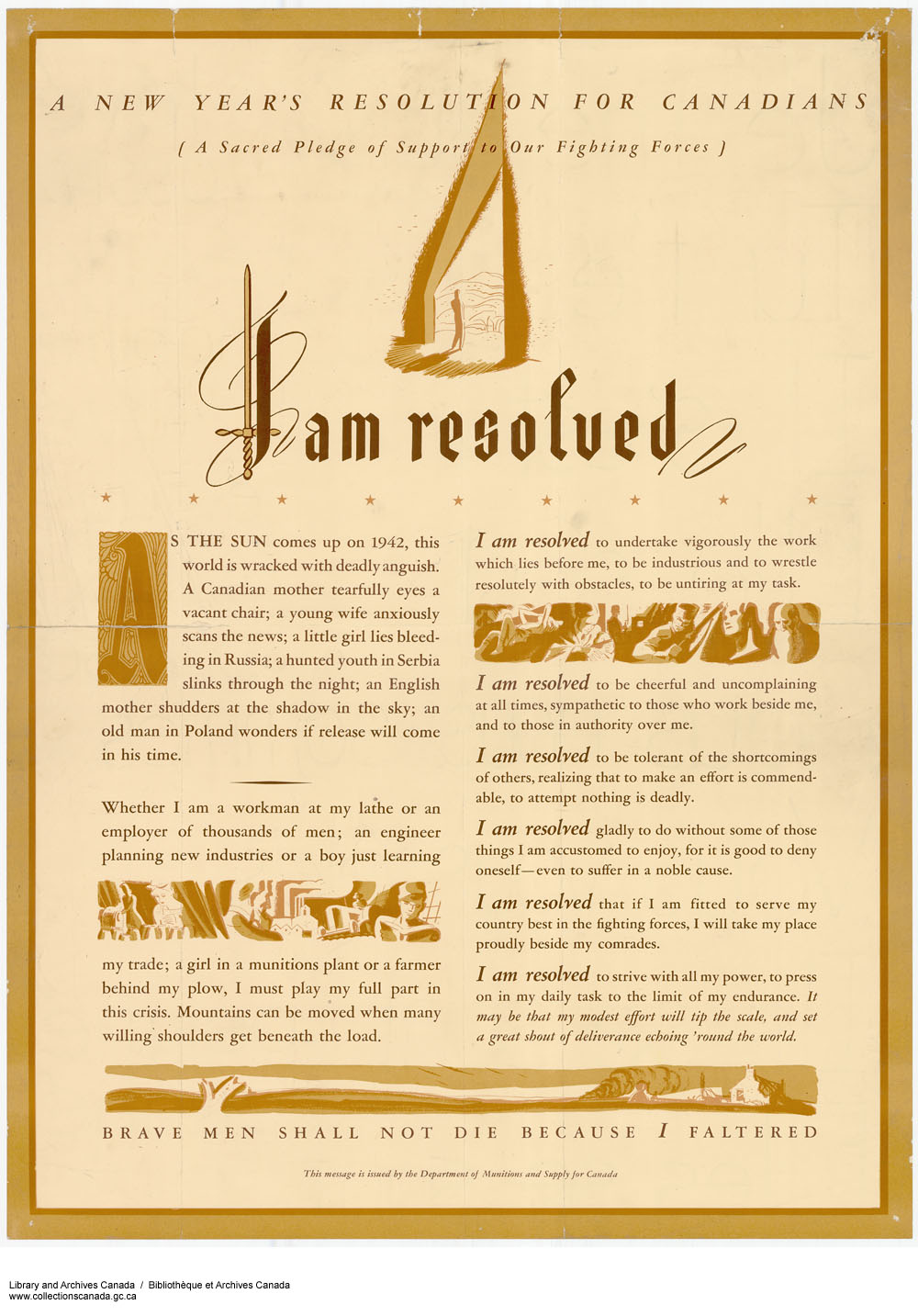
New Year's is a time for considering the past and projecting high hopes for the coming year.  In times of war, military powers have hoped to channel these sentiments of personal improvement to rally citizens to their militant duties.  A British Great War poster features an army of soldiers marching to victory in 1915.  Historical hindsight offers a grim reality-check to these optimistic hopes for the glowing rays of victory in the first year of the Great War.

With the coming of 1942, Canada's Department of Munitions and Supply opted for a more emotional appeal in hopes to channel New Year's resolutions.  Canada's broad mobilization for war in the previous year and a half is evident, as a limited liability strategy turned into a full-scale war effort.  The text-heavy poster is clearly aimed at increasing efforts on the home front to back the attack, yet includes a phrase imploring those best fit for military service to serve in the armed forces.

"I will resolve that if I am fitted to serve my country in the armed forces. I will take my place proudly beside my comrades."

Credit: Library and Archives Canada, Acc. No. R1300-262
German propagandists were not immune to tapping the celebratory expectations of the bombastic New Year's eve party.  Directed at American soldiers in Italy, one leaflet depicts decadent New York capitalists partying in luxury.  Targeting soldiers in the frigid conditions of January 1945, the leaflet attempts to raise memories of better times and evoke suspicions of war profiteering, while lowering morale on the front.  The broad expectations of New Year's parties and resolutions, it seems, have proven to be common themes in attempts to influence the public's militant resolve.

Hoping to drive a wedge between the homefront and the battlefield, the German pamphlet depicted a raucous orgy of heartless capitalism "THEY know what you are fighting for when they pocket their huge profits and big paychecks." Tapping in to the seasonal urge to ponder the future, the ultimate  anxieties of the soldier were exploited.

"What has the new year in store for you?
Will you die on the battlefield?
Will you be maimed or blinded?
Who knows?"    


New year's celebrations date back to the Romans.  Perhaps they too used military propagandaTheir large arena displays were one way they could use display to seek allegiance from the masses.  It seems, however, the expansion of print media made attempts to spread the a militant message easier. Glossy posters and the ability to bombard the enemy with paper messages spread material quickly throughout the target population.  The effectiveness of propaganda in any era is a contentious topic, but the concentrated resources forwarded to the efforts of those such as Joseph Goebbels, or on a smaller scale, John Grierson, of Canada's Department of Wartime Information, point to the Second World War as the high watermark of global propaganda.  Arguably, the introduction of the film reel changed the nature of propaganda, as the experiential effect of movies and newsreels drew participants to the medium's message.

Sunday, May 22, 2011

Big Top Images: The Circus comes to Canada

Ladies and Gentlemen, Boys and Girls, Children of all Ages, step right up and prepare yourselves for the most Exhilarating Exhibition on Earth! Animals from the far-flung jungles of Africa!  Exotic specimens from around the globe!  We've got the Wild West, Far East, Southern Belles and Natives of the North, all displayed for your amusement and curiosity under the Big Top!

The Circus in popular conception seems to wedded to America, yet one only need to think of the Roman Circus Maximus, where chariot races, animal displays and mock battles were staged, to consider the long human fascination with spectacle.  The modern circus is attributed to a Brit by the name of Philip Astley, whose riding school in the late 18th Century grew to include clowns, domesticated animals, music and acrobatics. Only in 1792 would the circus cross the Atlantic to the new world.  A number of circus posters at Library and Archives Canada show that the circus was a popular event in the twentieth-century dominion.  It was often the lure of the foreign unknown which drew Canadians in droves to the Big Top.

Poster From 1935. Library and Archives Canada, Acc. No. 1980-84-68


Part of the allure of the circus was the exotic animals and people on display.  Elephants, camels, tigers and lions were used to amaze patrons.  A fascination with foreign animals has long appealed to circus-goers, yet with the rise of animal rights activism, the humane treatment of these performers are increasingly scrutinized. Cole Bros. Circus, still active today, was recently fined for violating the endangered species act.


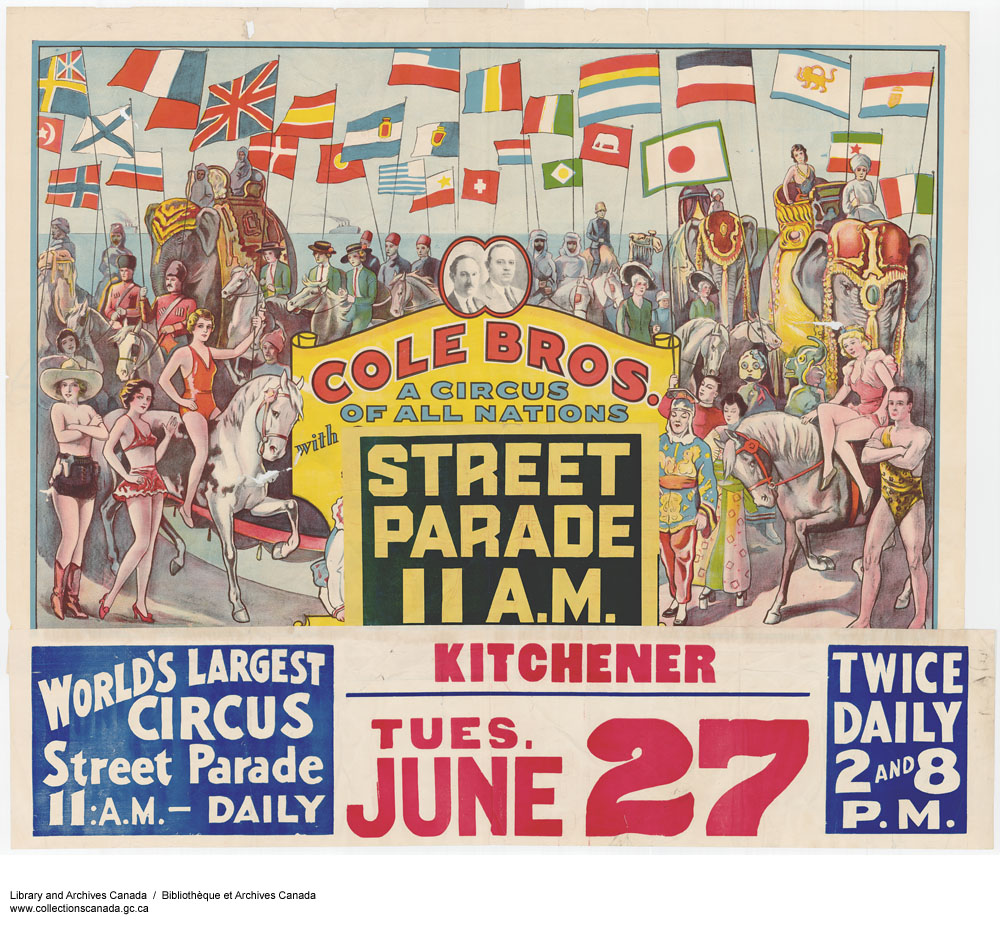
Human performers were another part of the exotic draw.  The Cole Bros. Circus advertised itself as a "circus of all nations", where locals could observe cultures and costume from around the world.
Poster from 1939.  Library and Archives Canada, Acc. No. 1980-84-159

Military display has always been a popular form of entertainment.  Buffalo Bill's Wild West Show, a form of Western circus and rodeo, featured theatrical battles, pitting cowboys versus Indians.  Gabriel Dumont was featured in the show after his role in the North-west Rebellion.  In the Great War, artillery pieces were brought back to Canada, and often featured in drives to recruit soldiers.  In a 1917 circus in Regina, a war exhibition featuring war posters and a captured German howitzer was free to all.
Glenbow Museum Archives.  NA-1574-6


Poster 1930. Library and Archives Canada, Acc. No. 1980-84-69


In international circuses, the Royal Canadian Mounted Policeman was featured as a dashing international figure of adventure.  The mountie has long been the symbol of Canada abroad, especially in the entertainment industry.  In the form of the Wild West show, the black and white division of the colonial world were played out in pantomime, with  brave Mounties standing their ground against the circling savage Indians.
Many of the Circuses travelling in Canada appear to have been American shows, but there were also home-grown Canadian exhibitions as well.  The Garden Bros.  Circus was one Canadian circus, perhaps based in Saskatchewan where its posters were printed.  Canada's most infamous circus, Cirque de Soleil, was not founded until 1984, but Canadians have long been entertained by the foreign spectacle of the circus, alongside more domestic interests in fairs, rodeos, and agricultural exhibitions.  In a world before television and internet, Canadians sought to experience in person the foreign sights, smells, and sounds of the Big Top.
1943 Library and Archives Canada, Acc. No. 1980-84-149

Thursday, April 21, 2011

Conscripting Youth: Children and the Posters of the Great War

Advertisers know that children can sell just about anything.  A grinning cherub armed with an endearing catch-phrase is often used to melt our hearts and open our pocketbooks.  It is no surprise, then, that during the Great War, images of children were conscripted to promote the war effort in many Allied countries.  It was not just the cute appeal of the innocent child, however, that was used to drum up money for war bonds or recruit men to the regiments. In many cases, the strong social bonds of family expectations were used to put pressure on citizens as family members.

As this British poster of the melancholy man shows, fathers were targeted by posters which hoped to recruit men to to the ranks.  Here it is the social pressure of participating in the major event of the generation that is used to coerce fathers into enlistment.  The girl on his knee points to a history book and inquires what her father's role was in this epic adventure.  One can only imagine the shame that the son may have endured in learning his father had stayed at home, missing out on the derring-do of the living-room floor campaigns of his heroic toy soldiers.

Compassion for children as family members was often used to attempt to convince citizens to contribute to war bonds.  A poster sponsored by Curtiss Airplanes has a child praying for a brother overseas.  The consoling mother in this domestic scene helps the youth send hopeful prayers for their soldier's safe return.  The strong coloured vertical lines from the American flag's bars are contrasted with the soft oval portrait.  In a case of patriotic product placement, in lieu of the flag's stars, the Curtis company has inserted its own biplanes.  If only the reader contributes to war savings stamps, the idyllic family will be reunited.
Children were also used symbolically as the youth of a nation. The national siblings of Australia and England are here portrayed as innocent friends with hands clasped.  The clean-handed childhood chums, clad in angelic white over the vibrant yellow seem to suggest that by contributing to the war effort, one would be on the side of purity and right.  Again it is the family member away at war that is used to implore contributions from the public.  Here the message is more explicitly aggressive.  Instead of focussing on bringing the family together again, in this case War loan bonds will help "daddy" win the war.


Children as targets themselves were used by the Red Cross to encourage contributions to their humanitarian efforts.  Here a stoic yet compassionate nurse looms over the destitute French orphans.  The drab outfits of the French citizens and the deep orange of the fire-wracked city are offset by the vulnerability of the infant's pink attire. Again the concept of family is used in the emphasis of motherless and fatherless suffering.


Library and Archives Canada has a vast online archive of war posters, from which all the above images came.