Showing posts with label manitoba history. Show all posts

Wednesday, October 10, 2012

General James Dickon's Indian Liberating Army

"General" James Dickson, the so-called "Liberator of the Indian Nations", is a curious character, who goes down in Western Canadian history as a brief sojourner with more passion than sense.  Dickson's lineage is vague, but he has been claimed to be the "mixed-blood son of a British trader and Toto-win, sister of Sisseton Sioux Chief Red Thunder."  (Thomas Ingersoll, To Intermix with Our White Brothers , p. 104)  The governor of the Hudson's Bay Company, George Simpson described him as "covered with huge whiskers and mustachios and seamed with sabre wounds."  Elsewhere it has been noted that,
a bizarre character appeared in fashionable circles in New York and Washington in the winter of 1835-36, endeavoring, as he then said, to secure recruits to aid the Texans in their struggle for independence.  He called himself General James Dickson and told fascinating stories of his life in Mexico and of his service in the Texan army. His striking military dress and a very nice attention to the amenities of social life secured recognition for him but seem to have brought him few recruits. (Nute, p.352)
Dickson's claim to fame was an attempt at gathering support for the establishment of a aboriginal state stretching from Rupert's Land to Texas. 
Banner from Martin McLeod's "Attestation Papers", Nute

In 1836, Dickson recruited around thirty men from Montreal to join him in his quest.  All were apparently made officers in his army, and granted dress uniforms complete with "showy uniforms and glittering epaulettes." (Lyman C Draper George Simpson would call these men, "wild thoughtless young men of good education and daring character, half-breed sons of gentlemen lately and now engaged in the fur trade."  (Jennifer Brown, Strangers in Blood, p.190)  Elizabeth Arthur, writing for the Dictionary of Canadian Biography, noted that he may not have told these recruits the full story of his plans to travel to Santa Fe, New Mexico, attack the fort and continue on to California, where he would establish a "utopian state in which Indians would hold all the property and where only a few white officials would be permitted."
McLeod County Minnesota.  Wikipedia.

One of Dickson's party was Martin McLeod, whose diary has survived the years.  McLeod was born near Montreal, but would later become a member of several councils in the Minnesota territorial legislature.   His presidency of the fourth council may be the reason why McLeod County, Minnesota was named for him.  Once in Minnesota, he would long function as a booster for the area, writing Canadian newspapers in praise of Minnesota. (Grace Lee Nute ed., The Diary of Martin McLeod, Aug 1922)

As McLeod made his way from Montreal to meet Dickson, he travelled Lake Ontario to Toronto, where he spent the day.  From his diary entry of 20 July 1836, it may be said that he did not enjoy his stay:
Remained one day at Toronto, do not like the place.  Saw Al[exander] Robertson of Inverness (an acquaintance at Montreal).  People kind enough apparently, but I think some what pompous.  Why?  God only knows.  What have they to bost of.  Their town or city (as I believe it is call'd) is a muddy hole - but then it is the Capital of [Upper Canada] and they are up to their ears in politics (damn politics) and they have Sir [Francis Bond Head] (whom by the by I saw a cheval) who is very popular &c &c and all that, so you see they are a people of some consequence, and not to be sneezed at, - that is if the d-------d stench of their town would allow a person to take his finger from his nasal organ long enough for that pleasant exercise. (McLeod, p.355)
It was in Black Rock several days later that McLeod would meet General Dickson.  McLeod seemed slightly skeptical of the "General's" abilities noting that Dickson,
privately, informed me of his plans &c relative to the intended expedition to the north via  the great lakes and onwards God only knows where; and where and when it may end.  D[ickson] appears quite sanguine of success. As yet I know little of the man, but if I may judge from so short an acquaintance, he is some what visionary in his views - n'importe I wish to go north & westward and will embrace teh opportunity, but must "look before I leap." (McLeod, p.359)

As Dickson had learned of Cuthbert Grant and the militant abilities of the Métis, he intended to gain recruits for his army in Red River.  He set out from Buffalo with only sixty of the 200 men that were initially proposed for the force.  As they had no money or supplies to speak of, they resorted to stealing and slaughtering some cattle near Detroit.  Unfortunately a sheriff's posse caught up with them, and they were made to pay a fine after some tricky negotiating.

The travelling was hard, and made particularly difficult by Dickson's questionable command decisions. (Anne Hyde, Empires, Nations, and Families, p.132)  Dickson could not help the damage done by a storm to their schooner on the Great Lakes which almost swamped them, but his decision to press ahead of his party in northern Minnesota without adequate supplies was highly questionable.

On the 27th November 1836, McLeod noted the difficulties crossing Cass Lake after the winds had polished the ice.  The party travelled 30 miles that day.  The next day McLeod noted, "Obliged to rest as a number of the party are unable to proceed from the fatigue of yesterday's march and the bruises which they received from frequent falls upon the ice. Indeed all our men were so "done up " that they did not arrise yesterday till near dark." (McLeod, p. 388)

It was when the party's Sioux guides left them on the 9th of December, that Dickson's leadership began to crumble.  They had left Thief River that day and were still around a week's walk to the Red River settlement, yet were not at all familiar with the open prairie.  As McLeod wrote in his diary:
Saturday 10th Decr At day break we were summoned together,and informed by Gen1 D[ickson] that as our guides had desserted and as we had but five days provisions, and had yet to travel near three hundred miles in a strange country of which we had not an accurate map, he left us all to act, each man for himself, to either follow him, as it was his determination to trust to fortune and push forward, or return to Red lake and there wait untill they could procure a guide. I had previously made up my mind to continue my route at every risk, and all the rest with the exception of two preferring to follow Gen1 D., we made immediate preparations to start.
It was several days later that Dickson left the main group without blanket, food, nor means to light a fire. Dickson arrived in Red River, starving and frost-bitten.  As Lyman Draper noted, "the cold weather set in before their arrival at Red river [sic], and Dickson had his toes frozen off, which crippled him as well as the whole enterprise."  (Draper) 

Sir George Simpson, Governor of the
 Hudson's Bay Company, 1857.
Credit: Library and Archives Canada, Acc. No.
1978-14-3 Source: Manuscript Division,
 W.W. Campbell Collection (MG30 D 8)
Governor Simpson was none too amused with the party, refused his bank drafts and quickly employed the men who had been recruited.  Several of Dickson's recruits were in fact the mixed-blood sons of HBC officials.  Their sense of adventure was probably supplanted by their common sense, after the hard travelling in the company of Dickson.  In the spring of 1837, the Indian Liberator left Red River, incredibly, worse off for resources than when he arrived. (Pannekoek, Snug Little Flock, 90).  As Grace Lee Nute put it in 1922, "America has been the land of roseate dreams; but, among all its visions of wealth and power, where is the equal for novelty and adventure of this mad product of Dickson's disordered mind?" (Nute, 352)

Thursday, February 2, 2012

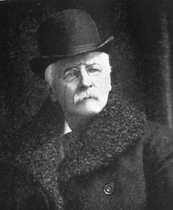
Charles Mair: Red River Rabble-rouser, 1868

Charles Mair
Tensions in the Red River settlement rose to a feverous pitch in the years leading up to the transfer of Rupert's Land from the Hudson's Bay Company to the Dominion government.  The premature survey of the road from the Lake of the Woods to Red River in 1867 proved to be an event which exacerbated tensions between the Metis and the growing number of Canadians.  Arriving with the road crew was a literary figure who would add fuel to the growing fires on the banks of the Red.  That man was the expansionist, Canadian nationalist and "warrior bard", Charles Mair.

Mair's letters home were published in that great liberal rag the Toronto Globe, and his condescending chauvinism was not in favour with the people of Red River.  Arthur S. Morton wrote in the language of his time that the letters, "brought the indignation of the settlers to boiling point, for in the Settlement the half-breeds were a respectable middle class, rather than the outcasts the Canadian public envisaged by the term.  Governor Mactavish's wife was an educated half-breed of remarkable grace and dignity, and he protested in indignant terms that she was fit to grace any table."  (Morton, History of Prairie Settlement, 41)
Charles Mair
As George Stanley wrote in his classic The Birth of Western Canada, "the female part of the population, about whom Mair had made many uncomplimentary remarks, was particularly angry.  One pulled his nose, another his ears, while a third, the wife of a leading citizen of the Settlement, drove him from the Post Office with a horse whip!" (Stanley, 1992, 1936, p.55).  Drought and grasshoppers would further aggravate the citizens of Red River, whose resistance against the expansionist Canadians could best be symbolized by Louis Riel standing on the surveyor's chains, and preventing the measurement for the meridian line.  Mair was paymaster for the original road crew, and would be sentenced to death by Riel and his followers before escaping and fleeing to Minnesota.

Wednesday, February 1, 2012

Buffalo Wool at the Selkirk Settlement

Merino Ram.  Powerhouse Museum 1953 Samuel Sidney.
The problems of transportation and production were major factors in the slow start of Lord Selkirk's Red River Colony.  Early frosts and drought meant that, in the words of A.S. Morton, "transforming the prairies into fields of golden grain" was not an option. (Morton, History of Prairie Settlement, 26)  Morton notes that wheat and flour were much too bulky, and their low price not worth shipping back to Britain. Attempting to get a herd of cattle established proved equally difficult. Selkirk turned his mind to wool, as industrial machinery in England had outpaced supply, and it was fetching a good price.  Merino sheep from Spain had, at this time been sent to Austrailia, and Selkirk would attempt to export some to his far distant colony.  Morton claims that the lack of industry and intelligence of the settlers, however, led to the experiment's ruin.

George Back Sketchbook 1820-21  Credit: Library and Archives Canada, Acc. No. 1994-254-1.53R
An attempt to use the resources at hand is observed in the founding of the Buffalo Wool Company to use buffalo hair as a weavable garment.  Morton notes that the mix of fine and coarse hairs made weaving difficult, and the wool's dark colour would not dye easily.  Chester Martin in his "Dominion Lands" Policy (1938) wrote that the Buffalo Wool Company was "the first and surely the most bizarre industrial venture of the West.  Lady Selkirk introduced the buffalo wool shawl into Scottish society but though remarkably soft and durable it would not take the vegetable dyes of those days." (Martin, 206)  The idea was eventually abandoned.  Interestingly, a modern company seems to have taken up the name, and sells buffalo yarn and garments, noting the institution was established in 1812, and re-established in 2011.

Further attempts to get sheep to the settlement met with disaster.  When a flock of over one thousand  was purchased in Kentucky and driven across country, they travelled through country rife with spear grass.  As Morton notes "the spears entered their flesh in such quantity as to make the whole body a festering sore.  The carcasses of the dead marked the way across the plains northward." (Morton, 27)   Morton sums up these efforts with a grim assessment: "all attempts to find an exportable product thus failing, the colony was necessarily reduced to playing the modest part of handmaid to the furtrade."

Tuesday, January 31, 2012

Beasts of the Selkirk Settlement, 1813

Stock-raising is an important facet of subsistence farming, especially when the nearest market is hundreds of miles away.  At the Selkirk Settlement on the Red River, an early attempt at an agrarian settlement in Western Canada, the first livestock were transported by the legendary fur-trader and explorer Peter Fidler. A.S. Morton, in his classic History of Prairie Settlement (1938) notes, the bull and two cows "must have been brought in as calves in the canoes.  They would be taught to jump in and out, and would be driven over the portages." (Morton, 10)  One can only wonder of the difficulties of transporting cattle in this manner.
Selkirk Settlement. National Archives of Canada / C-008714
Getting cattle to the colony proved near impossible.  Another bull and heifer were brought in by Miles Macdonnell, who picked them up from the Hudson's Bay Company at Oxford House.  Morton describes the ill fortune of these animals once arriving at the colony. He notes that Fidler's bull,

"proved vicious and was killed, though the scarcity of food may have had as much to do with its end as its viciousness, and, calamity upon calamity, the first, now the only remaining, bull was drowned while drinking at the water-hole in the ice on the river.  Selkirk urged Miles Macdonell to send out horsemen to drive quietly into the settlement a herd of heifer buffalo (they grazed apart from the bulls except in the rutting season), and to attempt a cross with a European bull.  This surely was a counsel of despair." (Morton, 16)

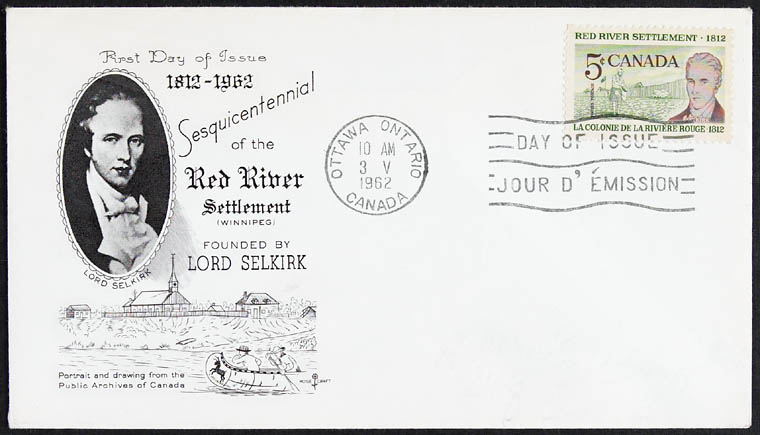
150th Anniversary Stamp. Credit: Library and Archives Canada  Copyright: Canada Post Corporation (stamp)
Copyright: Isobel M. Assad (cover)
Little did Morton realize that crossing cattle with buffalo was indeed feasible, however, the successful hybrid took much experimentation in animal husbandry to perfect.  By some accounts success was not gained in the endeavour until 1957.

It was not until 1821 that a substantial herd of cattle was brought in from the United States.  Livestock numbered 3 bulls, 6 oxen, 45 cows, and 39 calves with a number of sheep, horses and pigs as well.  As Morton notes, it took eleven years and much suffering to establish a healthy herd of livestock at the Selkirk Settlement.