|
| Thomas Phillips Thompson LAC C-38581 |
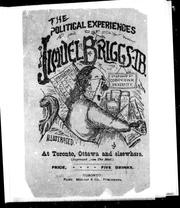
Thomas Phillips Thompson, was a Canadian satirist and social reformer. In the 1870s, Thompson wrote for Toronto's Telegraph as well as the Mail, where his lampooning of George Brown, the Grits and the Globe would become well known to the readers of the conservative press. His pseudonym, Jimuel Briggs was used to publish a fictitious autobiography incorporating some of his satirical journalism under the title, The Political Experiences of Jimuel Briggs, D.S., Graduate of Coboconk University. (1873)
His embellishment of Thomas Moss's 1873 attempt at election under a Canada First platform shows that patriotism could extend to the type of alcohol one preferred. Thompson satirizes the zeal of the Canada First movement, which in 1874 formed the Canadian National Association, a political party which went nowhere. The scene portrays the founding fathers of the party searching for a Canadian nationalist identity in the bottom of bottle:
There were fully twenty of us involved with the idea of Canadian nationality. Previous to our proceeding to business, one of those moved that we should wet the New Party, a proposition that was wildly encored. 'I move,' continued he, 'that we order a dozen bottles of Bass, or perhaps the party would prefer some hot Irish whiskey?'
I rose with concentrated indignation in my glance, and proceeded to excoriate the cuss. 'Do I hear aright? Have we already a traitor in our midst? Is it possible that any one of those here assembled to vindicate the glorious cause of Canadian nationalism is so lost to manhood, so degraded and servile a being as to advocate the use of such derogatory foreign beverages as Bass and Irish whiskey?'
'Never! Never! shall I be so false to our glorious motto "Canada First" so as to endorse such a proposition. Let us have Canadian old rye, hot and sweetened with the extract of the maple - the noblest tree of the forest to whose trunk the emblematic Moss clings as tightly as our candidate does to the principles of Canadian nationality - and some lemon in it - beg pardon, gentlemen, I retract the lemon, I forgot that was a foreign ingredient.' [...]
That night, under such auspicious circumstances, the Canadian party was formed, the germ of its existence being stimulated into growth by Canada's national beverage. [...]
We again moistened the roots of the Maple and adjourned.As cited in Ramsay Cook The Regenerators (p.155-56):
 After a sojourn to the United States, Thompson returned to Canada in 1879, when his wit was turned against the emerging industrial order. Thompson was increasingly concerned with labour issues, was associated with the Knights of Labor, and continued to lobby for socialist causes decades into the twentieth-century.

 After a sojourn to the United States, Thompson returned to Canada in 1879, when his wit was turned against the emerging industrial order. Thompson was increasingly concerned with labour issues, was associated with the Knights of Labor, and continued to lobby for socialist causes decades into the twentieth-century.