Thursday, March 29, 2012

Iroquoian Military-Religious Torture

Torture was a common occurrence between the warring Algonkians and Iroquoians at the time of contact with Europeans.  Jim Miller's Skyscrapers Hide the Heavens notes that prisoners were subjected to excruciating treatment by fire and blade.  Captured soldiers were expected to remain calm while the captors subjected them to this degradation.  Miller notes, "it would be even better if he laughed at his torturers and told them that he was enjoying the treatment he was receiving." (p.12)
Canadian Military Heritage Gateway


The tortured were kept alive throughout the night, and revived if they passed out from the pain.  Iroquoians adapted a form of sun worship in which the prisoner was finally put out of his misery when the sun rose in the morning.  Cannibalism was not uncommon.  Those who were particularly stoic would have their heart cooked and distributed among the young men to eat.
Champlain and Huron Allies attacking an Iroquois Fort on the Richelieu in 1610.  CMHG


Miller notes that these practices were both sun worship and a masculine "cult of prestige". (p.13)  By eating a portion of a brave soldier's heart, the young men could gain some of their captive's bravery.  Interestingly, after contact,  Europeans also participated in the desecration of their Native opponent's bodies. Desmond Morton notes is his A Military History of Canada that while such mutilation was part of Iroquoian religious ceremony, the Europeans had no such cultural justification for their actions.

Wednesday, March 28, 2012

Laurier's Electoral Brawl for Arthabaska, 1877

Wilfrid Laurier, M.P. (Drummond-Arthabaska, 
Quebec)  Apr. 1874Credit: William James Topley
 / Library and Archives Canada / PA-026430
When appointed to Alexander Mackenzie's cabinet in 1877, Wilfrid Laurier hoped to gain the federal seat from Arthabaska by acclamation.  Laurier had just become a national sensation, when his address to the Young Men's Liberal Association was publicized broadly, serving as a manifesto of reform based liberalism.  Fortunately coincident with the event, was the announcement by the clergy of Quebec that the "Catholic Program", church policy which fought against Catholic Liberalism, was not to discriminate against any specific political party.  With Laurier as the beaming Rouge ray of liberalism in Quebec, the Conservative party would rally its unseemly electoral goons to try to damper the glare.


Bourbeau, 1879. Topley Studio;LAC;PA-028311
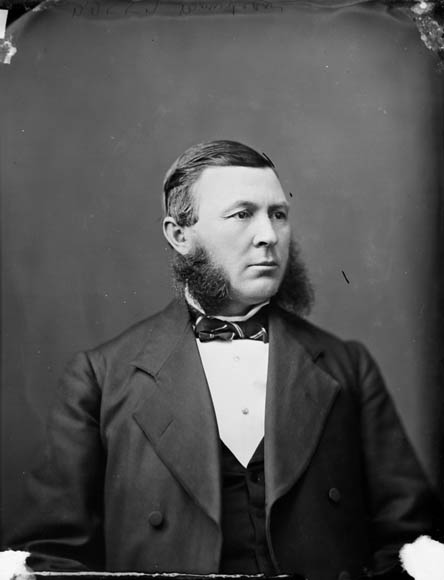
Desire-Olivier Bourbeau emerged as the opposing candidate, whom Joseph Schull in his Laurier: The First Canadian (1967), described  as "tall, bearded, and heavy, principally distinguished for a cane that rattled the wooden sidewalks and a voice that shook the windows of the church when he sang." (p.123)  One contemporary noted that Bourbeau addressed the tariff, "like a blind man speaking of colours [and] talked of hay, oats , and buckwheat and was stopped by his friends at the moment he was going to pass the potatoes."  Bourbeau found himself supported by a host of Conservatives who flooded in from other constituencies.  Laurier would later claim he was defeated due to the fact that 3,800 votes had been placed in a a constituency of 3,200 registered voters. (p. 132)

The election itself exposes the unseemly side of 1870s Canadian democracy.  The priests opinions were still well known and there would be no separation of the Quebec clergy from politics.  Schull writes that, "brawls and broken heads were a feature of every meeting and at one of the loudest of them a Rouge supporter was kicked to death." (p.124)  One supporter was noted as being "seemingly equipped with seven-league boots, certainly with a thunderous voice, and possessed of a portable grandmother who had been born within a mile of every stump he spoke from."  In one municipality a Bleu secretary failed to post the electoral lists for registration, and thus nullified many Rouge voters.  Bribery was used in three large parishes, as Laurier himself described it "railway contractors of the provincial government came there on the night of Friday to Saturday and went on buying votes as in the good old times."
Last of the Open Ballots, 1872.  Canadian Illustrated News. Elections Canada.


Laurier would lose the close battle for Arthabaska, but the new minister needed a seat.  In East Quebec, where he would earn his place in parliament, the authorities were called out to protect the peace.  Schull notes, "Early in the morning a battery of artillery and several squads of police were drawn up in Jacques Cartier Square.  Gangs of election 'whackers' moved restlessly about, but under the mouths of the guns and the eyes of the constabulary not a club was lifted.  Polls opened at nine with the strong-arm men of the parties standing by at the ready and again there were only glares." (Schull, p. 128)

Monday, March 12, 2012

Medicinal Spirits: Prescribing Liquor during Prohibition, 1919

The patriotic fervour of the Great War was a great impetus to the passing of nation-wide prohibition.  Sir Robert Borden could rely on the notion that the use of grain for alcoholic purposes was a waste of precious war material when he passed the bill against the booze.  At the war's end, it was illegal to import, transport, or create liquor with more than 2.5% alcohol content.
File number: NA-4534-2
Title: Soldier in dispensary, during First World War.
Date: [ca. 1914-1918]
The consumption of liquor for medicinal purposes, however, was perfectly legal during these dry days in the Dominion.  Ramsay Cook and Robert Craig Brown note in A Nation Transformed (1972, p. 301),  the tendency to abuse the stipulation that alcohol could still be used for health purposes.  In 1919, one writer in Vancouver noted:


"Toward Christmas especially it looked as if an epidemic of colds and colics had struck the country like a plague.  In Vancouver queues a mile long could be seen waiting their turn to enter the liquor stores to get prescriptions filled. Hindus, Japanese and Chinese varied the lines of the afflicted of many races.  It was a kaleidoscopic procession waiting in the rain for a replenishment that would drive the chills away; and it was alleged that several doctors needed a little alcoholic liniment to soothe the writer's cramp caused by inditing their signature at two dollars per line."

Interior of Knowlton's Drug Store [15 Hastings Street East] - [ca. 1920] City of Vancouver Archives 99-1338