Showing posts with label Algerian War. Show all posts

Thursday, May 17, 2012

Legendary Paratrooper : The Leadership of Marcel Bigeard, 1956

Syndey Morning Herald Obit 2010
Marcel Bigeard was one of the legendary paratrooper leaders of the Algerian conflict.  His training regime was as rough as they come, and his leadership style was a text-book example of leading from the front.

Bigeard's introduction to the Second World War shared the disapointment of many of his French compatriots, but he quickly rose to prominence.  Captured in 1940 in the Maginot Line, he managed to escaped the next year to Senegal joining a colonial infantry unit in De Gaulle's Free French Forces.  In 1944, he parachuted into France, and spent the postwar years in French Indo-China.
Bigeard in Indo-China. Independent.
On his third combat tour to Vietnam, it was Bigeard's misfortune to be dropped into Dien Bien Phu.  Again he showed his determination in commanding what Alistaire Horne called in his Savage War of Peace, "one of the most inspired counter-attacks."(1987, p.168)
Bigeard was subjected to three months of brainwashing, and this may have inspired his belief that the "subversive warfare" in Indo-China was the beginning of a world-wide attack of which Algeria was a part.

Rama CeCILL
Arriving in Algeria, Bigeard commanded the 3rd Regiment of Colonial Parachutists, which immediately was purged of the weakest members.  Others who did not wish to be in the unit were offered transfers.  Those that remained were subjected to a brutal training regime in the dry lands of Algeria.  They returned a new breed of Para, sporting a long-brimmed camouflage cap, causing the pied noirs (Algerians of european stock) to nick-name them, the "lizards".  Bigeard denied the use of torture during the conflict, but did admit to "muscular interrogations."


Alistair Horne doesn't pull his punches in describing the paras as, "on their way to becoming a crack force; one of the most effective in the Western world". (p. 168)  An early construction of the Bigeard legend was the book The Centurions (1960) by Jean Lartéguy, which featured a character modelled after the commander.
A film based on The Centurions.
Bigeard led from the front, conducted his own reconnaissance and jumped with the first wave.  Horne notes, "tall and powerful, with a beaked nose that imparted a look of a bird of prey, Bigeard had that particularly French quality of allure essential to an outstanding commander.  He seldom did anything without panache.  Instead of arriving by staff car, or even helicopter, his favourite manner of inspecting a unit was to drop by parachute, arm at the salute as he touched down."

Imitators of the Bigeard command-style should, however, be wary.  Horne notes that in later life, when Bigeard was approaching sixty, one such troop inspection went wrong.  In Madagascar, Bigeard was dropped into shark-infected waters, breaking an arm.  His unfortunate yet "faithful" staff, who parachuted into the water with him, managed to save the General from the waters.

Friday, April 13, 2012

Indiscriminate Killings during Insurgencies: Servan-Schrieber's "Lieutenant en Algerie"

Alistair Horne's A Savage War of Peace (1977) is a classic account of the 1954-1962 insurgency in Algeria.  The book was reportedly read by George W. Bush and numerous American military commanders after the 2003  invasion of Iraq.  Horne himself was consulted by the president, and wrote that, "In the Oval Office last year, I was questioned intently on how de Gaulle got out of Algeria; I had to reply, 'Mr President, very badly; he lost his shirt.' Though it was clearly a disappointing response, Mr Bush replied, with emphasis: 'Well, we're not going to get out of Iraq like that.' There are several ways in which the Americans lost their shirt in Iraq, and George W. Bush could be said to have personally lost his comfy pad on Pennsylvania Avenue.

Insurgencies are difficult to generalize.  Most are specific and chaotic, inseparable from their historical context, and refuse to be neatly compartmentalized into good guys and bad guys.  Algeria was a particularly brutal war, and Horne does not back away from the grisly details.  An account which he quotes from Jean-Jaques Servan-Schrieber's book Lieutenant en Algerie (1957), echos the frustrations of regular soldiers who cannot tell friend from foe.  An old campaigner here tells a fresh-faced captain about the realities of discriminating civilians from combatants:
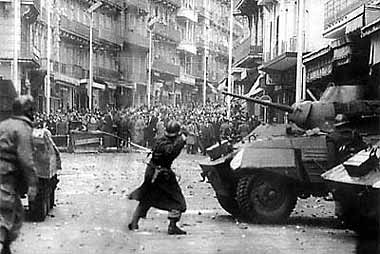
1960 Algerian Independence Demonstration
"Either you consider a priori that every Arab, in the country, in the street, in a a passing truck is innocent until he's proven the contrary; and permit me to tell you that if that is your attitude...you will immediately be posted, because the parents of reservists one has had killed don't like it, and will write to their deputies that you're a butcher...Or you will...consider that every Arab is a suspect, a possible fellagha...because that, my dear sir, is the truth...But once you're here, to pose yourself problems of conscience - and treat possible assassins as presumed innocents - that's a luxury that costs dear, and costs men, dear sir, young men themselves also innocent, and our own..."


Such sentiments are how insurgencies are won militarily and lost politically.  This brutal calculus of counterinsurgency exposes the attitude of distrust which creeps into the soldier's psyche when any passerby may be a potential killer.  This is one common thread to insurgencies: they are an extremely difficult psychological task for the soldiers that fight them.