Showing posts with label counterinsurgency. Show all posts

Monday, December 24, 2012

Scorched Earth: Kitchener's Boer War Counterinsurgency


A large group of horsemen of the Imperial
Yeomanry galloping over a plain. © IWM (Q 72318)
The old myth of the Boer War as one of the last gentlemanly wars, tied to romantic visions of honourable combatant knights, has long been revised and retired.  The conflict had no lack of ferocity and destruction, and the line between combatants and non-combatants was very much blurred.  The guerilla tactics of Boer commandos from 1900 posed a serious difficulty to the British Army. Attempts to curb the mobility of small groups of mounted riflemen included the use of blockhouses and barbed wire, with mobile columns attempting to press the Boers towards these defences. Ian Beckett notes in Modern Insurgencies and Counterinsurgencies (2001) that a more controversial method was the establishment of “concentration camps”, the destruction of houses and crops and the removal of livestock.

After the fall of Bloemfontein in the spring of 1900, Field Marshal Lord Roberts had ordered the protection of Boer property and allowed Boers considered loyal to return to their homes. After guerrillas began to emerge in the summer, however, Roberts ordered the destruction of houses close to vulnerable communications infrastructure. Other efforts to detract from guerrilla attacks were collective fines and the compulsion of Boer civilians to ride on trains.
 
Kitchener
Roberts policies may be deemed moderate. He rescinded less discriminate policies, and ordered the destruction of only those houses which were proven to be used by Boer fighters. From December of 1900, however, Roberts' successor Lord Kitchener extended the internment system to include both military prisoners and civilian refugees. Kitchener attempted to remove the entire Boer population from the veld. As he wrote in March 1901, "The refugee camps for women and surrendered boers [sic] are I am sure doing good work[;] it enables a man to surrender and not lose his stock and movable property . .. The women left in farms give complete intelligence to the boers of all our movements and feed the commandos in their neighbourhood". (Krebs, History Workshop, No. 33, p. 41)  
Kitchener’s internment policy was aimed at women as well, who were thought to be key figures in motivating the Boers. Women were originally rounded up to prevent them from spying for the Boers.  Yet as Paula Krebs suggests, this motivation was kept quiet, as it would admit that the women were incarcerated due to their military activities.  (Krebs, p.42)  Liberals and Irish M.P.s had been arguing that those in the camps were prisoners of war, not refugees.  In March of 1901, an exchange in the House of Commons evoked the gendered nature of imperialism.  Irish M.P. John Dillon asked, "What civilised government ever deported women? Had it come to this, that this Empire was afraid of women."  (Krebs, p.42)
 
"Garden of Remembrance, Aliwal North" 
Concentration Camp Memorial
License Creative Commons
AttributionNoncommercial Some rights reserved by G Bayliss
Beckett suggests that some women were held hostage to provoke Boer surrenders. Many women and children were condemned to a nomadic existence when their homes were razed.  Inside the camps, Boer children were subject to colonial indoctrination.  Research by Paul Zietsman notes that education provided in concentration camps attempted to Anglicize Boer children, which shows parallels with colonial aboriginal policies of assimilation behind residential schools. These policies invoked further political controversy back in Britain, especially when poor management of the camps led to the deaths of nearly one quarter of the 116,000 civilians detained.  When camp tents began to be populated by women and children, Britain, and especially British women, were alerted to a potential cause. 
 
After the uproar regarding the camps, Kitchener still claimed that their functional value outweighed the dissent.  In 1901, Kitchener claimed, "I wish I could get rid of these camps but it is the only way to settle the country and enable the men to leave their commandos and come in to their families without being caught and tried for desertion." (Krebs, p.43)
Typical group of Boer farmers at "Compensation" claims tent after war.Rodolphe Lemieux / Library and Archives Canada 1902-1903.
The success of these efforts is still debated among military historians.  It would not be the last time that the tactics of counterinsurgency led to political turmoil domestically.  Curiously, the tactic of burning farms was not as controversial as the camps themselves.  By May of 1902, somewhere in the range of 30,000 homes had been razed along with many acres of crops.  Larry Addington noted that Kitchener's tactics were very "un-Victorian", and observes the "systematic sweeps through Boer country foreshadowed American 'Search and Destroy' tactics during the Vietnam War nearly seventy years later." (Addington, Patterns of War since the Eighteenth Century, p.124).  Death rates are a matter of some debate, but figures of 25,000 Boer deaths, along with 12,000 black Africans.  The conflicts' brutal policy against non-combatants and domestic outrage at the harder facets of suppresion, resonate with students of twentieth-century counterinsurgency.

Thursday, October 18, 2012

Che the Failed Guerrilla

"Che" by Flick User JFabra. License
AttributionNoncommercialShare Alike Some rights reserved by JFabra
Che Guevara has become the ultimate symbol of counter-culture resistence and revolution. Ian Beckett in Modern Insurgencies and Counterinsurgencies, (2001), however, has little praise for the actual success of Che as revolutionary.  Beckett's critique is founded on the failure of Che to spread global revolution.  Others have expressed ethical reservations about Che's pop-hero status.  Writing for Slate magazine in 2004 upon the release of the acclaimed biographical film "The Motorcycle Diaries", Paul Berman moves beyond effectiveness in his critique of "The Cult of Che", calling his fame, "an episode in the moral callousness of our time."  To Berman, "Che was a totalitarian.  He achieved nothing but disaster."  Berman suggests that Che was central to the "hardline pro-Soviet faction" in the Cuban revolution, and was neither tolerant nor discriminant when it came to violence.
Che presided over the Cuban Revolution's first firing squads.  He founded Cuba's 'labor camp' system - the system that was eventually employed to incarcerate gays, dissidents, and AIDS victims.  To get himself killed, and to get a lot of other people killed, was central to Che's imagination.
Ernesto Guevara did not have a particularly revolutionary youth, beginning training in 1947 as a medical doctor at the age of nineteen, and spending summers working as a male nurse on merchant ships. Oddly, in 1950, he failed in an attempt to market an insecticide.  In his youth he travelled across South and Central America and observed the poverty there first hand.  Such experiences hardened his belief in Marxist revolution.
The 1954 American involvement in the overthrow of the Guzman government in Guatemala was a formative experience for Guevara. It was then that he received his nickname “Che”, which was Spanish for “buddy”, due to his frequent use of the term in his speech. In 1955, Che joined Castro in his revolutionary efforts, and led a guerrilla column into the Havana. With Castro's success over Batista in 1959, Che would become president of the National Bank of Cuba and minister of industry, working for the Castro government for a number of years.

Bookworld.
One of Beckett’s main arguments is that insurgency is a product of its time and place, and theory developed to counter insurgents is also a product of its historical setting. He sees Guevara’s revolutionary theory, heavily influenced by the French Marxist philosopher Debray, as failing to note that corruption, inefficiency, military ineffectiveness, and unpopularity were the real causes in the end of the Batista regime  (p. 171) Beckett cites a number of attempts at rebellion in the 1960s which failed to replicate the Cuban revolution in countries such as: Argentina, Brazil, Bolivia, Colombia, the Dominican Republic, Ecuador, Guatemala, Paraguay, Peru, and Venezuela.  Che would leave Cuba in 1965, due to friction there with certain leaders.  He hoped to foment global revolution, but attempts at training guerrilla forces in the Congo failed.


Beckett reserves the title of “the greatest failure of all” for that of Guevara’s attempts in Bolivia. (p. 173) In 1966 Guevara arrived there in hopes to organize resistance, but the 1950s had seen land reform and nationalization of the mining industry which denied Guevara the necessary bedrock of discontent. That Bolivia president Rene Barrientos, was of peasant origin did not help Che’s cause. Even the Bolivia communist party leaders objected to Che’s insistence on military control of the revolution, and abstained from support. Difficulties in the rugged terrain resulted in problems of manoeuvre, and as Beckett puts it, Guevara's force, "spent much of its time lost in the jungle.” (p. 174)
Guevara’s ultimate demise was a product of this lack of support, and the operations of a American Special Forces Mobile Training Team, under Major Robert “Pappy Shelton”. The Green Berets trained a ranger battalion for the Bolivian army which was deployed in fall of 1967. By 8 October 1967, Che’s remaining eighteen guerillas were surrounded at La Higuera. The wounded Che was captured and executed, and his body exhibited in Vallegrande.  Declassified American documents relate the final hours of his life.  A Lieutenant Perez was given the order to kill Guevara, but apparently did not have the heart to do so.   Perez asked Guevera what his last wishes were.
Guevara replied that he only wished to 'die with a full stomach'.  Perez then asked him if he was a 'materialist', by having requested only food.  Guevara returned to his previous tranquil manner and answered only 'perhaps'.  Perez then called him a 'poor shit' and left the room.  By this time, Sgt Terran had fortified his courage with several beers and returned to the room where Guevara was being held prisoner. [...]  'Willy', the prisoner taken with Guevara, was being held in a small house a few meters away.  While Terran was waiting outside to get his nerve back, Sgt Huacka entered and shot 'Willy'.  'Willy' was a Cuban and according to the sources had been an instigator of the riots among the miners in Bolivia.  Guevara heard the burst of fire in his room and for the first time appeared to be frightened.  Sgt Terran returned to the room where Guevara was being held.  When he entered, Guevera stood and faced him.  Sgt Terran told Guevara to be seated but he refused to sit down and stated, 'I will remain standing for this.'  The Sgt began to get angry and told  [...] him.  'Know this now, you are killing a man.'  Terran then fired a burst from his M2 Carbine, knocking Guevara back into the wall of the small house.  "Debriefing of Officers of Company B, 2nd Ranger Battalion"(www.gwu.edu)

The order to kill Guevara was made by General Ovando, the Chief of the Bolivian Armed Forces.  Walt Rostow wrote President Johnson of the execution, "I regard this as stupid, but it is understandable from a Bolivian standpoint.On the 13th of October, Rostow wired the president that Che was confirmed as dead.  It was long thought the body was discarded into the jungles via helicopter, but in 1997 Guevara’s remains were found under an airstrip in Vallegrande and re-interned in Cuba.
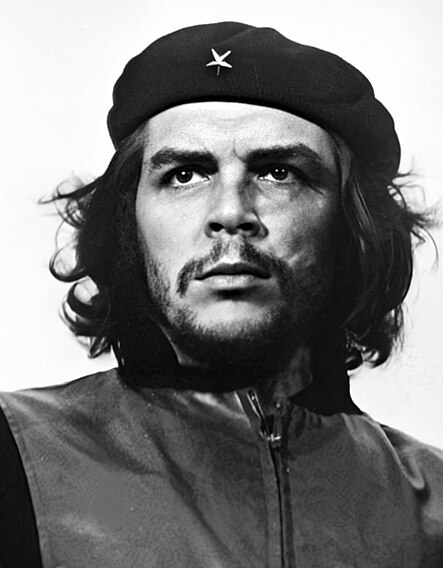
Date     Photo taken on 5 March 1960;
Source     Museo Che Guevara, Havana Cuba
Author     Alberto Korda Copyright

Che's beret-clad and bearded head has been said to be the most repoduced image in the world.  It seems that given his success as revolutionary, that Che as symbol, the Che of the rock t-shirts, and flags adorning teenage bedrooms across the world, is a fairly unlikely figure.  Indeed, one might say that he has inspired many more revolutionaries merely through the religious passion that his idol has evoked, more than any actual savvy regarding guerilla war.  In speaking of the Che's portrayal in "The Motorcycle Diaries", Berman notes "the entire movie, in its concept and tone, exudes a Chistological cult of martyrdom, a cult of adoration for the spiritually superior person who is veering toward death - precisely the kind of adoration that Latin America's Catholic Church promoted for several centuries, with miserable consequences."  The romantic ideal of Che as martyred revolutionary will probably never be excommunicated from the public mind.
"Che Guevara Monument and Mausoleum_Cuba 224" By James Emery.  License
Attribution Some rights reserved by hoyasmeg

Tuesday, October 16, 2012

Swamp Insurgency: Fighting Seminole Guerrillas in Nineteenth Century

The Seminole Wars show the problems that a conventional army can encounter when their enemies adopt guerilla tactics. Ian Beckett, in his survey work Modern Insurgencies and Counter-insurgencies (Routledge, 2001) describes the Seminoles as “particularly skillful opponents” of the United States Army. (p.29)  Throughout the first half of the eighteenth-century, skirmishes, ambushes, and raids typified a conflict, where American's had as much trouble finding their enemies as defeating them on the battlefield.

The Seminoles were largely Lower Creek people which had been driven into Spanish Florida, with other members from the Oconee, Yuchi, Alabama, Choctaw and Shawnee tribes. By the mid eighteenth century, familial links had also been made to runaway slaves which had found refuge in Floridian villages.  Their name has been variously suggested to derive from the Creek word simano-li, meaning "separatist" or "runaway", or the Spanish terms cimarron, for "wild" or cimarrones for "rebel" or "outlaw".  When Spain re-acquired Florida from Britain after the American Revolution, Spanish colonists, and American settlers alike aimed to settle in the area, coaxed in part by Spanish land grants.  Seminoles were allowed to take up land grants as well, as Spain hoped they would form a divide between the Spaniards and Americans.
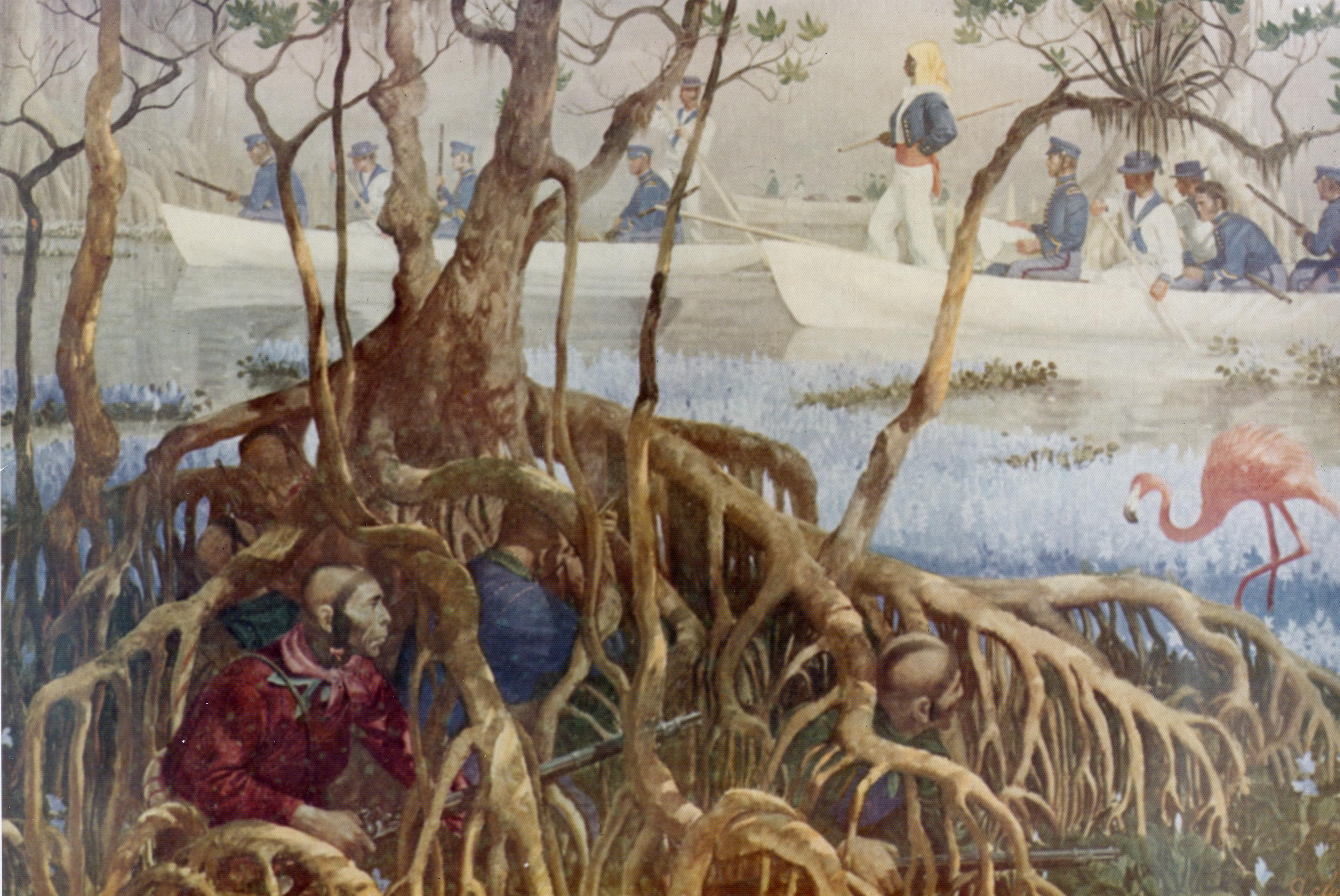
Marines battle Seminole Indians in the Florida War--1835-1842. Defense Dept. Photo (Marine Corps) 306073-A

Causes for American-Seminole violence may relate to older British tactics of using Seminoles against American settlers.  In the war of 1812 the Seminoles had supported Britain.  Harbouring runaway slaves was one offence that later caused the Americans to seek punitive justice against the tribe.  Beckett suggests the First Seminole War (1816-18) was largely motivated by the need to fight back against Seminole raiding partiesElsewhere, the murder of several Georgia families by chief Neamathla has been suggested as the event that sparked the conflict. General Andrew Jackson invaded Spanish Florida with around 3,000 soldiers and pushed the Seminoles further south.  Jackson dispersed villagers, burnt towns and seized Pensacola and St. Marks.  The Seminoles, in turn, conducted hit and run attacks on towns and plantations.  American ambitions for control of the peninsula were another casus belli, and in 1819, Florida was ceded by Spain to the United States

In 1823 a large reservation was established for the Seminoles, but this four million acre tract was not to remain a sanctioned home for long. In 1830, with Jackson as president, the Indian Removal Act become law. The United States governments attempts to remove all Indians west of the Mississippi into "Indian Territory" was accepted by some leaders who signed the Treaty of Payne's Landing in 1832.  Others refused to leave and moved deeper into the Everglades.

Oseola (As-se-he-ho-lor, Black Drink),
 a Seminole; bust-length, 1837. 
 
The treaty of 1832 allowed for three years for the Seminoles to move west, and in 1835 the stage was set for conflict with the hold-outs.  In December 1835, a 108 man detachment of Major Francis Dade’s forces was ambushed in the Wahoo swamp of the Withlacoochie River. A contemporary heritage website notes that, "As Major Francis Dade marched from Fort Brooke toward Fort King, 180 Seminole warriors led by Micanopy, Alligator and Jumper attacked. Only one man of that army detachment survived the ambush."  That the Seminole War was "the fiercest war waged by the U.S. government against American Indians", would presumably be contested by some historians.  Florida Heritage claims that more than  1500 American soldiers died in the conflict.
The action would begin the Second Seminole War (1835-42), which would see a series of frustrating actions for American generals.  The Seminoles crossed the Georgia border constantly and established safe havens in the Okefenokee Swamp.  Megan Kate Nelson quotes Ware County militia commander Thomas Hilliard who complained in 1836 that the Seminoles, "go concealed as much as possible, and are committing depredations continually, robbing our corn fields and killing our stock."  Seminoles destroyed numerous sugar plantations in Florida, crippling the industry and freeimg numerous slaves.  In February 1836, Major General Edmund Gaines' force of over 1,000 men was besieged and forced to retreat.  Subsequent generals fielding even more troops could not even find the enemy.  Campaigning in the summer months was difficult due to torrential rainfall and disease.

One noteworthy exception to American defeat is found in the campaign of future president Zachary Taylor, who benefited from the Seminoles abandonment of guerrilla tactics. At Lake Okeechobee in December of 1837, the Seminoles defended a fixed position in the everglades, and the Americans triumphed. The tribe did not make the mistake again, and Taylor’s counter-insurgency techniques divided the area and patrolled from outposts. It may have been racial conceptions of superiority which led American forces under General T.S. Jesup to ignore military custom and capture leader Osceola while under a flag of truce.  Osceola died in confinement several months later.  Meanwhile, Taylor destroyed crops and removed livestock, to little effect, and Taylor’s war continued until April 1840 when he asked to be removed from his command.  Jesup had some successes establishing forts and using mobile columns to sweep the country.
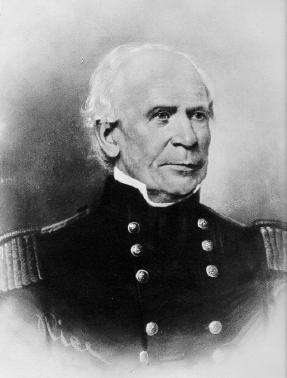
Thomas Sidney Jesup (1788–1860), 

As Beckett notes the war ended in 1842, not through any military success, but “largely by the army announcing it was over.” (p. 29) While 3800 Seminoles had been removed, there remained 500 guerrillas left in the swamps. The Third Seminole War (1855-58) reduced this number to mere 100 who continued to hide out in ever more remote areas of the everglades. Beckett suggests that the Americans little learned very little about counterinsurgency these early actions.

Thursday, May 17, 2012

Legendary Paratrooper : The Leadership of Marcel Bigeard, 1956

Syndey Morning Herald Obit 2010
Marcel Bigeard was one of the legendary paratrooper leaders of the Algerian conflict.  His training regime was as rough as they come, and his leadership style was a text-book example of leading from the front.

Bigeard's introduction to the Second World War shared the disapointment of many of his French compatriots, but he quickly rose to prominence.  Captured in 1940 in the Maginot Line, he managed to escaped the next year to Senegal joining a colonial infantry unit in De Gaulle's Free French Forces.  In 1944, he parachuted into France, and spent the postwar years in French Indo-China.
Bigeard in Indo-China. Independent.
On his third combat tour to Vietnam, it was Bigeard's misfortune to be dropped into Dien Bien Phu.  Again he showed his determination in commanding what Alistaire Horne called in his Savage War of Peace, "one of the most inspired counter-attacks."(1987, p.168)
Bigeard was subjected to three months of brainwashing, and this may have inspired his belief that the "subversive warfare" in Indo-China was the beginning of a world-wide attack of which Algeria was a part.

Rama CeCILL
Arriving in Algeria, Bigeard commanded the 3rd Regiment of Colonial Parachutists, which immediately was purged of the weakest members.  Others who did not wish to be in the unit were offered transfers.  Those that remained were subjected to a brutal training regime in the dry lands of Algeria.  They returned a new breed of Para, sporting a long-brimmed camouflage cap, causing the pied noirs (Algerians of european stock) to nick-name them, the "lizards".  Bigeard denied the use of torture during the conflict, but did admit to "muscular interrogations."


Alistair Horne doesn't pull his punches in describing the paras as, "on their way to becoming a crack force; one of the most effective in the Western world". (p. 168)  An early construction of the Bigeard legend was the book The Centurions (1960) by Jean Lartéguy, which featured a character modelled after the commander.
A film based on The Centurions.
Bigeard led from the front, conducted his own reconnaissance and jumped with the first wave.  Horne notes, "tall and powerful, with a beaked nose that imparted a look of a bird of prey, Bigeard had that particularly French quality of allure essential to an outstanding commander.  He seldom did anything without panache.  Instead of arriving by staff car, or even helicopter, his favourite manner of inspecting a unit was to drop by parachute, arm at the salute as he touched down."

Imitators of the Bigeard command-style should, however, be wary.  Horne notes that in later life, when Bigeard was approaching sixty, one such troop inspection went wrong.  In Madagascar, Bigeard was dropped into shark-infected waters, breaking an arm.  His unfortunate yet "faithful" staff, who parachuted into the water with him, managed to save the General from the waters.

Friday, April 13, 2012

Indiscriminate Killings during Insurgencies: Servan-Schrieber's "Lieutenant en Algerie"

Alistair Horne's A Savage War of Peace (1977) is a classic account of the 1954-1962 insurgency in Algeria.  The book was reportedly read by George W. Bush and numerous American military commanders after the 2003  invasion of Iraq.  Horne himself was consulted by the president, and wrote that, "In the Oval Office last year, I was questioned intently on how de Gaulle got out of Algeria; I had to reply, 'Mr President, very badly; he lost his shirt.' Though it was clearly a disappointing response, Mr Bush replied, with emphasis: 'Well, we're not going to get out of Iraq like that.' There are several ways in which the Americans lost their shirt in Iraq, and George W. Bush could be said to have personally lost his comfy pad on Pennsylvania Avenue.

Insurgencies are difficult to generalize.  Most are specific and chaotic, inseparable from their historical context, and refuse to be neatly compartmentalized into good guys and bad guys.  Algeria was a particularly brutal war, and Horne does not back away from the grisly details.  An account which he quotes from Jean-Jaques Servan-Schrieber's book Lieutenant en Algerie (1957), echos the frustrations of regular soldiers who cannot tell friend from foe.  An old campaigner here tells a fresh-faced captain about the realities of discriminating civilians from combatants:
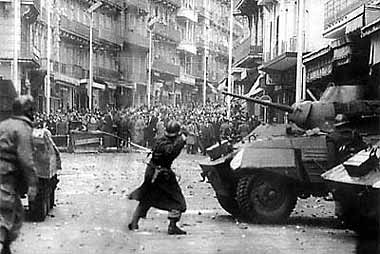
1960 Algerian Independence Demonstration
"Either you consider a priori that every Arab, in the country, in the street, in a a passing truck is innocent until he's proven the contrary; and permit me to tell you that if that is your attitude...you will immediately be posted, because the parents of reservists one has had killed don't like it, and will write to their deputies that you're a butcher...Or you will...consider that every Arab is a suspect, a possible fellagha...because that, my dear sir, is the truth...But once you're here, to pose yourself problems of conscience - and treat possible assassins as presumed innocents - that's a luxury that costs dear, and costs men, dear sir, young men themselves also innocent, and our own..."


Such sentiments are how insurgencies are won militarily and lost politically.  This brutal calculus of counterinsurgency exposes the attitude of distrust which creeps into the soldier's psyche when any passerby may be a potential killer.  This is one common thread to insurgencies: they are an extremely difficult psychological task for the soldiers that fight them.