Showing posts with label Calgary. Show all posts

Friday, September 7, 2012

Strychnine and Axe-attacks North of Cochrane Alberta, 1890

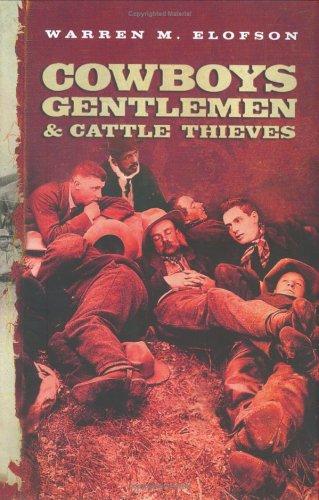
The old myth of the Canadian west as well-behaved and orderly, kept calm by respectable Mounties, and in no way related to the wild and woolly frontier south of the forty-ninth parallel, has not stood the test of time. Warren Elofson's Cowboys Gentlemen and Cattle Thieves (2002), is one work which argues that the image of the tame Canadian west dominated by metropolitan influences from Eastern Canada and Britain is in need of adjustment.  Elofson argues that Canadians could behave, "in astonishingly undisciplined and intemperate ways." He writes,
 
It is time to stop insisting on the absence of factors such as the frontier environment and lawlessness in western heritage. The frontier not only determined to a considerable extent the day to day practices utilized by the ranchers to run, protect and nurture their livestock, but did much to fashion their entire way of life, or culture in the broadest sense. A tendency towards extra-legal and even illegal modes and measures was part of that culture." (Elofson, xvi)

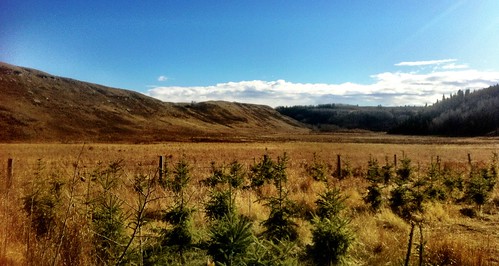
An 1890 North-West Mounted Police patrol report of the Cochrane, Bottrel, and Morley area seems to confirm Elofson's suggestions that the Canadian west could get downright unruly.  Corporal R. Macdonald was the leader of the patrol which set out west from Calgary at 8:30 a.m. on 6 June 1890.  What today takes no more than an hour's drive took the patrol all day, as they arrived in Cochrane at 5pm.  The next day they headed north on what was for some time called the Dog Pound, or Bottrel Road, but is now the Highway 22, (or, if you will, "The Cowboy Trail").  They stayed that evening at the Jenkins Brothers house.  The patrol learned that one of the Jenkins had been party to some spiteful violence which quickly escalated.

Corporal Macdonald's patrol report does not delve into the origins of the animosity between Jenkins and one James McDonough, but presumably a feud had been brewing for some time.  It may be the case that an errant canine was the source of the hostility.  As Macdonald wrote,
 A short time ago Jenkins + Nelson had determined to poison a dog belonging to James McDonough on account of its being in the habit of chasing their cattle.  Information to that effect was carried to him by Botterell - the consequence was a violent quarrel ending in the most abusive language by McDonough + a blow by Jenkins[. The] former then attempted to strike the latter with an axe. (RG18, Vol. 42, File 495)
It seems that McDonough was suspected of some foul play regarding poisonings in the area after the incident.  A horse some distance from Dog Pound Creek was found poisoned and it was discovered that McDonough had been to Calgary to buy fifty cents worth of strychnine.  Macdonald reported:
The bowels of the dead horse were examined by Dr. Heydon[?] of Mitford and strychnine was found in them.  In a conversation that I had with McDonough on the subject he said, "Its lucky that I live so far from him or he would suspect me of having killed them" he then went on to say "Its my opinion that they must have picked up some poisonous herb" and, on my telling him of the Doctors report, he said "Oh" several times in succession.
RG18, Vol 42, File 495. "Patrolling, Calgary District, Reports re."


The verdict on the McDonough poisoning case awaits further research, but the patrol report does provide some evidence supporting Elofson's thesis that the Canadian west could be violent.  The report gives great details on the region north of Cochrane, where in 1890 only twenty-four settler names could be procured in a area of approximately 500 square kilometers.  Corporal Macdonald reported healthy crops and fat sheep and cattle grazing on the open range.


Calgary Condominiums
Today the area is well-fenced, and cattle and a few sheep still placidly wander the grasslands, albeit with the occasional oil pump-jack in the way.  The Bottrel store sells grains and other agricultural goods, but children and adults alike from the nearby provincial campground seem to prefer the ice-cream.  Should one be interested in owning a piece of early western history, the store is up for sale!


Friday, June 8, 2012

Robert Rundle at Big Hill Springs, 1841

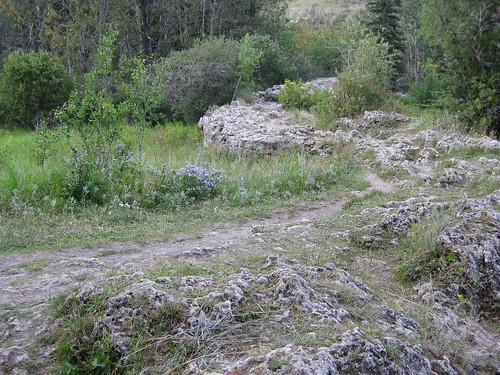
20111023 big hill springs - 17
Flickr: buzz.bishop [creative commons]
A pleasant stream along a meandering path, and some bulbous tufa rock mounds are the main attractions at Big Hill Springs provincial park, north-west of Calgary, Alberta.  Big Hill Springs was also the site of a pre-historic buffalo jump, which makes sense considering the sharp banks of the valley.  Buffalo still grazed in the area when the first fur-traders and missionaries reached the country. On 12 April 1841, itinerant Methodist missionary, Robert Terrill Rundle, encountered buffalo there when he camped after a frigid "spring" trek across the plains.  As Rundle recorded in his diary,


Ap. 13th- Started for the Black Foot Camp on Bow River.  Launched forth for the 1st time on the Plains.  Weather cold & hard wind.  Dined near the carcass of an old buffalo.  Towards evening reached the Banks of O-mis-ce-nipe or writing gulley.  Saw Indians running buffalo.  Encamped with the Indians.  Sang & prayed before we retired.  Very cold.
A note from published version of The Rundle Journals 1840-1848 (1977) by historian Gerald Hutchinson, suggests the location of "writing gulley" was,
probably near Big Hill Spring Provincial Park, north of Cochrane.  In 1885, J.C. Nelson recorded "Picture Rocks" on a stream at the Big Hill above Calgary, and identified them as omisinah. (Hutchinson and Dempsey, Rundle Journals, p. 63, 327)
Tufa
Tufa Flickr: trickydevil [creative commons]
Tufa is a limestone sediment created from carbonates drawn from the water itself.  The waters from the springs were useful for Alberta's first commercial dairy, and in the mid-twentieth century were utilized as a fish hatchery.  The site then, has had numerous uses since Rundle visited.  The chances of a visitor spotting a buffalo at today's provincial park, however, are slim indeed!

Wednesday, June 6, 2012

D-Day Prayer in Calgary, 6 June 1944

Crowds on 1st Street SW, Calgary 6 June 1944
Canadian thoughts on the anniversary of D-DAy, are focused on the beaches of Normandy.  Those on the homefront during the Second World War also gave their thoughts to the men in France, and many took to the streets to show their solidarity.  Calgarians on 6th June 1944, took time from their day for a public prayer, in a show of concern for the soldiers, hopes for victory and a lasting peace after the conflict.

The display was not exactly spontaneous, having been organized by the Calgary Ministerial Association, and sanctioned by the mayor of Calgary.  An estimated 15,000 people who gathered on 1st Street West at 7-8th Avenues abandoned their daily duties to join in prayer.  Author Grant MacEwan, in his Calgary Cavalcade : From Fort to Fortune (1975), estimated that one sixth of the city's total population showed up that day to show their support. MacEwan wrote,
As if by magic the word went around downtown Calgary.  Stores closed at 11.20 a.m., and at 11.35 a military band led the huge host of earnest people in the singing of "O Canada." Usual street noises having ceased, the singing could be heard at Mount Royal College, almost a mile away.   (MacEwan, p.174)
The Calgary Herald  reported that the ceremony had a number of symbols familiar to Remembrance Day.  One Reverend Morley noted that it had been twenty-six years since the, "fallen heroes of the last war" in John McCrae's "immortal poem" had pleaded "to you from failing hands we throw the torch, be yours to hold it high." In keeping with Remembrance Day rituals, a minute of silence was held.


The Herald recorded the reaction from a cross section of Calgarians, most of whom were confident of success.  Worried mothers were happy, if concerned, and servicemen wished they were with their buddies on the beaches of France.  The Herald noted that there had been great anticipation of the event,
The announcement that today was D-Day did not surprise many Calgarians.  Most of them had expected that the invasion would be timed by the capture of Rome.
'Besides being a moral victory for us, the fall of Rome proved that our force in Italy do not need further support, and that our troops are now free to concentrate on France,' said a man who had been a major in the last war.
Advertising for War Savings Certificates shows the invasion was much anticipated.  6 June 1944 Calgary Herald.
The public ceremony, and its press reportage, is interesting for the what it does and does not say.  Were the protestant hymns happily sung by those who did not practice the faith? Did Calgarians really have the confidence of success that news articles portrayed? Some may not have believed this was the real show at all after false rumours of the invasion had been previously leaked.

As an instance when the fighting in Europe and the Canadian homefront are clearly linked, the public display frames an interesting moment in the Canadian experience of the Second World War.  Yet, as might be expected, the historical record cannot answer a myriad of questions regarding how thousands of diverse citizens understood the war.