Showing posts with label methodism. Show all posts

Wednesday, June 20, 2012

George McDougall and Methodist Conceptions of Death

Image No: NA-659-44
Title: Reverend George McDougall.
Date: [ca. 1875-1876]
Photo: Field, Montreal, Quebec.
The death of the Reverend George McDougall, in January of 1876, is one of the iconic moments in Western Canadian history.  Out on a buffalo hunt with his son John, George lost his way, and was found in the snows, laying on his back as if readied to meet his maker, or those of the search party that would find him.  Sarah Carter, in her 1981 thesis wrote of the mystery of the event:
In January of 1876, George and John McDougall and two other men were buffalo hunting north of present-day
Calgary . On one clear evening George rode ahead to prepare supper for the others but did not make it to camp. The search lasted for several days during which there was a fierce blizzard . His frozen body was eventually found but there were no clues as to the cause of death . The mystery was that there was no explanation for how an experienced frontiersman could become lost on a clear night . (Carter, Man's Mission of Subjugation, p.20)


Grave of George McDougall
Alison Jackson Photograph Collection, AJ 1458
Canadian Methodist missionary writings of the nineteenth century often take a surprisingly positive stance on death.  Oftentimes, the deathbed confessions of aboriginal peoples are taken as moments of joy, which show that they are in transition to a peaceful eternity in heaven.


Ironically, George McDougall took death as the topic of a letter he wrote James Ferrier on 6 January 1876, very shortly before he died on the plains somewhere near today's Calgary, Alberta.

There is something that strikes on all hearts in the spectacle of a great man's funeral. The hearse, the solemn march of the procession are both very impressive, and yet the subject of all this show may have been heedless of the great salvation, and if so, is now suffering the doom of a lost spirit.[...] Reflections like these often cross the mind of the Indian missionary., as he looks for the last time upon all that is mortal of one of his Sabbath School scholars. In the past twenty five years I have assisted at the burial of hundreds of these little red children; the squirrel now gambols in the boughs of the trees that everhang their graves, and the partridge whistles in the long grass that floats over the solitary place, but the incidents connected with their short pilgrimage cannot be forgotten.
(James Ferrier Canadian Methodist collection, Public Archives of Alberta, PR 1975.0572)

McDougall wrote the passage for a model Sabbath School curriculum that Ferrier was organizing, and included the death stories of two  aboriginal children.  There is a curious serendipity to McDougall's morbid topic.  It must have come as a shock to Ferrier to learn, shortly after, if not before he received McDougall's letter, that the famous missionary had departed the mortal realm.

Saturday, June 9, 2012

The Canadian Methodist Missionary Interpretation of the First Sino-Japanese War, 1895

The Japanese victory over China in the 1895 Sino-Japanese war has been attributed to modernization under the Meiji restoration.  Westerners assumed that the Chinese navy's ironclads and presumably extensive army would handily crush the Japanese.  This was not the case, and the shift in power in the region from China to Japan, caused consternation among some in the Western world.
Battle of Weihaiwei.  Woodblock by Ogata Gekko. 1895?
The Canadian Methodist Missionary Society, had established missionaries to Japan in 1873, and were quick to attribute the victory to the very concept of civilization which they were promoting overseas.  By the 1890s, over twenty missions were established in Japan, with over two thousand members of the church tallied.   As the Society's 1895-96 general report noted,
Of late our foreign work has been subjected to disturbing forces of an unusual kind, which at first seemed to threaten the progress, if not the existence, of the cause; but the outcome has confirmed our faith and put to flight our fears.  Japan has emerged from the conflict victorious.  Destiny has decided in favor of the minority.  This is doubtless due to that higher plane of intelligence and efficiency up to which the people, as a whole, have been raised in the last few years.  Christianity is now being recognized by the most 'advanced minds' as the important factor in the up-lifting of the nation, and is likely to receive a greater and more sympathetic attention than heretofore. (CMMS 72nd annual report, p. xi)

How the 2137 members of the Canadian Methodist Church's missions could have any actual influence on the war remains to be seen.

The war was fought over control of Korea, whose independence was accepted at the 17 April 1895 Treaty of Shimonoseki.  China also gave up Port Arthur and Taiwan, the former being swiftly snatched up by Russia, backed by its Triple Intervention allies, France and Germany.  There were clearly several overlapping layers of active colonialism surrounding the conflict.

Friday, June 8, 2012

Robert Rundle at Big Hill Springs, 1841

20111023 big hill springs - 17
Flickr: buzz.bishop [creative commons]
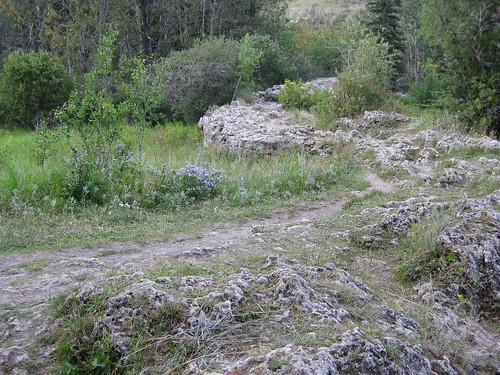
A pleasant stream along a meandering path, and some bulbous tufa rock mounds are the main attractions at Big Hill Springs provincial park, north-west of Calgary, Alberta.  Big Hill Springs was also the site of a pre-historic buffalo jump, which makes sense considering the sharp banks of the valley.  Buffalo still grazed in the area when the first fur-traders and missionaries reached the country. On 12 April 1841, itinerant Methodist missionary, Robert Terrill Rundle, encountered buffalo there when he camped after a frigid "spring" trek across the plains.  As Rundle recorded in his diary,


Ap. 13th- Started for the Black Foot Camp on Bow River.  Launched forth for the 1st time on the Plains.  Weather cold & hard wind.  Dined near the carcass of an old buffalo.  Towards evening reached the Banks of O-mis-ce-nipe or writing gulley.  Saw Indians running buffalo.  Encamped with the Indians.  Sang & prayed before we retired.  Very cold.
A note from published version of The Rundle Journals 1840-1848 (1977) by historian Gerald Hutchinson, suggests the location of "writing gulley" was,
probably near Big Hill Spring Provincial Park, north of Cochrane.  In 1885, J.C. Nelson recorded "Picture Rocks" on a stream at the Big Hill above Calgary, and identified them as omisinah. (Hutchinson and Dempsey, Rundle Journals, p. 63, 327)
Tufa
Tufa Flickr: trickydevil [creative commons]
Tufa is a limestone sediment created from carbonates drawn from the water itself.  The waters from the springs were useful for Alberta's first commercial dairy, and in the mid-twentieth century were utilized as a fish hatchery.  The site then, has had numerous uses since Rundle visited.  The chances of a visitor spotting a buffalo at today's provincial park, however, are slim indeed!

Thursday, June 7, 2012

Hard Times at the Woodville Mission, 1880s

Over its intermittent lifespan, the unfortunate mission at Pigeon Lake was the site of a good deal of destitution, disease and death.  What would be known later as the Woodville mission has its roots in the visit of legendary itinerant Wesleyan Methodist missionary Robert Rundle.  Rundle attempted to plant potatoes and beans, but found that the climate and soil were not conducive to agriculture.  In 1847 Benjamin and Robert Sinclair arrived in the region at Rundle's request, and stayed on for around five years when the mission was abandoned.

In 1864 the Reverend John McDougall's "honeymoon" with his new wife Abigail Steinhauer consisted of a travelling to Pigeon Lake to reopen the mission, which had reportedly been abandoned for around six years.  Upon visiting the mission in 1873, after he had been assigned to Morleyville, he later wrote, "long before I reached the house a multitude came running to meet their old friend. My first task was to shake hands with upwards of 300 persons."  Within a decade, these three hundred souls would be scattered to the winds, or worse.
"Mission houses at Pigeon Lake as photographed by J.B. Tyrrell during his survey of the area.
1886  Pigeon Lake, Alberta." 
Community Memories
In 1882 John Nelson arrived at the again abandoned mission, now named Woodville after mission superintendent Josiah Wood.    It appears the mission was moved from the original site on the north side of Pigeon lake to the south-east side by 1883.  The Sharphead Stoneys were the band at Pigeon Lake at the time, and the decision was made to move them and the mission to the Bear Hills alongside the Cree.  This did not work, and in 1884 the mission was moved to where Wolf Creek meets the Battle River.  


Rev. John Nelson. Community Memories
The Woodville mission met with further hardship in the 1880s.  In 1886-87, the measles broke out killing one third of the band, and half the scholars at the school. (63rd Annual Report of the Methodist Missionary Society, p. xxv)  Two years later, it was noted that "The band at Woodville, fourteen miles from the Battle River Mission, has been greatly depleted by death, and the school almost extinguished." (65th MMS report, p. lii) The year after, the Methodist Missionary Society wrote in great understatement that, "The Rev. John Nelson writes in a somewhat despondent tone".  Nelson wrote,

Our Work here does not present the cheering aspect that we had desired.  There seems to be nothing on which to rest our hopes.  Disease and death have apparently marked the entire band.  (MMS Report, 1889-90, p.xxxii)
At the end of the 1880s, the mission was all but abandoned yet again.  Brother Nelson reported,
It is not without considerable regret that I make the last report of what has been one of the oldest and one of the most successful Indian missions.  It is here that the McDougalls, Woolsey, Steinhauer, and Campbell faithfully taught the people the "Way of Life."  Our band has been so reduced in numbers that the Indian Department has withdrawn the instructor, and the remnant of the people will be urged to join other reserves
It is with genuine sorrow we part from those with whom we have endured privation and suffered affliction.  I have witnessed their grief, heard their earnest entreaties that the Great Spirit would lift the afflicting hand.  (MMS Report, 1890-91, p. xlii)
Ross' suggestion that the Woodville mission was "successful" in any way is hard to reconcile with its history, but perhaps he was simply paying deference to those missionary greats that had come before him.  Today's Pigeon Lake Reserve is home to a population of 353, representing the First Nations of Louis Bull, Samson, Ermineskin, and Montana.