Monday, December 5, 2011

A Bath of Bubbly in Brandon: Captain Vivian bathes in his Profits

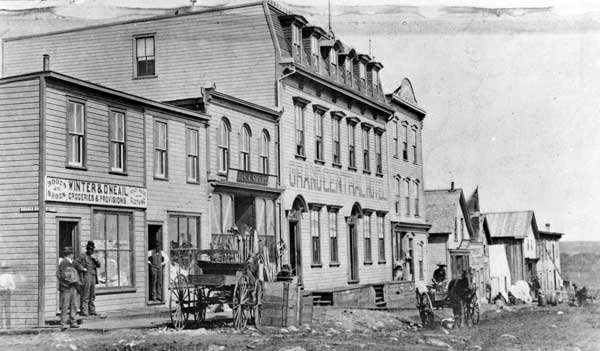
Few writers can top the late Pierre Berton in the use of colourful anecdotes to add life and interest to the history books.  His work on the construction of the C.P.R.'s main line, The Last Spike, is one of the most readable books in Canadian history.  His account of a certain Captain Vivian, in the heady days of 1881, when the C.P.R. thrust its main line due west from Winnipeg, and real estate speculation was in its heyday, is worth re-telling.  Vivian was English gentry in bearing, sported a gleaming monocle, and spent a thousand pounds on a quarter section near Brandon.  As Berton recounted:
Rosser St. and 6th Ave. Brandon, 1882.   MHS Source: S. J. McKee Archives, Brandon University, Lawrence Stuckey Collection C1

"Vivian sank the entire sum into a quarter section homestead in the Brandon district, which he proceeded to sell at inflated prices.  By February he was said to be worth four hundred thousand dollars.  Unable to drink up all the champagne he had purchased, he filled a bathtub with it and invited his friends to watch him splash about.  The affair cost him seven hundred and fifty dollars."


Berton reports that the Brandon real estate boom was so sudden that no cemetery was planned and the dead had to be shipped back to Winnipeg.

Sunday, December 4, 2011

Diaper Drill: Infant Training Vol. 1 1939

Canada. Dept. of National Defence/Library and Archives Canada/PA-008102 .  
The Second World War Canadian Armoured Corps journal The Tank, provides an interesting look into the professional and social life of the Armoured Fighting Vehicle School in Borden, Ontario.  An editorial of September 1942 provides the standard drill for the changing of diapers, which given reports in the journal, were skills necessary for a number of Canadians in England.

"S/Sgts Hughes, Stacy and Borman have been appointed instructors in Diaper Drill.  The following are "extracts" from "Infant Training Vol. 1 1939."  On the command "Change Diapers" the following procedure will be adopted.

     One. Place the infant upwards, head pointing to the left, on lap.

     Two.  With a smart movement of the right forefinger and thumb, detach safety pin (feel for it) and place same between the lips, point to the front.

     Three. Supporting infant with the left had, open the flaps of diaper with the right, giving the infant a smart cant upwards with the left hand, jerk diaper away with right, and place it on ground two inches from rear of right hind leg of char (with chairs, folding MK 2, put level with crossbar).

     Five.  Carefully clean and oil infant with rags, white, pattern C2.  Sprinkle all parts with dusting powder and examine thoroughly for wear.

     Six Cant infant smartly upward with the left hand, at the same time taking clean diaper from its position on right shoulder.  Spread diaper on lap.

     Seven.  Assemble diaper as taught in Elementary Diaper Drill and secure with safety pin.  Tension on pin should not exceed 2 lbs.

     Note. App. VIII.  This sequence will not apply to the new diaper, zipper type, pattern 39, which will be on issue through the usual channels."

It appears that there is still contemporary use for strict guidelines on infant operation.  Here poor old Stephen Harper receives a jab at his powers of the people :
http://www.mackaycartoons.net/

Saturday, December 3, 2011

Flying Vehicles: Canadian Army Vehicles in Flight, 1942

A number of pictures from 1942 show the enthusiasm for obtaining first flight for army vehicles in Camp Borden.  Borden was the centre of Canadian Armoured Corps activities in Canada during the war, and trained innumerable reinforcements for Canadian units overseas.  While some tactical manoeuvres were carried out at Borden, in the early years, the task was largely to turn recruits with basic or no training whatsoever into specialized tradesmen.  Courses on gunnery, wireless, and driving and maintenance sought to familiarize troopers with the tricks of the trade.  Many men arriving in England in the years before 1943, however, would be inadequately trained in the most basic trades.  This is no reflection on the efforts at Borden, but shows the massive expansion of the Canadian Armoured Corps, which possessed only a handful of Great War-era Renaults at the outbreak of hostilities.
 Above and Below: August 1942, The Tank - Canada

Title: Military personnel driving a jeep at Camp Borden Date: [ca. 1942]
Place: CAMP BORDEN (ONT.) Creator: Gordon W. Powley
Format: Black and white negative Reference Code: C 5-1
Item Reference Code: C 5-1-0-67-12 Ontario Archives
Getting army vehicles airborne cannot be considered a logical tactical manoeuvre.  Attempting to jump minefields is not standard operating procedure!  It is possible that the men are putting jeeps and carriers through their paces, but more likely that these flying jeeps were launched for publicity purposes.  The Canadian public grew increasingly anxious for their army to take part in the war, and especially after Hitler's panzerkampfwagens stormed across France in May 1940, mechanized warfare was on the mind.  The public conducted buy-a-tank campaigns as a way to show their support, raising money for the government to purchase armoured fighting vehicles.  If the Canadian public perceived modern war as highly mechanized, then pictures of high-flying vehicles may have served to bolster the idea that the Canadian army was doing its utmost to gain proficiency.  Whatever the motivation, the launching of army vehicles made for some great photos. Perhaps these army drivers should have joined the Royal Canadian Air Force?!