Showing posts with label Quebec. Show all posts

Saturday, May 26, 2012

Raucous Procession: Montreal Protests and Charivari

Montreal street protest
Flickr xddorox
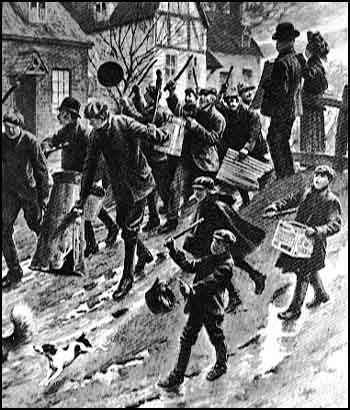
The spring 2012 Quebec protests have expanded beyond their focus on student tuition hikes in part due to the backlash against Bill 78.  In response to the law, which necessitates police approval for protest and assembly, Quebecois of various backgrounds have taken to the streets armed with various culinary noisemakers.  Banging pots and pans in protest has a long history in the province.  French-Canadians imported these practices from Europe, where the "charivari", a raucous procession used to shame a moral offender, dates back to the Middle Ages.

G. Desplat, Charivaris en Gascogne.1982.Darby's Diary

Brian Palmer outlines the practice of charivari in its earlier European forms in a 1978 article in Labour/Le Travail, "Discordant Music: Charivaris and Whitecapping in Nineteenth-Century North America."  Palmer wrote that, "the demonstration was most often initiated under the cover of darkness, a party gathering at the house of the offender to beat pans and drums, shoot muskets, and blow the ubiquitous horn, which butchers often rented out for the occasion. Sometimes the guilty party was seized, perhaps to be roughly seated on a donkey, facing backwards, and then paraded through the streets, passers-by loudly informed of his/her transgression.  (p.9) The ritual was "most often used to expose to the collective wrath of the community adulterous relationships, cuckolded husbands, wife and husband beaters, unwed mothers, and partners in unnatural marriage."


Palmer notes that in England, the term "rough music" was applied to the ritual, and that if warnings for bad behaviour were not heeded, the procession would set out for the house of the deviant.  "Under the cover of darkness a procession formed, headed by two men with huge cow-horns, followed by an individual with a large old fish-kettle around his neck, representing the trumpeters and big drum of a serious parade. The legendary neo-marxist historian E.P. Thompson described the procession as, "a motley assembly with hand-bells, gongs, cow-horns, whistles, tin kettles, rattles, bones, frying-pans, everything in short from which more and rougher music than ordinary could be extracted.''  Palmer notes that the different forms of charivari in early-modern Europe were "a pre-political form of class action" used for social control.  (p.15).


In North America, the charivari was first prominent in Lower Canada, Lousiana and Alabama (Palmer, p.17)  At times the practice could manifest in racist actions where citizens felt racial boundaries had been overstepped.  On occasion the rite was used as a form of political protest, but Palmer argues this was rare. Palmer notes that around 1890, North American charivari practice died down, replaced in part by white-capping, or vigilante justice against moral offenses.


Allan Greer disagreed with Palmer on the importance of charivari as a mode of political protest.  In his 1990 Social History article "From folklore to revolution: charivaris and the Lower Canadian rebellion of 1837", he notes that the rebellion changed the charivari procession from its traditional role of social protest to more explicit political purposes.  Prior to the rebellion, charivaris were used specifically against marriages which were considered ill-matched.  Yet during the failed uprising of the Patriotes, the charivaris could take a aggressive stance towards local Loyalist officials.


Greer cites the case of one Lieutenant Dudley Flowers of St Valentin, whose house was subject to a particularly violent form of charivari, where the Patriots sought his resignation.  Flowers wrote in 1837,

On the following day (Sunday) about seven in the evening, some sixty or seventy individuals attacked my house a third time in the same manner and with the same threats as on the former occasions but if possible with much more violence, beating kettles and pans, blowing horns, calling me a rebel, saying it would be the last time they would come as they would finish me in half an hour. They had in a short time with stones and other missiles broken in part of the roof of my house and boasted that it would soon be demolished. Fearing that such must inevitably be the case, I opened the door and told them that if four or five of their party would come in and give their names I would give them up my commission. (Greer, p.38)


flag
Flickr: alexsnaps
It appears that it is this form of political protest that has inspired Montrealers to take their pots and pans to the streets.  Some mention has been made of the Chilean cacerolazo protest of the 1970s and 1980s, and a facebook callout linking the Montreal protests to this practice.  It seems odd that charivaris would be downplayed as the logical cultural precursor to this form of protest.


Thursday, March 3, 2011

Sean Mills Podcast on the Empire Within

I have already posted my own two cents on Sean Mills' The Empire Within.  For those of us not content reading Mills' words, we can now listen to them, courtesy of the National Campus Radio Association.  Mills basically gives a short teaser to the major themes in his work, which covers post-colonial ideas within the various strains of the protest movement in 1960s Montreal.
Sean Mills Drinks Coffee

Mill's interview emphasizes the global context of the Quiet Revolution, and an understanding of the complexities of various Montreal groups.  He also addresses the rise of the various strains of the neo-nationalist movement in Quebec, and shows that the various voices of dissent during the 1960s, were acting as an alternative to this state-centred neo-nationalist refrain.

Mills speaks to the way in which thinkers such as Sartre and Memmi, were at first  skeptical towards the notion of Quebec as a post-colonial society, but were later to accept the province within an anti-colonial framework.

The rise of women in the 1960s movements is also addressed.  Women's support of the organizations of dissent started in periphery roles.  Later they demanded gender equality, not only within these organizations, but in greater Quebec society.

Admittedly, there isn't allot here for those who have read the book already, but the podcast serves as a good overview for those who haven't picked it up yet, and a refresher for those who have.

Listen to the Podcast

Thursday, February 3, 2011

Review - Sean Mills - The Empire Within: Postcolonial Thought and Political Activism in Sixties Montreal

Sean Mills' The Empire Within: Postcolonial Thought and Political Activism in Sixties Montreal (McGill: Montreal, 2010), traces the discourse of decolonization throughout the rise of diverse Montreal protest groups in the 1960s. The work shows that activism during the period was dynamic and complex, and moves far beyond a simplified popular version of the era centred on the FLQ's radicalism. Revising a historiography which shows the period as a reaction to the social conditions of 1950s Quebec, Mills contextualizes the intellectual ferment in Montreal with that of international dissident political movements and thinkers. Despite the diversity of groups struggling for empowerment across racial, linguistic, economic, and gender divides, Mills observes that "hovering over all of the conversation of leftists throughout the city was Montreal's relationship to empire." (51)


Sir George Williams Riot, 1969

Intellectuals such as Jacques Bergue, Albert Memmi and Frantz Fanon developed a conceptual framework which saw colonialism divide human groups. The colonizer systematically suppressing the culture, language and history of the colonized. Such a process leads to the internalization of racist structures by both sides of the power relations, which can still persist in neo-colonial forms. The Quebec protest movement would infuse these ideas with the specificity of anti-colonial Marxism, which Robert Young claims "emphasizes [...] the untranslatability of revolutionary practices, the need for attention to local forms, and the translation of the universal into the idiom of the local." (34) Mill sees the Partis Pris as having the largest impact on the "language of dissent" in Quebec. This publishing house cum political party saw the Catholic Church as a primary mechanism of colonial power and adopted a program of secularization, independence and socialism. With these ideas and the demographic transition fuelled by increased immigration, the post-war baby boom, and urbanization, Montreal became a hot-bed of criticism against what was increasingly characterized as a unjust colonial system.

         Mills traces the rise of social protest groups which differentiated themselves due to race, gender, language and class, emphasizing their shared international influences in the realm of post-colonial thought. The emphasis is on the writers of the manifestos and the intellectual leadership, and it is noted that the postcolonial message is diluted when analysis strays from these "elites" to the rhetoric of the street protest. As militant protest rose after 1968, a blend of socialist decolonization, Marxism and the old "tropes of traditional nationalism" were prevalent in popular protest. (158) While an underlying nostalgia seems impossible to avoid in dealing with the sixties era, Mills does not romanticize his subjects. The macho and masculine discourse of black-power is shown to exclude women, the FLQ's accusations against Trudeau are denounced as homophobic, and women's groups are seen splintered along the lines of whether to include men in their struggle. It seems that the non-hierarchical and democratic nature of many protest groups made for unification against a common enemy at first, but then led to dissipation and internal conflict. Ultimately, leftist protest and their post-colonial framework was usurped by the class-based analysis of the labour movement.
Student Protest Montreal, October 1968
        Mills' work approaches a stand-alone history of the Quiet Revolution, yet its focus is clearly on the left, leaving the provincial and Catholic Church's reactions to the protest movement to other monographs. Also remaining unexplored is the intertwined conceptual framework of Marxist structures with post-colonial thought, which is perhaps germane to a history of leftist protest. The extent to which the post-colonial thought of the manifesto writers was on the public's mind is left ambiguous by Mills' brief comments on the rhetoric of street-protest, but an analysis of the broader public discourse during the era is perhaps another book awaiting its author. The clean sweep of historical awards granted The Empire Within shows that historical establishment is favourable to Mills' work. For moving beyond an exceptional Quebec in this transnational approach, rising above a historiography focused on the radicals behind the October Crisis, and providing an excellent readable history of a fascinating period of Quebec, Mills' work is a necessary addition to the literature of the period.

Sean Mills, The Empire Within: Postcolonial Thought and Political Activism in Sixties Montreal (McGill: Montreal, 2010).

Sunday, January 30, 2011

The Face of Jacques Cartier

Hero Cover: Theophile Hamel's Cartier 1844.
A recent work on the famous explorer Jacques Cartier shows the specious origins of powerful historical images and the macabre uses they can at times be put to.  Alan Gordon's The Hero and the Historians:Historiography and the Uses of Jacques Cartier (2010) traces the rise and fall of "Cartiermania" in Quebec.  Gordon follows the construction of the public memory of the Breton explorer from its beginnings as the work of archive-obsessed amateurs,  to its height as a late nineteenth-century French-Catholic nationalist symbol, and on to its co-option by  federalists and eventual contemporary dispersal.  The beginnings of the spread of the idea of Cartier as heroic founding father was the popularization of his portrait in Lower Canada, which has an interesting story of its own.


In 1843, the remains of a ship believed to be Cartier's Petite Hermine from his second voyage (1535-36) were discovered by a hunter and examined by some Cartier enthusiasts.  (Gordon, 67) When these relics were sent to Saint Malo, France, (Cartier's home town) for confirmation, the news was revealed that the town hall contained a portrait of the explorer, whose appearance was still a mystery in Lower Canada.  The painting was the work of one Francois Riis, who claimed to have composed the portrait  by memory from a sketch found in Paris' Bibliotheque Imperiale.  In the 1840s this painting was copied several times and sent to Quebec City where Theophile Hamel painted the version which was lithographed and distributed widely, marking what Gordon sees and the beginnings of Cartiermania.  Hamel's Cartier graces the cover of The Hero and the Historians.


Theophile Hamel, Self Portrait, 1837.
The problem is, no one has ever verified that the Riis original was a faithful copy of an original sketch.  Researchers soon after the painting was commissioned attempted to find the work in the Bibliotheque Imperiale to no avail. It is highly likely that Hamel's painting is a copy of a copy of a copy of a total fabrication!  No contemporary portrait of Cartier has ever been found.


Uncovering Cartier's Remains. DEA.
The history behind the portrait borders on the absurd when tracing the events surrounding the 1949 search for Cartier's final remains. (Gordon, 169)  Saint-Malo had suffered extensively from Allied bombing during the war and the corpses from several tombs had become inter-mingled.  To further obscure the location of Cartier's bones, revolution in the 1790s had removed the church records, leaving only memory to guide researchers to the location.  Furthermore, there was a competing story that Cartier's tomb had been found in a chapel in the countryside!

In 1949, workers uncovered a skeleton under the Saint Malo cathedral, and examination of the corpse found traces of lime, which suggested that the corpse was Cartier's as he had (perhaps) died of the plague and adding lime was a common technique in the burial of affected bodies.  One final method of identification served to confirm the corpses identity
...comparison of the skull with portraits based on
Theophile Hamel's specious lithographs!
Copyright Happy Loving World Order


For a recent controversy surrounding the identification of Caravaggio's remains see:
Caravaggio's Remains...We Think - New York Times

For the latest in the ongoing saga of identification of the Mona Lisa see:
Mona Modelled on the Masculine? - Globe and Mail


For an article on the search fo Cartier's Remains and source of the discovery picture above see:

KELLY, E.. Bones of Contention: Gustave Lanctot's Pursuit of Jacques Cartier's Remains. Archivaria, North America, 1, jan. 1985. Available at: http://journals.sfu.ca/archivar/index.php/archivaria/article/view/11180/12118. Date accessed: 04 Feb. 2011.