Friday, February 3, 2012

1885 Rebellion and Dry Farming

The development of dry farming methods, were imperative for farming in the Canadian West, especially as the optimistic reports of those such as Henry Youle Hind, were far from the mark in terms of precipitation.  A.S. Morton noted in his History of Prairie Settlement (1938), Hind, touring the West in 1855-56, reported 82 inches of precipitation, while normal rates were closer to 20-25 inches.  Morton notes that the development of summer fallowing, a key dry farming method, may have been influenced by happenstance and the 1885 Rebellion.
Transport train en route from Swift Current to Saskatchewan Landing with supplies for General Middleton and Lt. Col. Otter. Photo donated by Reg. No. 4072, ex-S/Sargeant White.
RCMP Museum, Regina 34.25.III
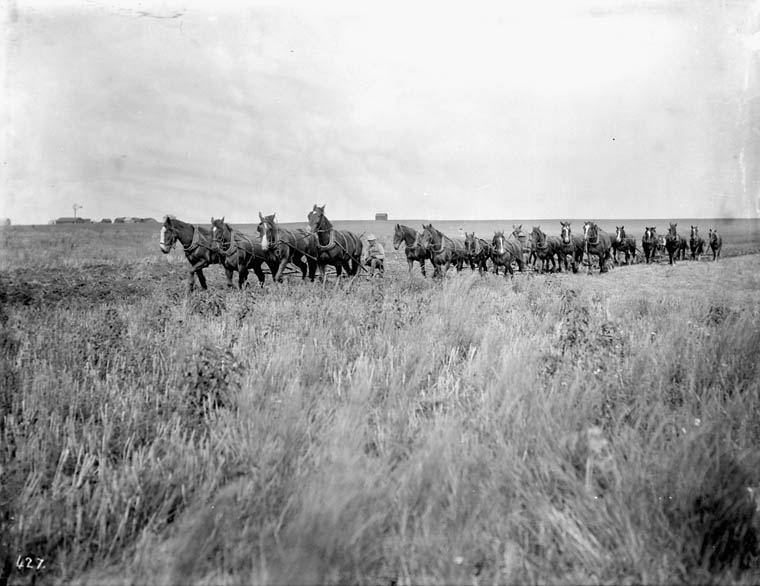
Summer fallow ploughing on Indian Head farm of Francis, J. H.
Credit: Topley Studio / Library and Archives Canada / PA-026134
The Bell farm near Indian Head, where one of the major experimental farms would evolve, lost a number of horses to the service of General Middleton's column.  Because of this, much of the ploughing had to wait until June.  In 1885, many of the fields were left on summer fallow as these were too late to plant.  Crops on these fields in 1886, a drought year, were remarkably productive, and summer fallow would later be proven to hold soil moisture for the following year.

Thursday, February 2, 2012

Charles Mair: Red River Rabble-rouser, 1868

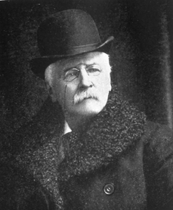
Charles Mair
Tensions in the Red River settlement rose to a feverous pitch in the years leading up to the transfer of Rupert's Land from the Hudson's Bay Company to the Dominion government.  The premature survey of the road from the Lake of the Woods to Red River in 1867 proved to be an event which exacerbated tensions between the Metis and the growing number of Canadians.  Arriving with the road crew was a literary figure who would add fuel to the growing fires on the banks of the Red.  That man was the expansionist, Canadian nationalist and "warrior bard", Charles Mair.

Mair's letters home were published in that great liberal rag the Toronto Globe, and his condescending chauvinism was not in favour with the people of Red River.  Arthur S. Morton wrote in the language of his time that the letters, "brought the indignation of the settlers to boiling point, for in the Settlement the half-breeds were a respectable middle class, rather than the outcasts the Canadian public envisaged by the term.  Governor Mactavish's wife was an educated half-breed of remarkable grace and dignity, and he protested in indignant terms that she was fit to grace any table."  (Morton, History of Prairie Settlement, 41)
Charles Mair
As George Stanley wrote in his classic The Birth of Western Canada, "the female part of the population, about whom Mair had made many uncomplimentary remarks, was particularly angry.  One pulled his nose, another his ears, while a third, the wife of a leading citizen of the Settlement, drove him from the Post Office with a horse whip!" (Stanley, 1992, 1936, p.55).  Drought and grasshoppers would further aggravate the citizens of Red River, whose resistance against the expansionist Canadians could best be symbolized by Louis Riel standing on the surveyor's chains, and preventing the measurement for the meridian line.  Mair was paymaster for the original road crew, and would be sentenced to death by Riel and his followers before escaping and fleeing to Minnesota.

Wednesday, February 1, 2012

Buffalo Wool at the Selkirk Settlement

Merino Ram.  Powerhouse Museum 1953 Samuel Sidney.
The problems of transportation and production were major factors in the slow start of Lord Selkirk's Red River Colony.  Early frosts and drought meant that, in the words of A.S. Morton, "transforming the prairies into fields of golden grain" was not an option. (Morton, History of Prairie Settlement, 26)  Morton notes that wheat and flour were much too bulky, and their low price not worth shipping back to Britain. Attempting to get a herd of cattle established proved equally difficult. Selkirk turned his mind to wool, as industrial machinery in England had outpaced supply, and it was fetching a good price.  Merino sheep from Spain had, at this time been sent to Austrailia, and Selkirk would attempt to export some to his far distant colony.  Morton claims that the lack of industry and intelligence of the settlers, however, led to the experiment's ruin.

George Back Sketchbook 1820-21  Credit: Library and Archives Canada, Acc. No. 1994-254-1.53R
An attempt to use the resources at hand is observed in the founding of the Buffalo Wool Company to use buffalo hair as a weavable garment.  Morton notes that the mix of fine and coarse hairs made weaving difficult, and the wool's dark colour would not dye easily.  Chester Martin in his "Dominion Lands" Policy (1938) wrote that the Buffalo Wool Company was "the first and surely the most bizarre industrial venture of the West.  Lady Selkirk introduced the buffalo wool shawl into Scottish society but though remarkably soft and durable it would not take the vegetable dyes of those days." (Martin, 206)  The idea was eventually abandoned.  Interestingly, a modern company seems to have taken up the name, and sells buffalo yarn and garments, noting the institution was established in 1812, and re-established in 2011.

Further attempts to get sheep to the settlement met with disaster.  When a flock of over one thousand  was purchased in Kentucky and driven across country, they travelled through country rife with spear grass.  As Morton notes "the spears entered their flesh in such quantity as to make the whole body a festering sore.  The carcasses of the dead marked the way across the plains northward." (Morton, 27)   Morton sums up these efforts with a grim assessment: "all attempts to find an exportable product thus failing, the colony was necessarily reduced to playing the modest part of handmaid to the furtrade."