Saturday, March 10, 2012

German-American Hordes, 1914

One of the sordid aspects of Canadian social reform in the early years of the twentieth-century was the nativist sentiment which resisted non-white-anglo-saxon-protestant attempts to share in the prosperity of the era.  The Chinese head-tax, and the repulsion of a boat-load of Indians from the Pacific coast are two of the more notorious instances of racism during the period.  Racism was not confined to the "non-White races", however, and Europeans were also discriminated against.  With the advent of the First World War, Germans and Austrians would receive their share of racist ire, having their shops vandalized, being socially ostracized, and in some cases being interned in "enemy alien" camps.
Large Image
File number: NA-838-8
Title: Fireman attacking effigies of German soldiers, Calgary, Alberta.
Date: [ca. 1914-1918]
 Across the desk of JD Hazen,minister for Marine, Fisheries and Naval Affairs, came one particularly inventive account of the alleged conspiracies of German-Americans.  As Ramsay Cook and Robert Craig Brown noted in A Nation Transformed (1972, p.224), anti-German rhetoric could become quite fanciful:

"The Germans all over the United States are holding meetings, their intentions are to invade Canada on the lines of the Fenian Raid...Their headquarters is Milwaukee.  They are getting all the automobiles they can possibly get without causing suspicion; they intend to muster 150,000 men along the border and invade in three or four places, destroy the canals, the railroads and grain elevators; their plans are for inland invasion; they have plenty of money behind this."
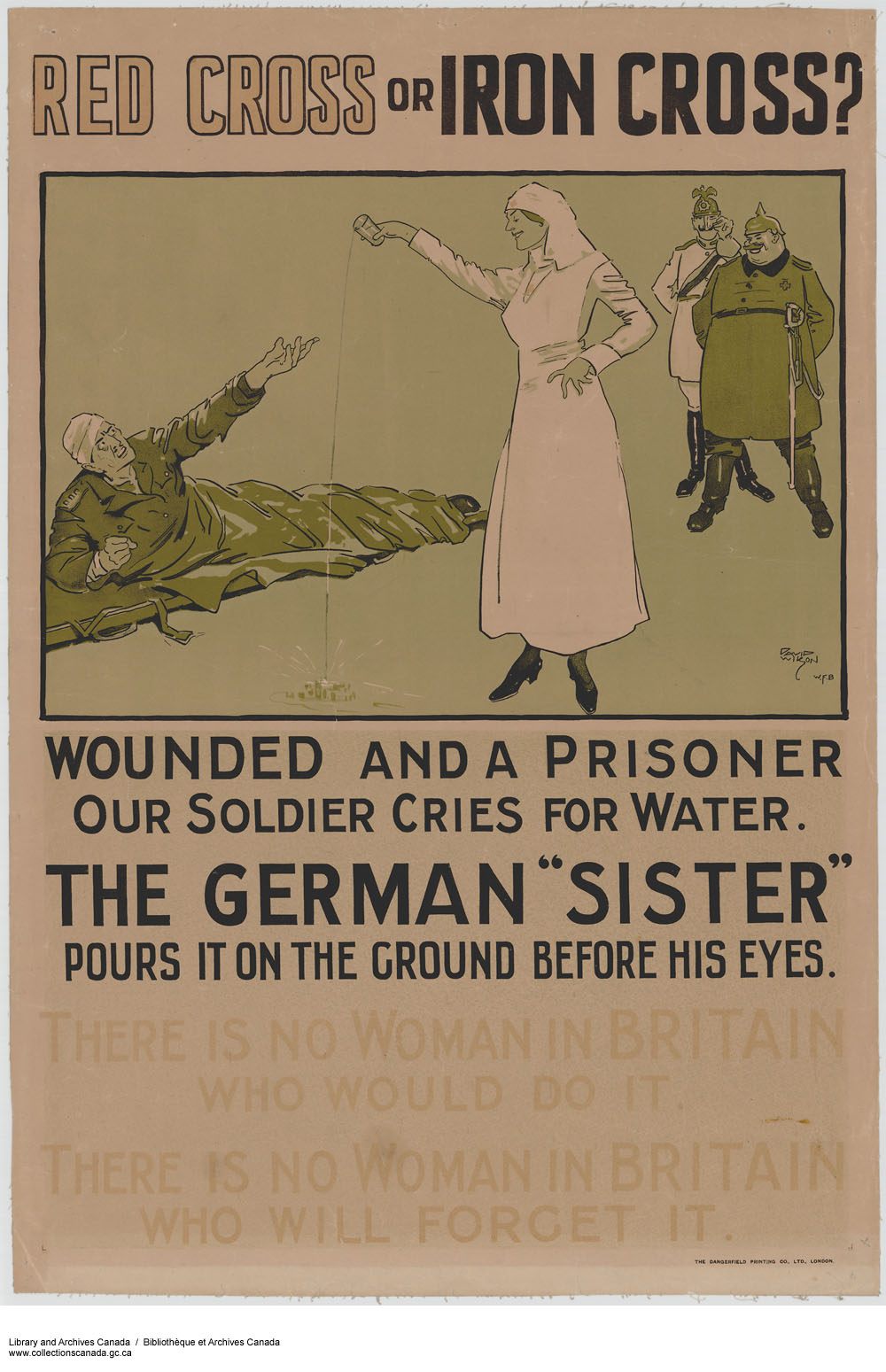
British Propaganda Poster. Credit: Library and Archives Canada, Acc. No. 1983-28-38

Friday, March 9, 2012

Modernity Quaffs a Brew, Selkirk Hotel Sign, 1913

The Laurier years in Canada featured the rise of modernity with all the bureacratic, urban,and industrial graft and grit that the word implies.  Ramsay Cook and Robert Craig Brown's classic survey, A Nation Transformed (1972), follows the growth of Canadian institutions in their attempts to catch up with a rapidly transforming society.  By 1921, Canada was as much urban as it was rural, and the bright light of modernity was illuminating innumerable vices in the burgeoning cities.

One rustic young "homesteader's son" was flabbergasted by the tall buildings and electric lights found in Edmonton upon his first visit in 1913.  (Cook and Brown, 100)  As the young hayseed noted:

"The buildings tower over the street two or three storeys high and even brick and stone buildings of six storeys.  Whoever imagined so many buildings, or such variety?  And the signs advertising their owners' business, painted in large letters, some illuminated and all overhanging the street in bewildering confusion, why, they make your head swim!...it was only after dark that the king of the signs stood out in all its glory over the Selkirk Hotel.  This one, done in many lightbulbs, showed by successive combinations a man pouring a glass of beer, lifting it to his lips, and then quaffing the liquor.  If I had seen nothing else in all the city, this would have been enough."

The incredible sign is seen in the top right of this photo from the Glenbow Archives. File number: NC-6-4776Title: Corner of 101st Street and Jasper Avenue showing Selkirk Hotel, Edmonton, Alberta.
Date: 1919

Tuesday, March 6, 2012

FO Martin Palmer Northmore, RCAF, Grave Vandalism

Toronto Star, 2 Nov 1943, p.2.
The sad news  of the desecration of a commonwealth war cemetery in Benghazi, Libya, is the latest shocking instalment in the unrest in Africa and the Middle East.  (Globe story, Star Story) One Canadian airman's grave was smashed, and has been identified as that of Flight Officer Martin Palmer Northmore.  Northmore was flying hurricanes with No. 94 Squadron in late 1943.  The Toronto Star reports that his final flight was escorting a convoy "over Italy" when his aircraft went into a spin.  The Star reports a touching poem composed by Northmore's aunt Leila Bishopp Martin when she learned of his death.

Your love so fond — your spirit true and gay,
Soared high to reach the stars beyond the night;
But groping still — along our dusty way —
We search the skies, above a broken flight.”


Northmore's surviving family reported their shock upon learning of the vandalism and the Star has published a few of his letters from the war.  While the tragedy of the desecration of this pilot's last resting place is not to be played down, at least the event can be used to commemorate his war service. The outrage across the nation shows that Canadians care deeply about the memory of their fallen soldiers, sailors and airmen.  By reflecting on his war service and experiences, citizens  show that they will not forget  Flight Officer Northmore and his fellow pilots.
AIRCRAFT OF THE ROYAL AIR FORCE 1939-1945: HAWKER HURRICANE.
Hurricane IICs of No. 94 Squadron, operating out of El Gamil Egypt 1942-43 © IWM (CM 3653)