Thursday, October 27, 2011

Of "Puff-Pastries" and Partisans: Soviet partisans vs. GRM rail traffic 1943

Flames of War
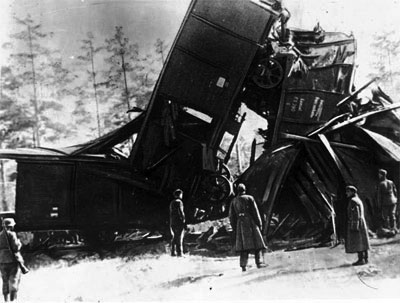
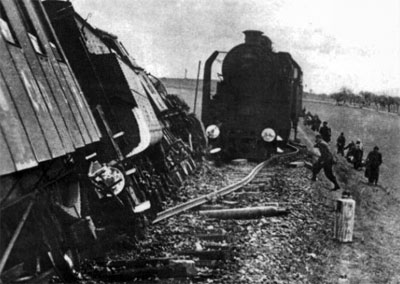
Leonid Grenkevich's The Soviet Partisan Movement, 1941-1944 argues that the Soviet partisans behind the German lines were effective in their efforts to destroy communications.  One major success was the dismantling of railways, which were critical to German logistics.  When lacking explosives for basic demolitions, partisans were said to dismantle rails and hide them in marshes, rivers or lakes.  Grenkevich notes, "in this fashion, in August 1943 the fighters of three large partisan units in the Rovno District of the Ukraine managed both to blow up and dismantle about 34 kilometres of permanent railroad way." (249)  Actions such as this led to the greatest success of the partisans during the war, greatly hampering the later stages of the Battle of Kursk.

Flames of War
Partisans reportedly innovated in their methods of disrupting German rail traffic.  Removing both rails and sleeping cars, they would pile these up on top of each other resembling a layered "culinary delicacy".  When these so called "puff-pastries" were set on fire, the result was rails which were so mangled, they would never be used again.  Partisans near Minsk reportedly bent rails in such a way that they could never be used again, reminiscent of the famed Sherman's neckties in his destructive march to the sea.
Bedwetting as a Ticket Home: Canadian Psychiatrists in Britain, 1940

Psychiatry was a relatively new field when Canada went to war in 1939.  The establishment in 1940 of the No. 1 Neurological Hospital (or No. 1 Nuts as the group was known), in Basingstroke, England, to deal with neuropsychiatric cases was thus a milestone in Canadian Military History.  Here the staff assessed a number of men who had become stress casualties, during the Blitz.  Terry Copp and Bill McAndrew noted in their work Battle Exhaustion, that a number of men riding motorcycles on the wrong side of the road during the blackouts caused not only accidents but post-traumatic anxieties as well.   Some of these unfortunate men were treated to an "electric wire brush treatment", but most were diagnosed, treated to some psychotherapy and sent on their way.
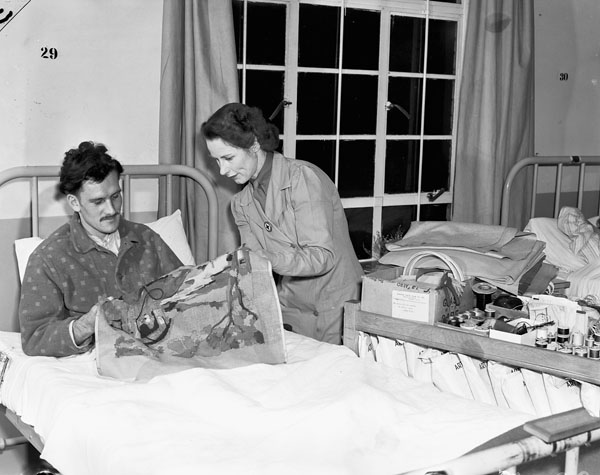
Mrs. M.A. Simpson of the Canadian Red Cross assisting Lance-Corporal L.D. Turner with needlepoint work, No.11 Canadian General Hospital, Royal Canadian Army Medical Corps (R.C.A.M.C.), Taplow, England, 14 December 1944.  Credit: Capt. Jack H. Smith. / Canada. Dept. of National Defence / Library and Archives Canada / PA-128180

With little in the way of psychological screening for the original members of the 1st Canadian Division, a number of soldiers with previous records of neurosis had been enlisted and were visiting the hospital.  H.H. Hyland, who had worked in the Toronto General Hospital in the interwar years, was not convinced anything could be done for these men.  Alcoholics and the occasional psychopath that graced Basinstroke's halls were also deemed incurable.  Hyland was determined that these men should be returned to Canada, but that policy was soon found to be troublesome.  When administrators told one "chronic bedwetter" that he would be returned to Canada, the other patients soon caught wind of the news.  As Copp and McAndrew note, "by next morning word had spread and the ward stank of urine."

A wartime article by Hyland on neuroses cases at No. 1 Neurological Hospital:
http://www.ncbi.nlm.nih.gov/pmc/articles/PMC1827527/pdf/canmedaj01696-0113.pdf

Friday, October 7, 2011

Major Rogers Cusses a Blue Streak

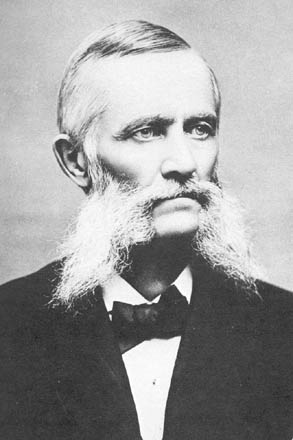
Rogers.  Explorer and Cusser.  Train Web
Major Albert Bowman Rogers is deeply entrenched in Canadian history for the discovery of a railway route through the mountain pass that bears his name.  Pierre Berton's Last Spike characterizes Rogers as a hard travelling man who could survive on some hard tack and a plug of tobacco for long periods in the bush.  Rogers was no shrinking violet, and his demeanour could best be described as gruff.


An incident in 1881 serves to illuminate the colourful language spat when Rogers rode into a survey crew's Bow River camp. The top engineer, Hyndman, was the unfortunate recipient of Rogers' ire.  Rocky Mountain outfitter and guide Tom Wilson noted that he had the honour of leading Rogers, described as the "tattered creature on the scarecrow horse", to the man's tent.


"'What's your altitude?' [Rogers] shot at Hyndman.  The engineer stammered that he did not know. 'Blue Jesus!  Been here several days and don't know the altitude yet.  You _____!' There followed what Wilson described as 'wonderful exhibition of scientific cussing [which] busted wide all of Hyndman's 'Holy Commandments' and inspired delighted snickers and chuckles of admiration from the men who had quickly gathered around.'"


Buy your Own Blue Jesus at room322shop
Pierre Berton had to guess at what expletive came after the word "Blue", as Wilson had edited it out of his memoirs.  Berton explains that, "it is doubtful that he would have censored so mild a word as 'blazes' (and equally doubtful that the Major himself would have lapsed into such a euphemism), I have filled in the blank with the most obvious expletive." "Blue Jesus", seems to be a fitting 1880s epithet. One is left to wonder what term Rogers used to call Hyndman at the end of the statement.  There is so many options that Berton didn't even wager a guess and left the expletive blank.


"You _____!"